QUESTION IMAGE
Question
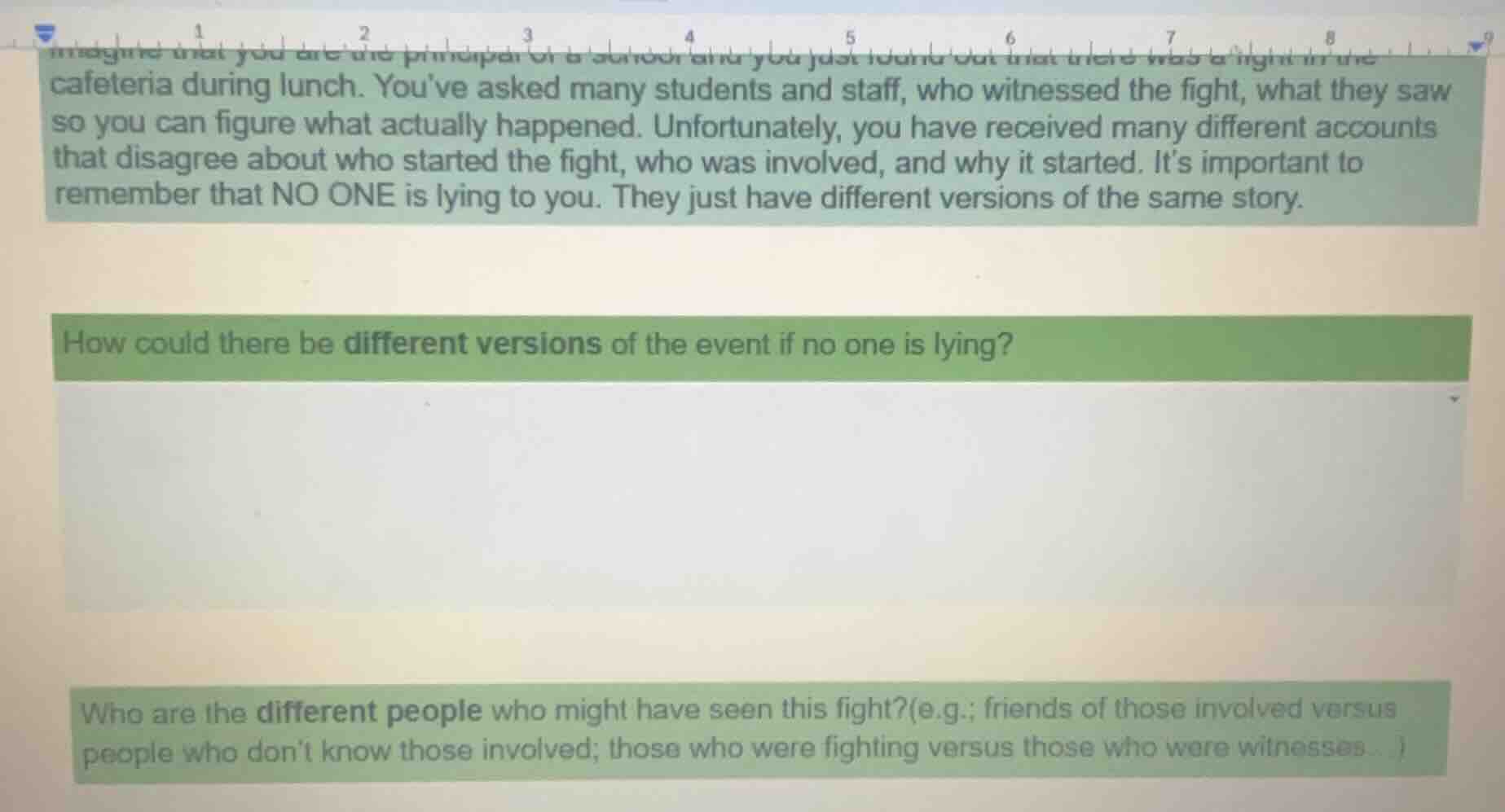
imagine that you are the principal of a school and you just found out that there was a fight in the cafeteria during lunch. youve asked many students and staff, who witnessed the fight, what they saw so you can figure what actually happened. unfortunately, you have received many different accounts that disagree about who started the fight, who was involved, and why it started. its important to remember that no one is lying to you. they just have different versions of the same story.
how could there be different versions of the event if no one is lying?
who are the different people who might have seen this fight?(e.g.; friends of those involved versus people who dont know those involved; those who were fighting versus those who were witnesses... )
First Question: How could there be different versions of the event if no one is lying?
- Perspective Differences: Witnesses have unique viewpoints (e.g., different angles in the cafeteria), so they notice distinct details (e.g., one sees a push, another sees the reaction).
- Memory and Attention: People focus on different elements (e.g., a student might notice the aggressor’s face, a staff member the location). Memory also distorts details over time or based on prior biases.
- Interpretation of Actions: A playful shove to one witness might seem aggressive to another, based on their experiences or relationships with those involved (e.g., a friend of the “pusher” vs. a friend of the “pushed”).
- Information Filtering: Witnesses might omit details they consider unimportant (e.g., background noise) or emphasize what they perceive as key (e.g., the first punch vs. the argument leading to it).
- Direct Participants: The students who were fighting (each has their own recount of initiating or reacting).
- Friends/Associates of Fighters: Friends of those involved (e.g., a friend of Student A might focus on Student B’s “unprovoked” action, while a friend of Student B sees Student A as aggressive).
- Neutral Peers: Students/staff not connected to the fighters (more objective but less invested, may notice broader context like the argument’s start).
- School Staff: Teachers, cafeteria workers, or administrators (may focus on safety/rule-breaking, e.g., a teacher notices the fight’s location and discipline violations).
- Bystanders at a Distance: Students/staff in the cafeteria but far from the fight (see the event as a whole but miss fine details, e.g., a student at another table sees the commotion but not the initial trigger).
- People Intervening: Staff or students who broke up the fight (their account centers on stopping the fight, not the cause).

Snap & solve any problem in the app
Get step-by-step solutions on Sovi AI
Photo-based solutions with guided steps
Explore more problems and detailed explanations
Different versions occur due to: 1) Unique perspectives (varying viewpoints/angles), 2) Selective attention/memory (focusing on different details), 3) Subjective interpretation of actions (e.g., playful vs. aggressive), and 4) Information filtering (omitting/emphasizing details). All witnesses report truthfully from their own experience, leading to conflicting accounts.