QUESTION IMAGE
Question
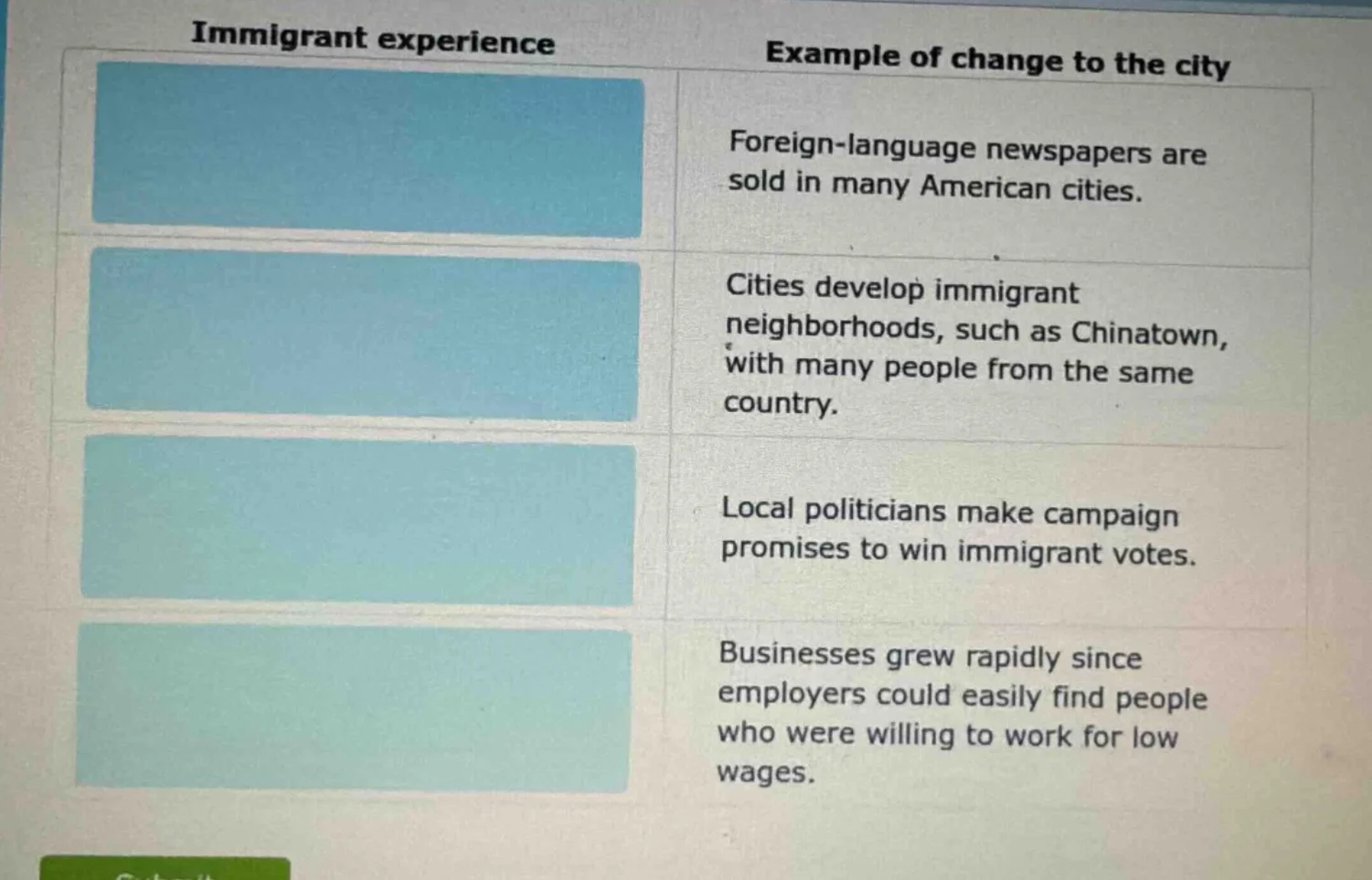
immigrant experience example of change to the city
foreign - language newspapers are sold in many american cities.
cities develop immigrant neighborhoods, such as chinatown, with many people from the same country.
local politicians make campaign promises to win immigrant votes.
businesses grew rapidly since employers could easily find people who were willing to work for low wages.
To solve this, we analyze each example of city change and match it to the corresponding immigrant experience:
- Foreign - language newspapers sold:
Immigrants want to stay connected to their home culture/language. So the experience is Immigrants want to read news from their home countries (or in their native language).
- Immigrant neighborhoods (e.g., Chinatown):
Immigrants often cluster with others from their home country for community, support, and cultural familiarity. So the experience is Immigrants cluster with others from their home country to form communities.
- Politicians target immigrant votes:
Immigrants gain political influence as they become a voting bloc. So the experience is Immigrants gain political influence as a voting group.
- Businesses grow with low - wage immigrant labor:
Immigrants are often willing to work for low wages, providing a labor source for businesses. So the experience is Immigrants provide a large, low - wage labor force for businesses.
Filling the Table (Row - by - Row):
| Immigrant experience | Example of change to the city |
|---|---|
| Immigrants cluster with others from their home country to form communities | Cities develop immigrant neighborhoods, such as Chinatown, with many people from the same country. |
| Immigrants gain political influence as a voting group | Local politicians make campaign promises to win immigrant votes. |
| Immigrants provide a large, low - wage labor force for businesses | Businesses grew rapidly since employers could easily find people who were willing to work for low wages. |
These connections are made by linking the cause (immigrant experience) to the effect (city change) based on the context of immigration’s impact on urban areas.

Snap & solve any problem in the app
Get step-by-step solutions on Sovi AI
Photo-based solutions with guided steps
Explore more problems and detailed explanations
To solve this, we analyze each example of city change and match it to the corresponding immigrant experience:
- Foreign - language newspapers sold:
Immigrants want to stay connected to their home culture/language. So the experience is Immigrants want to read news from their home countries (or in their native language).
- Immigrant neighborhoods (e.g., Chinatown):
Immigrants often cluster with others from their home country for community, support, and cultural familiarity. So the experience is Immigrants cluster with others from their home country to form communities.
- Politicians target immigrant votes:
Immigrants gain political influence as they become a voting bloc. So the experience is Immigrants gain political influence as a voting group.
- Businesses grow with low - wage immigrant labor:
Immigrants are often willing to work for low wages, providing a labor source for businesses. So the experience is Immigrants provide a large, low - wage labor force for businesses.
Filling the Table (Row - by - Row):
| Immigrant experience | Example of change to the city |
|---|---|
| Immigrants cluster with others from their home country to form communities | Cities develop immigrant neighborhoods, such as Chinatown, with many people from the same country. |
| Immigrants gain political influence as a voting group | Local politicians make campaign promises to win immigrant votes. |
| Immigrants provide a large, low - wage labor force for businesses | Businesses grew rapidly since employers could easily find people who were willing to work for low wages. |
These connections are made by linking the cause (immigrant experience) to the effect (city change) based on the context of immigration’s impact on urban areas.