QUESTION IMAGE
Question
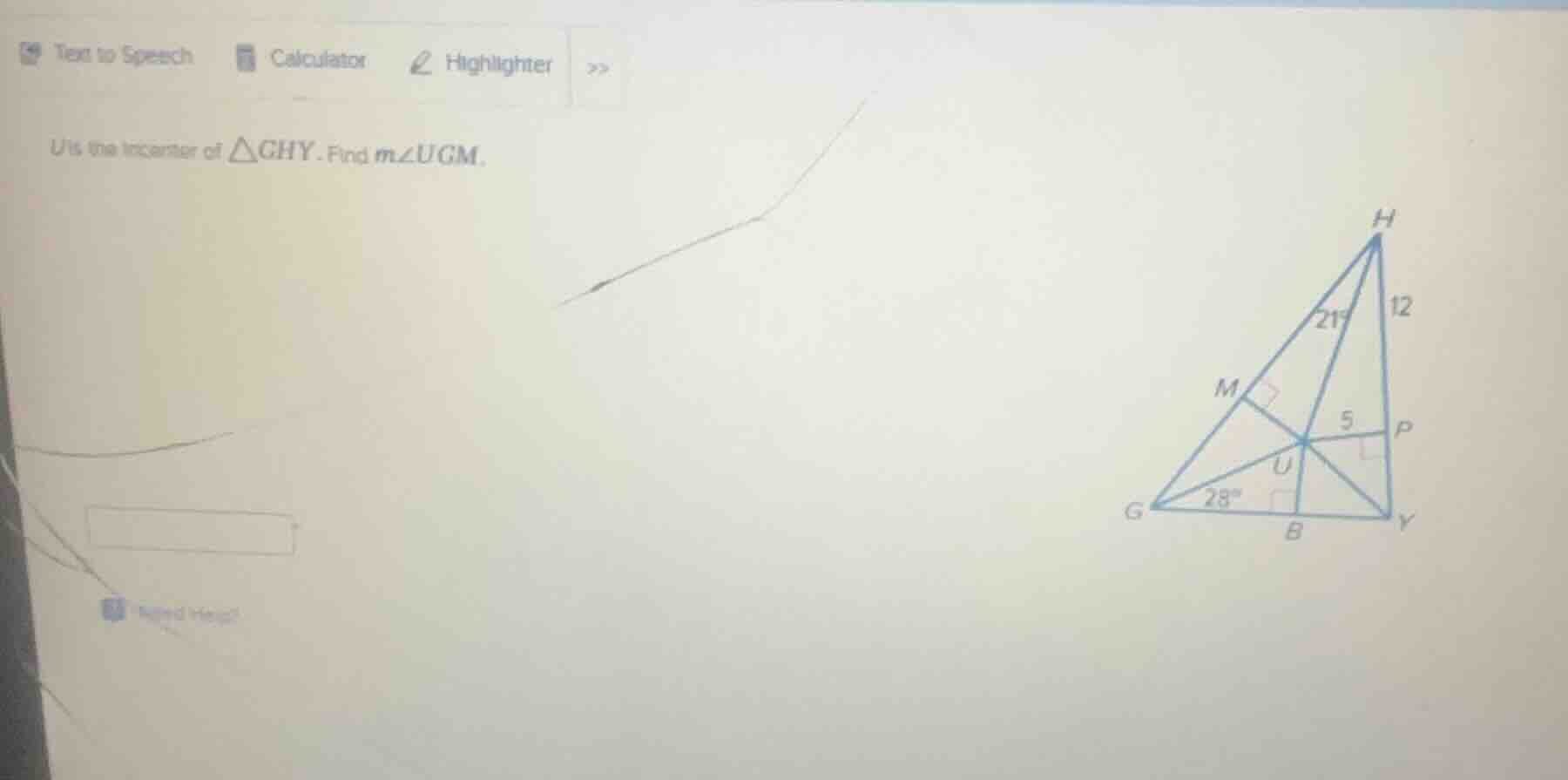
u is the incenter of \\(\triangle ghy\\). find \\(m\angle ugm\\).
Step1: Recall Incenter Property
The incenter of a triangle is the intersection of the angle bisectors. So, \( GU \) bisects \( \angle G \) (i.e., \( \angle UGM \) is half of \( \angle G \) if we consider the right angle, but wait, looking at the diagram, \( MB \) is perpendicular? Wait, no, the given angle at \( G \) with the right angle: Wait, the diagram shows \( \angle G \) has a 28° angle, and \( U \) is the incenter, so \( GU \) bisects \( \angle G \). Wait, but in the right triangle? Wait, no, \( M \) is a right angle (since \( \angle GMU \) is a right angle, as \( M \) has a right angle symbol). Wait, actually, the key is: the incenter bisects the angles, so \( \angle UGM \) is equal to the angle given at \( G \) divided? Wait, no, looking at the diagram, the angle at \( G \) with the right angle: the angle between \( GB \) and \( GU \) is 28°? Wait, no, the diagram shows \( \angle G \) has a 28° angle, and \( U \) is the incenter, so \( GU \) bisects \( \angle G \). Wait, no, maybe I misread. Wait, the problem is to find \( m\angle UGM \). Since \( U \) is the incenter, \( GU \) is the angle bisector of \( \angle G \). Wait, but in the diagram, \( \angle G \) has a 28° angle? Wait, no, the right angle at \( B \) (since \( GBY \) has a right angle at \( B \)), and \( \angle G \) is split by \( GU \). Wait, actually, the angle \( \angle UGM \) is equal to 28°? Wait, no, maybe the angle at \( G \) is 56°? Wait, no, let's think again. The incenter is the intersection of angle bisectors, so \( GU \) bisects \( \angle G \). If the angle at \( G \) (the angle of the triangle \( \triangle GHY \) at \( G \)) is such that the angle between \( GB \) and \( GY \) is, say, 56°, then \( GU \) would bisect it into 28° each. Wait, but the diagram shows \( \angle UGB = 28° \), and since \( GM \) is perpendicular (because \( M \) has a right angle), then \( \angle UGM \) is equal to \( \angle UGB \), which is 28°? Wait, no, maybe I'm overcomplicating. Wait, the key is: the incenter bisects the angles, so \( \angle UGM = 28° \)? Wait, no, maybe the angle at \( G \) is 56°, so bisected into 28°? Wait, no, the diagram shows \( \angle G \) with a 28° angle, so \( \angle UGM = 28° \). Wait, let's confirm: incenter bisects the angle, so if the angle at \( G \) is, say, 56°, then each bisected angle is 28°, but in the diagram, the angle between \( GU \) and \( GB \) is 28°, so \( \angle UGM = 28° \). Wait, maybe the answer is 28°? Wait, no, maybe I made a mistake. Wait, let's check the diagram again: \( M \) is a right angle (right angle symbol), \( P \) is a right angle, \( B \) is a right angle. So \( GM \perp HM \), \( PY \perp HY \), \( BY \perp GY \). So \( GM \), \( PY \), \( BY \) are the angle bisectors? No, the incenter is where angle bisectors meet, so \( GU \), \( HU \), \( YU \) are angle bisectors. So \( GU \) bisects \( \angle G \), so \( \angle UGM = \angle UGB \). From the diagram, \( \angle UGB = 28° \), so \( m\angle UGM = 28° \). Wait, but maybe the angle at \( G \) is 56°, so bisected into 28° each. So the answer is 28°? Wait, no, maybe I'm wrong. Wait, let's think again. The incenter bisects the angle, so if the angle at \( G \) is \( 2 \times 28° = 56° \), then \( \angle UGM = 28° \). Yes, that makes sense. So the measure of \( \angle UGM \) is 28 degrees.
Wait, maybe I was overcomplicating. The key is: \( U \) is the incenter, so \( GU \) bisects \( \angle G \). The diagram shows that the angle between \( GU \) and \( GB \) is 28°, so \( \angle UGM = 28° \).
Step1: Identify Incenter Property
The incenter \( U \) of \( \…

Snap & solve any problem in the app
Get step-by-step solutions on Sovi AI
Photo-based solutions with guided steps
Explore more problems and detailed explanations
\( 28^\circ \)