QUESTION IMAGE
Question
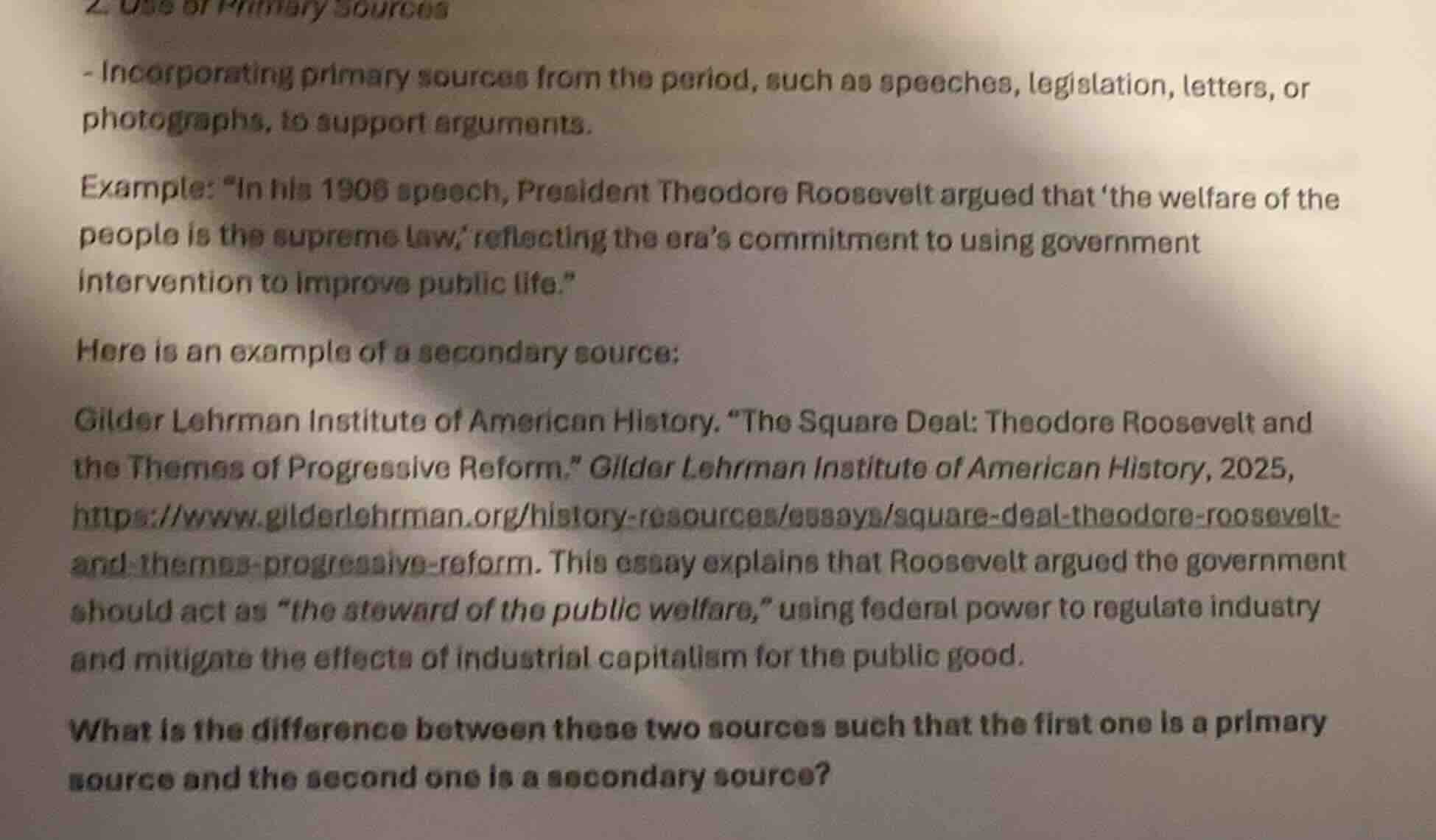
- incorporating primary sources from the period, such as speeches, legislation, letters, or photographs, to support arguments.
example: \in his 1906 speech, president theodore roosevelt argued that the welfare of the people is the supreme law, reflecting the eras commitment to using government intervention to improve public life.\
here is an example of a secondary source:
gilder lehrman institute of american history. \the square deal: theodore roosevelt and the themes of progressive reform.\ gilder lehrman institute of american history, 2025, https://www.gilderlehrman.org/history-resources/essays/square-deal-theodore-roosevelt-and-themes-progressive-reform. this essay explains that roosevelt argued the government should act as \the steward of the public welfare,\ using federal power to regulate industry and mitigate the effects of industrial capitalism for the public good.
what is the difference between these two sources such that the first one is a primary source and the second one is a secondary source?
A primary source is a direct, firsthand creation from the historical period being studied, created by someone who experienced or participated in the events. The 1906 Roosevelt speech is this type: it is the original, direct statement from the figure in the era. A secondary source is a later analysis, interpretation, or summary of primary sources, created by someone not directly involved in the original events. The Gilder Lehrman essay is this type: it uses Roosevelt's original ideas (from primary sources) to analyze and explain his policies after the fact.

Snap & solve any problem in the app
Get step-by-step solutions on Sovi AI
Photo-based solutions with guided steps
Explore more problems and detailed explanations
The primary source (Roosevelt's 1906 speech) is a firsthand, original creation from the historical period, directly produced by someone involved in the events/era. The secondary source (Gilder Lehrman Institute essay) is a later, external analysis or interpretation that uses and comments on primary sources, created by someone not directly part of the original historical context.