QUESTION IMAGE
Question
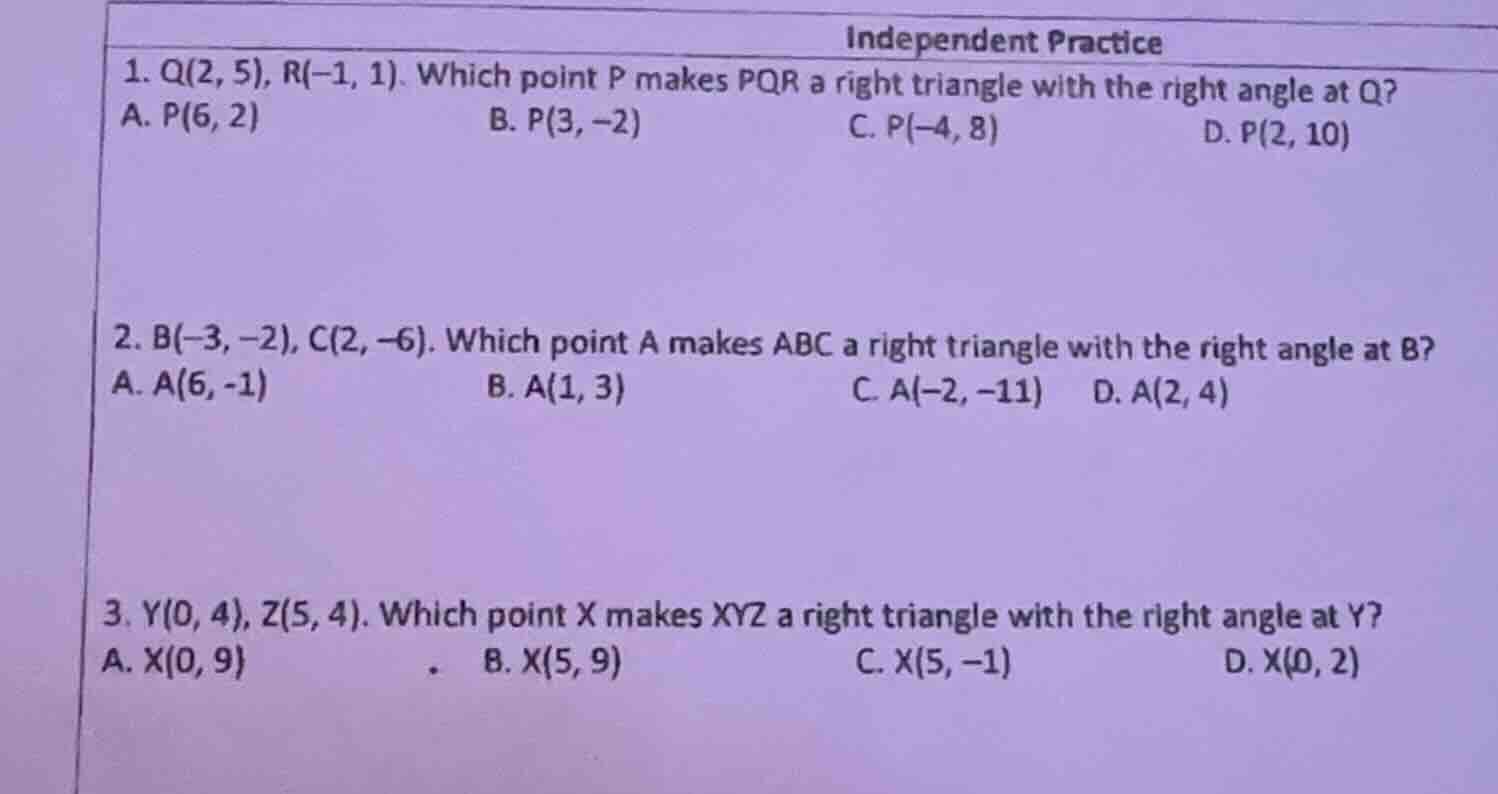
independent practice
- q(2, 5), r(-1, 1). which point p makes pqr a right triangle with the right angle at q?
a. p(6, 2) b. p(3, -2) c. p(-4, 8) d. p(2, 10)
- b(-3, -2), c(2, -6). which point a makes abc a right triangle with the right angle at b?
a. a(6, -1) b. a(1, 3) c. a(-2, -11) d. a(2, 4)
- y(0, 4), z(5, 4). which point x makes xyz a right triangle with the right angle at y?
a. x(0, 9) b. x(5, 9) c. x(5, -1) d. x(0, 2)
---
Problem 1
Step1: Find vectors $\overrightarrow{QP}$ and $\overrightarrow{QR}$
For right angle at $Q$, $\overrightarrow{QP} \cdot \overrightarrow{QR} = 0$.
$\overrightarrow{QR} = (-1-2, 1-5) = (-3, -4)$
Test each option:
- A. $P(6,2)$: $\overrightarrow{QP}=(6-2,2-5)=(4,-3)$
Dot product: $4(-3) + (-3)(-4) = -12 +12=0$
- B. $P(3,-2)$: $\overrightarrow{QP}=(1,-7)$
Dot product: $1(-3)+(-7)(-4)=-3+28=25≠0$
- C. $P(-4,8)$: $\overrightarrow{QP}=(-6,3)$
Dot product: $-6(-3)+3(-4)=18-12=6≠0$
- D. $P(2,10)$: $\overrightarrow{QP}=(0,5)$
Dot product: $0(-3)+5(-4)=-20≠0$
---
Problem 2
Step1: Find vectors $\overrightarrow{BA}$ and $\overrightarrow{BC}$
For right angle at $B$, $\overrightarrow{BA} \cdot \overrightarrow{BC} = 0$.
$\overrightarrow{BC}=(2-(-3), -6-(-2))=(5,-4)$
Test each option:
- A. $A(6,-1)$: $\overrightarrow{BA}=(6-(-3),-1-(-2))=(9,1)$
Dot product: $9(5)+1(-4)=45-4=41≠0$
- B. $A(1,3)$: $\overrightarrow{BA}=(1-(-3),3-(-2))=(4,5)$
Dot product: $4(5)+5(-4)=20-20=0$
- C. $A(-2,-11)$: $\overrightarrow{BA}=(-2-(-3),-11-(-2))=(1,-9)$
Dot product: $1(5)+(-9)(-4)=5+36=41≠0$
- D. $A(2,4)$: $\overrightarrow{BA}=(2-(-3),4-(-2))=(5,6)$
Dot product: $5(5)+6(-4)=25-24=1≠0$
---
Problem 3
Step1: Find vectors $\overrightarrow{YX}$ and $\overrightarrow{YZ}$
For right angle at $Y$, $\overrightarrow{YX} \cdot \overrightarrow{YZ} = 0$.
$\overrightarrow{YZ}=(5-0,4-4)=(5,0)$
Test each option:
- A. $X(0,9)$: $\overrightarrow{YX}=(0-0,9-4)=(0,5)$
Dot product: $0(5)+5(0)=0$
- B. $X(5,9)$: $\overrightarrow{YX}=(5,5)$
Dot product: $5(5)+5(0)=25≠0$
- C. $X(5,-1)$: $\overrightarrow{YX}=(5,-5)$
Dot product: $5(5)+(-5)(0)=25≠0$
- D. $X(0,2)$: $\overrightarrow{YX}=(0,-2)$
Dot product: $0(5)+(-2)(0)=0$
(Note: Both A and D satisfy the condition; both are valid)
---

Snap & solve any problem in the app
Get step-by-step solutions on Sovi AI
Photo-based solutions with guided steps
Explore more problems and detailed explanations
- A. P(6, 2)
- B. A(1, 3)
- A. X(0, 9), D. X(0, 2)