QUESTION IMAGE
Question
independent practice
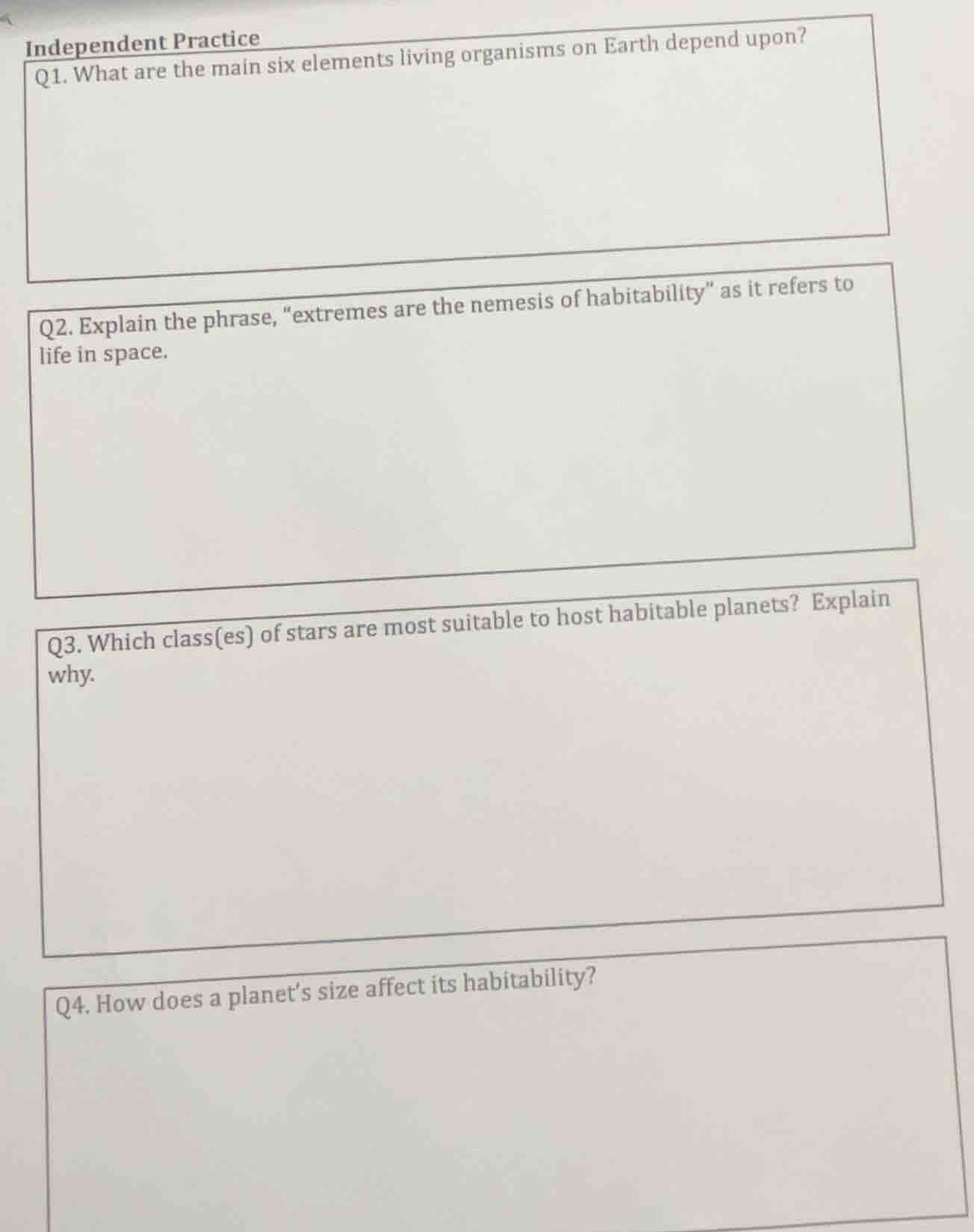
q1. what are the main six elements living organisms on earth depend upon?
q2. explain the phrase, \extremes are the nemesis of habitability\ as it refers to life in space.
q3. which class(es) of stars are most suitable to host habitable planets? explain why.
q4. how does a planets size affect its habitability?
Q1: These elements form the core of biological molecules like proteins, nucleic acids, and carbohydrates, which are essential for all life processes.
Q2: Habitable environments require stable, moderate conditions; extreme values of factors like temperature, radiation, or pressure make it impossible for life to survive or evolve.
Q3: These stars have stable, long lifespans (billions of years) that allow time for life to evolve, and they emit consistent radiation levels that support liquid water on orbiting planets.
Q4: A planet's size directly impacts its ability to retain an atmosphere and internal heat, both critical for habitability.

Snap & solve any problem in the app
Get step-by-step solutions on Sovi AI
Photo-based solutions with guided steps
Explore more problems and detailed explanations
- Carbon (C), Hydrogen (H), Nitrogen (N), Oxygen (O), Phosphorus (P), Sulfur (S)
- This phrase means that extreme environmental conditions (like extreme temperatures, intense radiation, extreme pressure, or lack of stable resources) prevent a celestial body from being habitable for life. Life as we know it requires narrow, moderate ranges of conditions to survive, reproduce, and evolve, so any extreme factor makes a space environment unlivable.
- G-type (like our Sun) and K-type main-sequence stars are the most suitable. G-type stars have stable energy output and long lifespans (~10 billion years) that give life time to develop. K-type stars are even longer-lived (~20-70 billion years) and emit less harmful UV radiation than hotter stars, while still providing enough energy to support liquid water on planets in their habitable zones. Hotter stars (O, B, A types) have short lifespans and intense radiation that would sterilize planets, while cooler M-type stars are prone to violent flare activity that can strip planetary atmospheres.
- - Too small: A small planet has weak gravitational pull, so it cannot hold onto a dense atmosphere. Without an atmosphere, the planet cannot trap heat (to maintain surface temperatures for liquid water) or shield against harmful cosmic radiation. Small planets also lose internal heat quickly, so they lack geological activity (like plate tectonics) that recycles nutrients and maintains a stable climate.
- Too large: A very large planet has extremely strong gravity, which will attract and hold a thick, dense atmosphere that creates crushing surface pressure and a runaway greenhouse effect, leading to scorching surface temperatures too hot for liquid water.
- Optimal size: A planet similar in size to Earth has enough gravity to retain a stable, breathable atmosphere, maintains internal heat for geological activity, and supports surface conditions where liquid water (a key requirement for life) can exist.