QUESTION IMAGE
Question
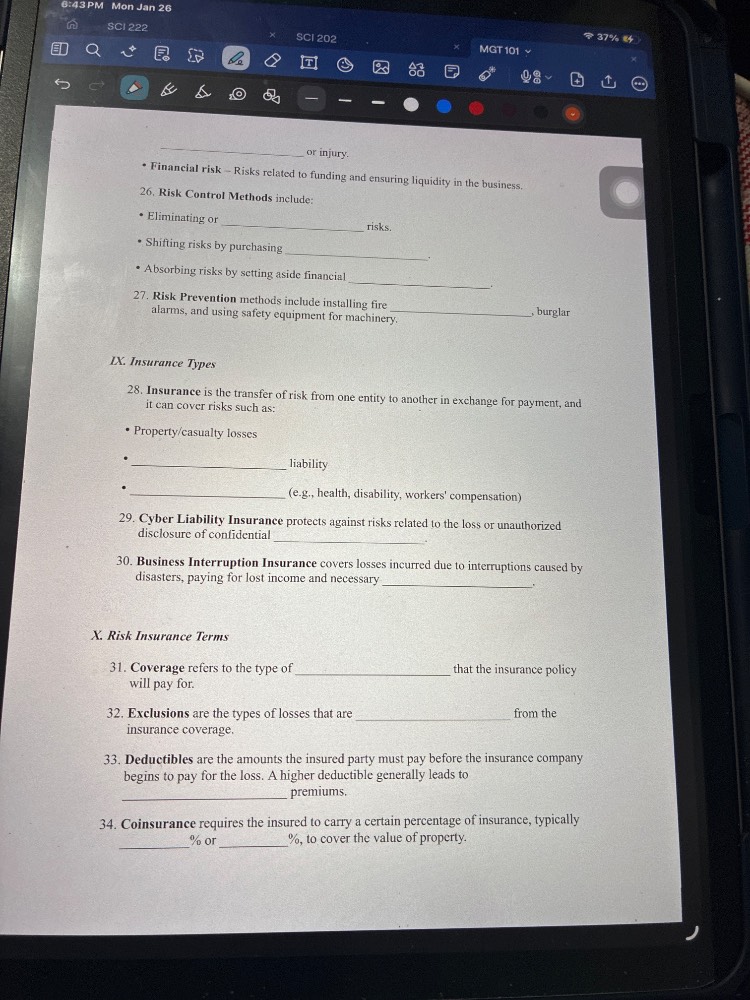
or injury.
- financial risk – risks related to funding and ensuring liquidity in the business.
- risk control methods include:
- eliminating or ______ risks.
- shifting risks by purchasing ______.
- absorbing risks by setting aside financial ______.
- risk prevention methods include installing fire ______, burglar
alarms, and using safety equipment for machinery.
ix. insurance types
- insurance is the transfer of risk from one entity to another in exchange for payment, and
it can cover risks such as:
- property/casualty losses
- ______ liability
- ______ (e.g., health, disability, workers compensation)
- cyber liability insurance protects against risks related to the loss or unauthorized
disclosure of confidential ______.
- business interruption insurance covers losses incurred due to interruptions caused by
disasters, paying for lost income and necessary ______.
x. risk insurance terms
- coverage refers to the type of ______ that the insurance policy
will pay for.
- exclusions are the types of losses that are ______ from the
insurance coverage.
- deductibles are the amounts the insured party must pay before the insurance company
begins to pay for the loss. a higher deductible generally leads to ______ premiums.
- coinsurance requires the insured to carry a certain percentage of insurance, typically
____% or ____%, to cover the value of property.
To solve these fill - in - the - blank questions, we rely on knowledge of business risk management and insurance concepts.
Question 26
Step 1: Analyze the first blank in Risk Control Methods
Risk control methods often involve eliminating or mitigating risks. Mitigating means reducing the impact or likelihood of risks.
Step 2: Analyze the second blank in Risk Control Methods (Shifting risks)
When shifting risks, a common way is by purchasing insurance. Insurance transfers the risk to the insurance company.
Step 3: Analyze the third blank in Risk Control Methods (Absorbing risks)
To absorb risks, a business can set aside financial reserves (or a similar term like "funds"). Reserves are used to cover unexpected losses.
Question 27
In risk prevention, for fire safety, we install fire extinguishers (along with fire alarms), and for security against burglars, we use burglar alarms.
Question 28
Step 1: First blank (liability type)
A common type of liability in insurance is Professional liability (for example, for professionals like doctors, lawyers who may be sued for professional negligence).
Step 2: Second blank (insurance type for health, disability etc.)
The insurance type that covers health, disability, workers' compensation is Employee Benefits (or more specifically "Personal" in some contexts, but "Employee Benefits" is more accurate for workers' compensation and related coverages).
Question 29
Cyber Liability Insurance protects against risks related to the loss or unauthorized disclosure of confidential information (such as customer data, trade secrets).
Question 30
Business Interruption Insurance covers losses incurred due to interruptions caused by disasters, paying for lost income and necessary expenses (like rent, utility bills, or costs to get the business back on track).
Question 31
Coverage refers to the type of losses that the insurance policy will pay for. The policy defines what kinds of losses are covered.
Question 32
Exclusions are the types of losses that are excluded (or "not covered") from the insurance coverage. The policy states what it will not pay for.
Question 33
A higher deductible generally leads to lower premiums. Since the insured is taking on more of the risk (by paying a higher deductible), the insurance company charges less in premiums.
Question 34
Coinsurance requires the insured to carry a certain percentage of insurance, typically 80% or 90%, to cover the value of property. This is a common coinsurance percentage in property insurance.

Snap & solve any problem in the app
Get step-by-step solutions on Sovi AI
Photo-based solutions with guided steps
Explore more problems and detailed explanations
s:
- mitigating; insurance; reserves
- extinguishers
- Professional; Employee Benefits (or Personal)
- information
- expenses
- losses
- excluded
- lower
- 80; 90
(Note: Some of the answers may have alternative correct terms depending on the specific textbook or course material, but the above are the most common and accurate answers for these insurance and risk management concepts.)