QUESTION IMAGE
Question
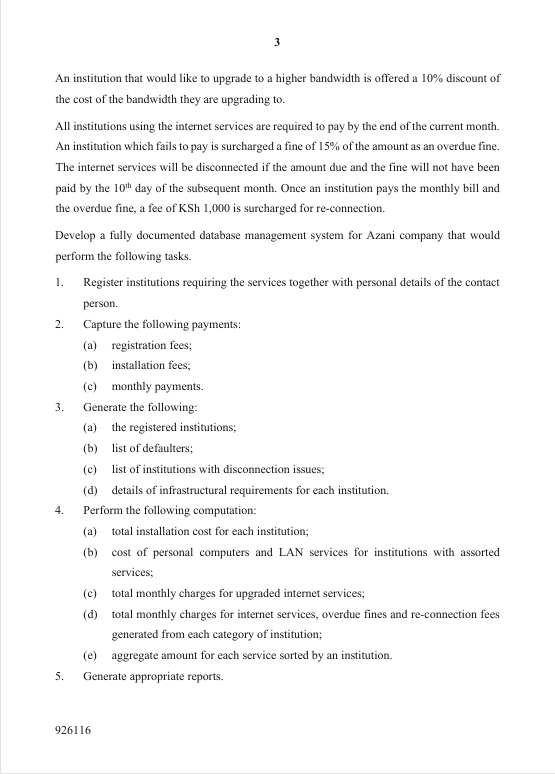
an institution that would like to upgrade to a higher bandwidth is offered a 10% discount of the cost of the bandwidth they are upgrading to.
all institutions using the internet services are required to pay by the end of the current month.
an institution which fails to pay is surcharged a fine of 15% of the amount as an overdue fine.
the internet services will be disconnected if the amount due and the fine will not have been paid by the 10th day of the subsequent month. once an institution pays the monthly bill and the overdue fine, a fee of ksh 1,000 is surcharged for re - connection.
develop a fully documented database management system for azani company that would perform the following tasks.
- register institutions requiring the services together with personal details of the contact person.
- capture the following payments:
(a) registration fees;
(b) installation fees;
(c) monthly payments.
- generate the following:
(a) the registered institutions;
(b) list of defaulters;
(c) list of institutions with disconnection issues;
(d) details of infrastructural requirements for each institution.
- perform the following computation:
(a) total installation cost for each institution;
(b) cost of personal computers and lan services for institutions with assorted services;
(c) total monthly charges for upgraded internet services;
(d) total monthly charges for internet services, overdue fines and re - connection fees generated from each category of institution;
(e) aggregate amount for each service sorted by an institution.
- generate appropriate reports.
To solve this problem of developing a database management system for Azani company, we'll focus on the computational tasks (sub - question 4) using a step - by - step approach for clarity.
4(a): Total Installation Cost for Each Institution
Step 1: Define Variables
Let \(I\) be the base installation cost (before any adjustments, if applicable), and let \(D\) be any discount (in decimal form) on the installation cost. For example, if there's a discount of \(d\%\), then \(D=\frac{d}{100}\).
Step 2: Calculate Discounted Cost (if applicable)
If a discount is applicable, the discounted installation cost \(I_{discounted}=I\times(1 - D)\). But if there's no discount on installation, \(I_{discounted}=I\).
Step 3: Add Other Installation - Related Costs (if any)
Let \(C_1,C_2,\dots,C_n\) be other installation - related costs (like equipment costs, labor costs for installation etc.). Then the total installation cost \(T_{install}=I_{discounted}+\sum_{i = 1}^{n}C_i\)
4(b): Cost of Personal Computers and LAN Services for Institutions with Assorted Services
Step 1: Define Costs per Item
Let \(P\) be the cost of one personal computer, \(n_p\) be the number of personal computers, \(L\) be the cost of LAN services (either a one - time cost or a recurring cost, but in the context of installation, it can be a one - time setup cost), and \(n_l\) be the number of LAN service units (if applicable).
Step 2: Calculate Cost of Personal Computers
The cost of personal computers \(C_p = P\times n_p\)
Step 3: Calculate Cost of LAN Services
The cost of LAN services \(C_l = L\times n_l\) (if \(L\) is per - unit cost) or \(C_l = L\) (if \(L\) is a flat - rate setup cost)
Step 4: Total Cost
The total cost \(T_{pc - lan}=C_p + C_l\)
4(c): Total Monthly Charges for Upgraded Internet Services
Step 1: Define Base Cost and Discount
Let \(B\) be the base monthly cost of the upgraded internet service, and \(d = 0.1\) (since there's a 10% discount, so the discount factor is \(0.1\)).
Step 2: Apply Discount
The discounted monthly cost \(M_{discounted}=B\times(1 - d)\) (because of the 10% discount on the upgraded bandwidth cost)
4(d): Total Monthly Charges for Internet Services, Overdue Fines and Re - connection Fees Generated from Each Category of Institution
Step 1: Calculate Internet Service Cost (from 4(c))
Let \(M\) be the monthly internet service cost (after discount, from 4(c)), so \(M = B\times(0.9)\)
Step 2: Calculate Overdue Fine (if applicable)
Let \(A\) be the amount due (which is \(M\) if the institution has only the internet service bill) and \(f = 0.15\) (15% fine rate). If the institution is a defaulter, the overdue fine \(F = A\times f\)
Step 3: Calculate Re - connection Fee (if applicable)
Let \(R = 1000\) KSH (the re - connection fee). If the institution has been disconnected and re - connected, we add this fee.
Step 4: Total Monthly Charges
The total monthly charges \(T_{total}=M+F + R\) (we add the re - connection fee only if the institution was disconnected and re - connected, otherwise \(R = 0\))
4(e): Aggregate Amount for Each Service Sorted by an Institution
Step 1: Identify Services and Their Costs
Let the services be \(S_1,S_2,\dots,S_k\) with costs \(C_1,C_2,\dots,C_k\) respectively (for example, \(S_1\) could be registration fee, \(S_2\) installation fee, \(S_3\) monthly internet fee etc.)
Step 2: Sum the Costs
For a particular institution, the aggregate amount \(A_{agg}=\sum_{i = 1}^{k}C_i\) (where \(C_i\) is the cost of service \(S_i\) for that ins…

Snap & solve any problem in the app
Get step-by-step solutions on Sovi AI
Photo-based solutions with guided steps
Explore more problems and detailed explanations
s (for the computational parts):
- 4(a): \(T_{install}=I\times(1 - D)+\sum_{i = 1}^{n}C_i\) (where \(I\) is base installation cost, \(D\) is discount factor, \(C_i\) are other installation costs)
- 4(b): \(T_{pc - lan}=P\times n_p+L\times n_l\) (or \(P\times n_p + L\) depending on LAN cost structure)
- 4(c): \(M_{discounted}=B\times0.9\)
- 4(d): \(T_{total}=B\times0.9+(B\times0.9\times0.15)+R\) (where \(R = 1000\) if re - connection is needed, else \(R = 0\))
- 4(e): \(A_{agg}=\sum_{i = 1}^{k}C_i\) (sum of costs of all services for the institution)
For the non - computational tasks (like registering institutions, capturing payments, generating reports etc.), a database management system (DBMS) like MySQL, PostgreSQL or a software like Microsoft Access can be used. The steps for these non - computational tasks would involve:
- Registering Institutions: Design a table with columns for institution details (name, address, contact person details etc.) in the DBMS. Use SQL commands like
CREATE TABLEandINSERTto create the table and add institution records. - Capturing Payments: Design separate tables for registration fees, installation fees, and monthly payments. For example, a
registration_feestable with columns likeinstitution_id,amount,payment_date; similar tables forinstallation_feesandmonthly_payments. UseINSERTstatements to add payment records. - Generating Lists/Details:
- Registered Institutions: Use a
SELECT * FROM institutions(whereinstitutionsis the table with institution details) query to get the list of registered institutions. - List of Defaulters: Query the
monthly_paymentstable (or a combined table of payments) to find institutions where the payment date is beyond the end of the current month. For example,SELECT institution_id FROM monthly_payments WHERE payment_date > LAST_DAY(CURRENT_DATE)(in SQL, depending on the DBMS, the function to get the last day of the month may vary). - List of Institutions with Disconnection Issues: Query the table (say
disconnection_status) where the disconnection status is 'disconnected' (you need to design a table to track disconnection status with columns likeinstitution_id,disconnection_date,reconnection_dateetc.). - Details of Infrastructural Requirements: Design a table
infrastructural_requirementswith columns likeinstitution_id,number_of_pcs,lan_requirementsetc. and useSELECTqueries to retrieve the details.
- Generating Reports: Use reporting tools available in the DBMS (like report generators in Access) or export the query results to a format like CSV or PDF and then format them to generate reports.
Final Answers (for computational parts):
- 4(a): \(\boldsymbol{T_{install}=I\times(1 - D)+\sum_{i = 1}^{n}C_i}\)
- 4(b): \(\boldsymbol{T_{pc - lan}=P\times n_p+L\times n_l}\) (or relevant variation based on cost structure)
- 4(c): \(\boldsymbol{M_{discounted}=0.9B}\)
- 4(d): \(\boldsymbol{T_{total}=0.9B+(0.9B\times0.15)+R}\) (with \(R = 1000\) if re - connection is applicable)
- 4(e): \(\boldsymbol{A_{agg}=\sum_{i = 1}^{k}C_i}\)
(For non - computational tasks, the implementation depends on the chosen DBMS and the specific design of the database tables and queries as outlined above)