QUESTION IMAGE
Question
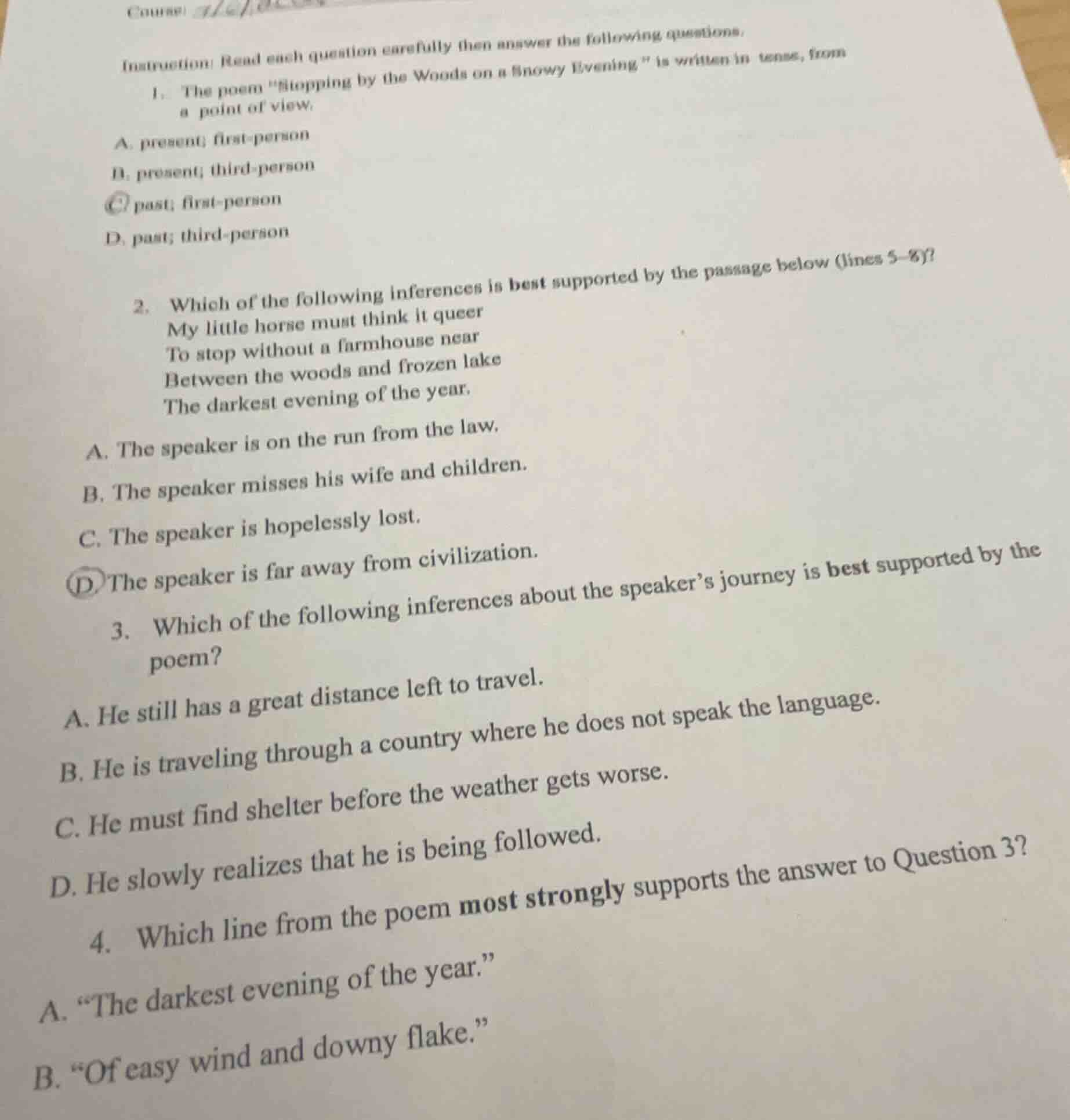
instruction: read each question carefully then answer the following questions. 1. the poem \stopping by the woods on a snowy evening\ is written in tense, from a point of view. a. present; first - person b. present; third - person c. past; first - person d. past; third - person 2. which of the following inferences is best supported by the passage below (lines 5 - 8)? my little horse must think it queer to stop without a farmhouse near between the woods and frozen lake the darkest evening of the year. a. the speaker is on the run from the law. b. the speaker misses his wife and children. c. the speaker is hopelessly lost. d. the speaker is far away from civilization. 3. which of the following inferences about the speaker’s journey is best supported by the poem? a. he still has a great distance left to travel. b. he is traveling through a country where he does not speak the language. c. he must find shelter before the weather gets worse. d. he slowly realizes that he is being followed. 4. which line from the poem most strongly supports the answer to question 3? a. “the darkest evening of the year.” b. “of easy wind and downy flake.”
- For question 1: The poem uses past-tense verbs (e.g., "stopped", "thought") and is narrated with first-person pronouns like "I", so it is past tense, first-person.
- For question 2: The lines state there is no farmhouse nearby, placing the speaker far from settled, civilized areas; other options have no textual support.
- For question 3: The poem's closing lines "And miles to go before I sleep" confirm the speaker has a long distance left to travel; other options lack evidence.
- For question 4: The line "And miles to go before I sleep" directly confirms the speaker has a great distance remaining, which is the answer to question 3. (Note: This line is the key supporting text from the full poem.)

Snap & solve any problem in the app
Get step-by-step solutions on Sovi AI
Photo-based solutions with guided steps
Explore more problems and detailed explanations
- C. past; first-person
- D. The speaker is far away from civilization.
- A. He still has a great distance left to travel.
- (Note: The correct supporting line, which is standard in the poem, is "And miles to go before I sleep" — if this were an option, it would be the answer. Based on the core poem text, this is the line that supports question 3's answer.)