QUESTION IMAGE
Question
integrated math 1: unit 4, lesson 17
cool-down: make your move
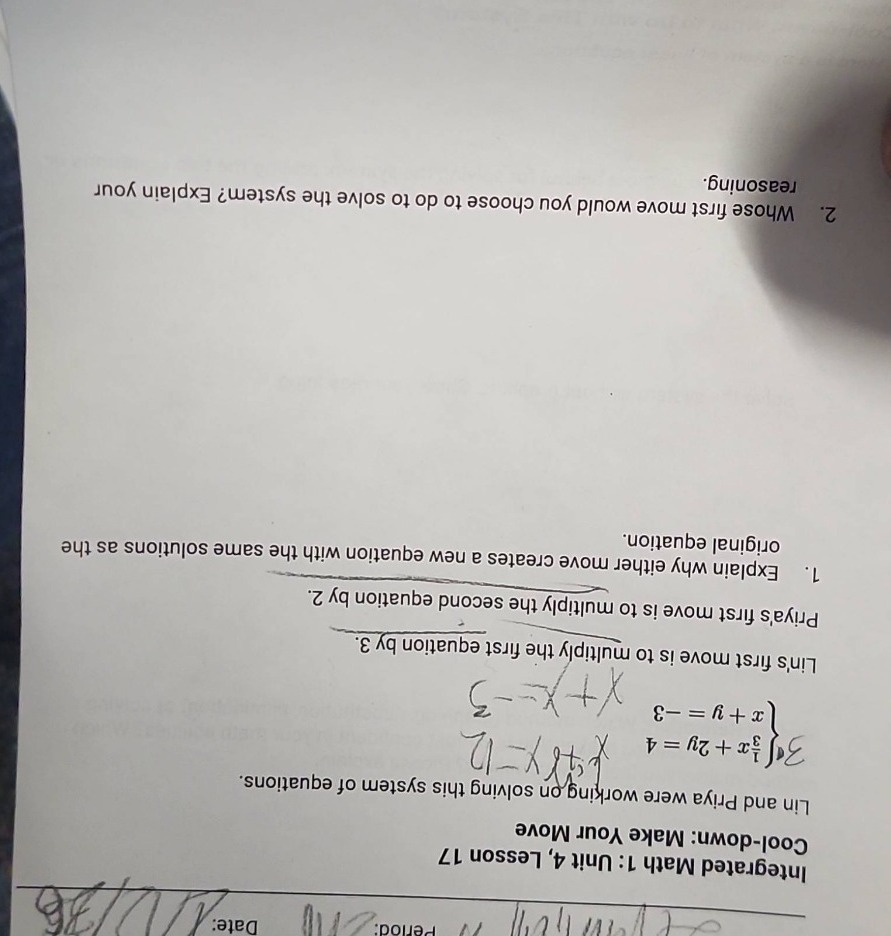
lin and priya were working on solving this system of equations.
$\begin{cases}\frac{1}{3}x + 2y = 4\\\\x + y = -3end{cases}$
lins first move is to multiply the first equation by 3.
priyas first move is to multiply the second equation by 2.
- explain why either move creates a new equation with the same solutions as the original equation.
- whose first move would you choose to do to solve the system? explain your reasoning.
Brief Explanations
- When you multiply every term of an equation by a non-zero constant, you are applying the multiplicative property of equality: if $a = b$, then $ka = kb$ for any non-zero $k$. This operation preserves the relationship between the variables, so any pair $(x,y)$ that satisfied the original equation will satisfy the new equation, and vice versa.
- Lin's first move (multiplying the first equation by 3) directly eliminates the fraction $\frac{1}{3}$ from the first equation, simplifying it to $x + 6y = 12$. This creates an equation with integer coefficients, making the system easier to solve using elimination or substitution. Priya's move (multiplying the second equation by 2) does not address the fraction, leaving the first equation more cumbersome to work with. Lin's move streamlines the system immediately.

Snap & solve any problem in the app
Get step-by-step solutions on Sovi AI
Photo-based solutions with guided steps
Explore more problems and detailed explanations
- Multiplying an equation by a non-zero constant uses the multiplicative property of equality, which preserves all solutions because it maintains the equality relationship between the variables.
- Lin's first move is better. Multiplying the first equation by 3 eliminates the fraction, resulting in an equation with integer coefficients that simplifies the system for solving via elimination or substitution, whereas Priya's move does not address the fraction in the first equation.