QUESTION IMAGE
Question
interpret findings activity (part 2 of 2)
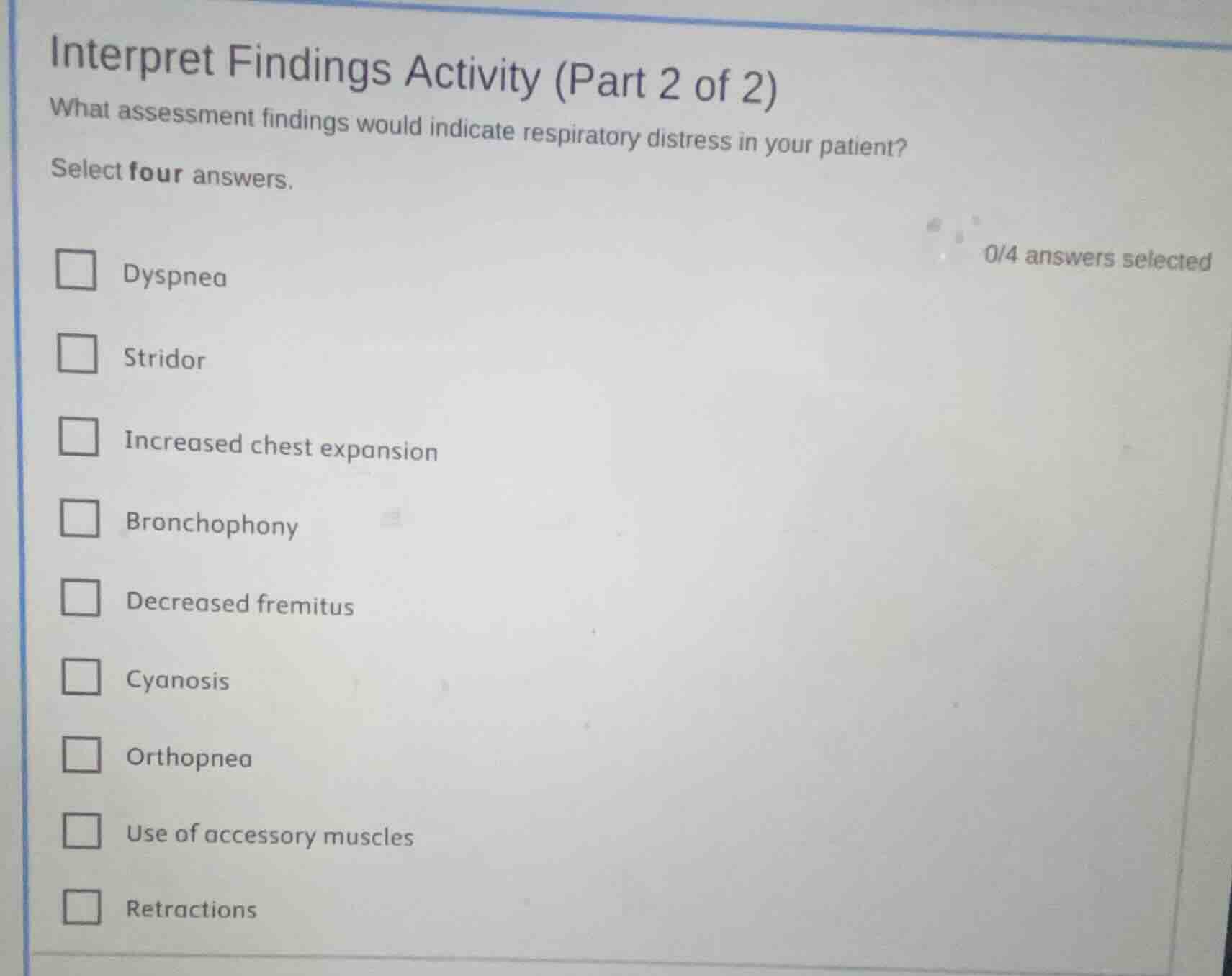
what assessment findings would indicate respiratory distress in your patient?
select four answers.
□ dyspnea
□ stridor
□ increased chest expansion
□ bronchophony
□ decreased fremitus
□ cyanosis
□ orthopnea
□ use of accessory muscles
□ retractions
0/4 answers selected
To determine assessment findings indicating respiratory distress, we analyze each option:
- Dyspnea: Shortness of breath, a key sign of respiratory distress.
- Stridor: High - pitched airway - obstruction sound, indicates distress.
- Cyanosis: Bluish skin due to low oxygen, a sign of respiratory issues.
- Use of accessory muscles: When normal breathing muscles are insufficient, accessory muscles are used, indicating distress.
- Orthopnea: Difficulty breathing when lying down, a respiratory distress sign.
- Retractions: Indrawing of chest muscles, shows increased work of breathing.
- Increased chest expansion is not a sign of distress (normal or increased in some cases, not distress - related).
- Bronchophony is a voice - transmission finding, not directly distress - related.
- Decreased fremitus is more about lung density, not distress.
The four (among the correct ones, a common set) are Dyspnea, Stridor, Cyanosis, Use of accessory muscles (other correct ones like Orthopnea, Retractions can also be part of the four - answer set depending on context, but these four are clear indicators).

Snap & solve any problem in the app
Get step-by-step solutions on Sovi AI
Photo-based solutions with guided steps
Explore more problems and detailed explanations
A. Dyspnea, B. Stridor, F. Cyanosis, H. Use of accessory muscles (Note: Other combinations with Orthopnea, Retractions are also correct, but this is a common valid set of four.)