QUESTION IMAGE
Question
intro to triangle proportionality (tues 1/27)
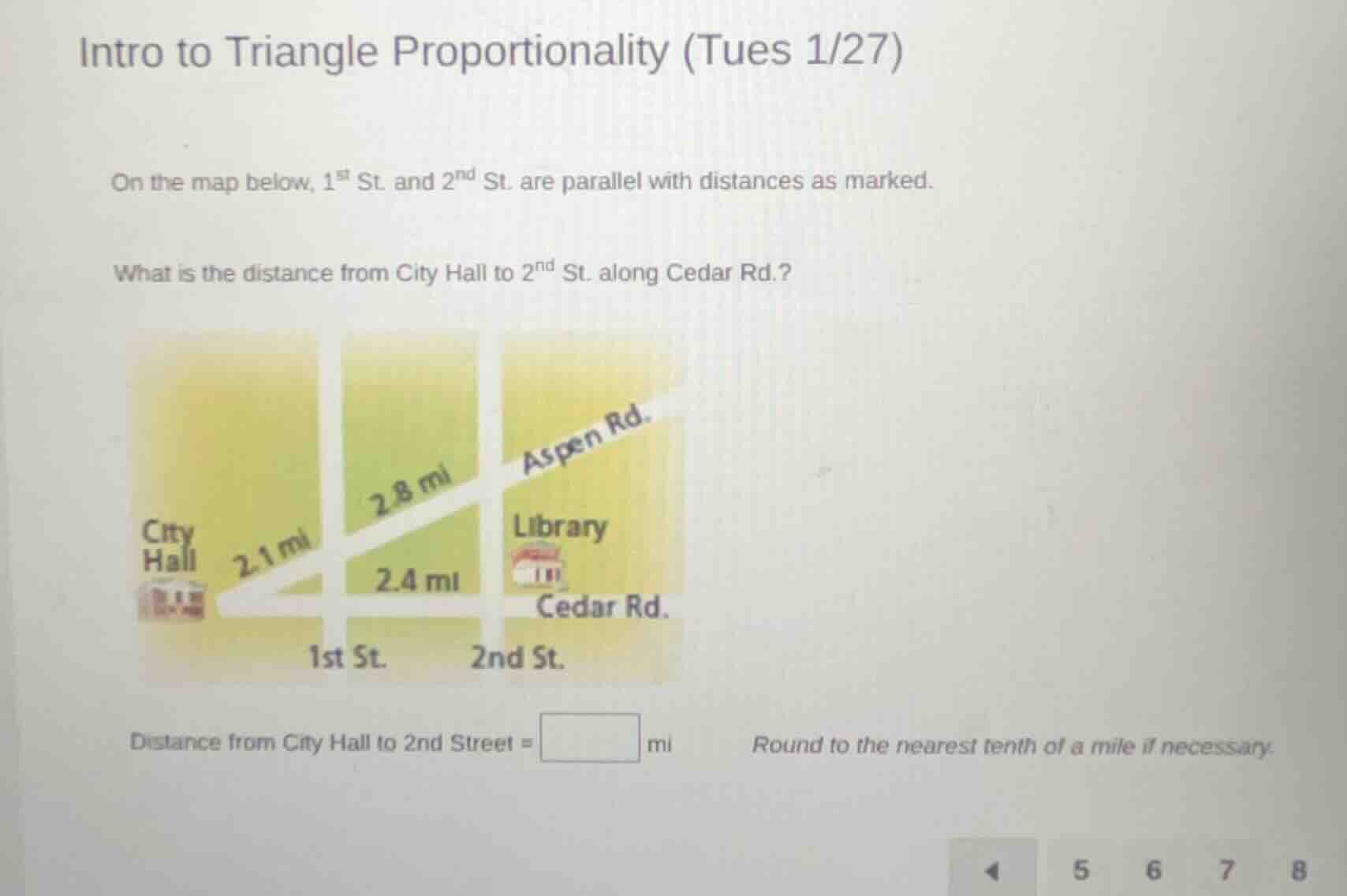
on the map below, $1^{\text{st}}$ st. and $2^{\text{nd}}$ st. are parallel with distances as marked.
what is the distance from city hall to $2^{\text{nd}}$ st. along cedar rd.?
distance from city hall to 2nd street = \boxed{} mi \\ \\ \\ \\ round to the nearest tenth of a mile if necessary.
Step1: Apply Triangle Proportionality Theorem
Let \( x \) be the distance from City Hall to \( 2^{\text{nd}} \) St. along Cedar Rd. By the Triangle Proportionality Theorem (also known as the Basic Proportionality Theorem or Thales' theorem), since \( 1^{\text{st}} \) St. and \( 2^{\text{nd}} \) St. are parallel, we have the proportion:
\[
\frac{2.1}{2.8}=\frac{x - 2.4}{2.4}
\]
Wait, no, actually, the correct proportion is based on the segments created by the transversals. Let's re - establish the proportion. The segments on Aspen Rd. are \( 2.1\) mi and \( 2.8 - 2.1=0.7\) mi? No, better to see: the two parallel lines (\(1^{\text{st}}\) St. and \(2^{\text{nd}}\) St.) are cut by two transversals: Cedar Rd. and Aspen Rd. So, the ratio of the segments on one transversal should equal the ratio of the segments on the other transversal.
Let the distance from City Hall to \(1^{\text{st}}\) St. along Cedar Rd. be \(2.4\) mi? Wait, no, looking at the diagram: along Aspen Rd., the distance from City Hall to the intersection with \(1^{\text{st}}\) St. is \(2.1\) mi, and from that intersection to the intersection with \(2^{\text{nd}}\) St. is \(2.8 - 2.1 = 0.7\) mi? No, the total length of Aspen Rd. between the two vertical streets ( \(1^{\text{st}}\) and \(2^{\text{nd}}\) St.) is \(2.8\) mi, and the part from City Hall to \(1^{\text{st}}\) St. along Aspen Rd. is \(2.1\) mi. Along Cedar Rd., the distance from City Hall to \(1^{\text{st}}\) St. is, let's say, \(y\) and from \(1^{\text{st}}\) St. to \(2^{\text{nd}}\) St. is \(2.4\) mi. Wait, actually, the correct proportion is:
Since \(1^{\text{st}}\parallel2^{\text{nd}}\), by the Triangle Proportionality Theorem, \(\frac{\text{Distance from City Hall to }1^{\text{st}}\text{ St. along Aspen Rd.}}{\text{Distance from }1^{\text{st}}\text{ St. to }2^{\text{nd}}\text{ St. along Aspen Rd.}}=\frac{\text{Distance from City Hall to }1^{\text{st}}\text{ St. along Cedar Rd.}}{\text{Distance from }1^{\text{st}}\text{ St. to }2^{\text{nd}}\text{ St. along Cedar Rd.}}\)
The distance from City Hall to \(1^{\text{st}}\) St. along Aspen Rd. is \(2.1\) mi, from \(1^{\text{st}}\) St. to \(2^{\text{nd}}\) St. along Aspen Rd. is \(2.8 - 2.1=0.7\) mi. The distance from \(1^{\text{st}}\) St. to \(2^{\text{nd}}\) St. along Cedar Rd. is \(2.4\) mi. Let \(x\) be the distance from City Hall to \(2^{\text{nd}}\) St. along Cedar Rd., so the distance from City Hall to \(1^{\text{st}}\) St. along Cedar Rd. is \(x - 2.4\) mi.
So the proportion is:
\[
\frac{2.1}{0.7}=\frac{x - 2.4}{2.4}
\]
Step2: Solve the proportion
First, simplify \(\frac{2.1}{0.7}\). \(2.1\div0.7 = 3\). So our equation becomes:
\[
3=\frac{x - 2.4}{2.4}
\]
Multiply both sides by \(2.4\):
\[
x-2.4=3\times2.4
\]
\[
x - 2.4 = 7.2
\]
Add \(2.4\) to both sides:
\[
x=7.2 + 2.4
\]
\[
x = 9.6
\]
Wait, that can't be right. Maybe I set up the proportion wrong. Let's try another way. The two parallel lines are \(1^{\text{st}}\) St. and \(2^{\text{nd}}\) St. The transversals are Cedar Rd. and Aspen Rd. So the ratio of the segments on Cedar Rd. should equal the ratio of the segments on Aspen Rd.
Let the distance from City Hall to \(2^{\text{nd}}\) St. along Cedar Rd. be \(x\). The distance from City Hall to \(1^{\text{st}}\) St. along Cedar Rd. is \(x - 2.4\) (if \(2.4\) is the distance from \(1^{\text{st}}\) to \(2^{\text{nd}}\) along Cedar Rd.). The distance from City Hall to \(1^{\text{st}}\) St. along Aspen Rd. is \(2.1\), and from \(1^{\text{st}}\) to \(2^{\text{nd}}\) along Aspen Rd. is \(2.8-2.1 = 0.7\). So:
\(\frac{\text{City Hall to }1^{\text{st}}\text…

Snap & solve any problem in the app
Get step-by-step solutions on Sovi AI
Photo-based solutions with guided steps
Explore more problems and detailed explanations
\(3.2\)