QUESTION IMAGE
Question
introduction
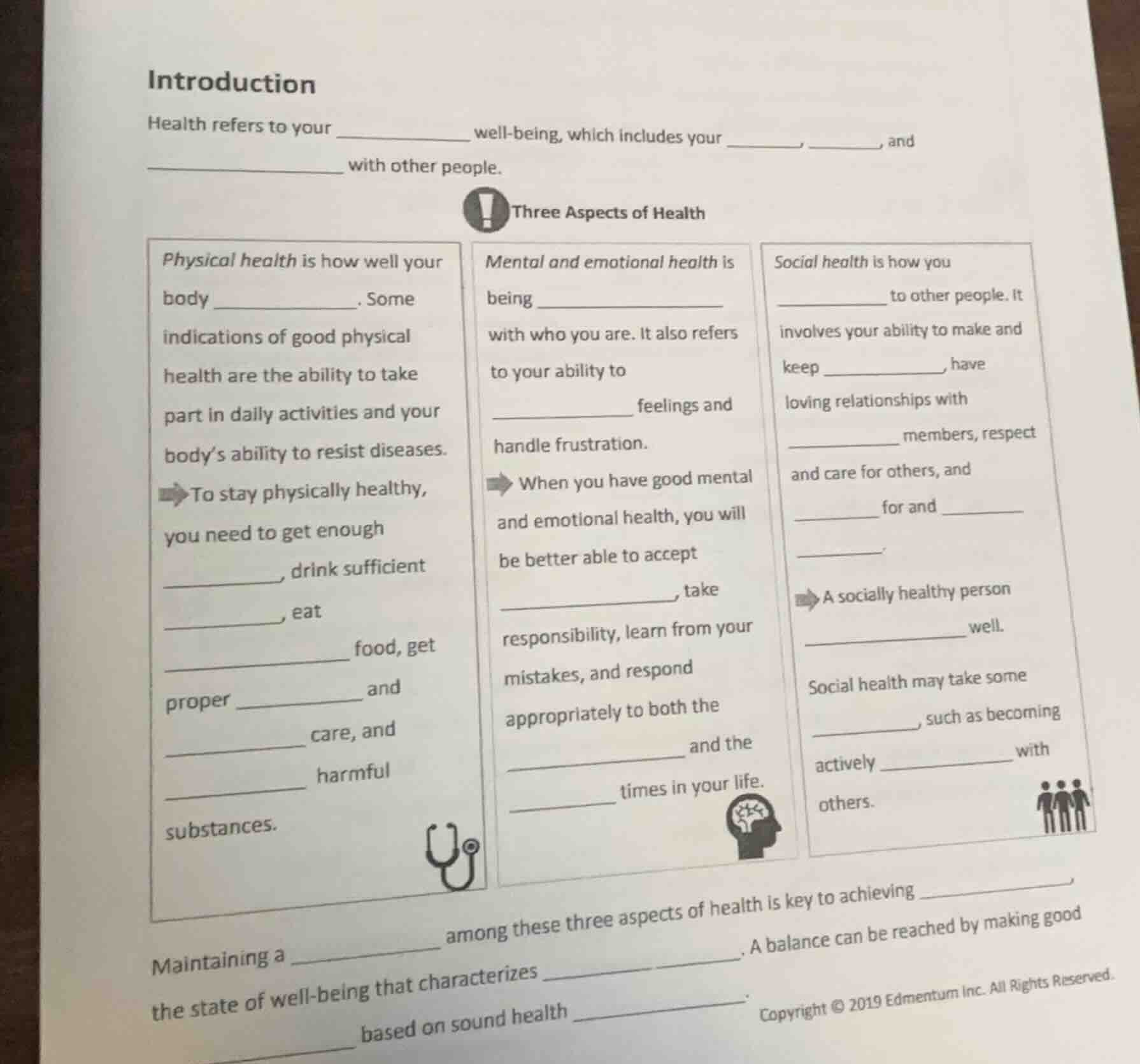
health refers to your ________ well - being, which includes your __, ____, and
____________ with other people.
three aspects of health
physical health is how well your
body __________. some
indications of good physical
health are the ability to take
part in daily activities and your
body’s ability to resist diseases.
to stay physically healthy,
you need to get enough
________, drink sufficient
________, eat
________ food, get
proper ________ and
________ care, and
________ harmful
substances.
mental and emotional health is
being __________
with who you are. it also refers
to your ability to
________ feelings and
handle frustration.
when you have good mental
and emotional health, you will
be better able to accept
________, take
responsibility, learn from your
mistakes, and respond
appropriately to both the
________ and the
______ times in your life.
social health is how you
______ to other people. it
involves your ability to make and
keep ______, have
loving relationships with
______ members, respect
and care for others, and
____ for and ____
______.
a socially healthy person
______ well.
social health may take some
______, such as becoming
actively ______ with
others.
maintaining a ______ among these three aspects of health is key to achieving ______,
the state of well - being that characterizes ______ ______. a balance can be reached by making good
____ based on sound health ______.
This is a fill - in - the - blank question about the concept of health. We need to recall the knowledge of health education (a sub - field of Social Science, specifically Education related to health).
- For the first blank in the introduction: Health refers to your overall well - being. This is a basic definition of health, which encompasses all aspects of a person's well - being.
- The three aspects of health are physical, mental/emotional, and social. So the next blanks are physical, mental/emotional, and social interaction (for the last blank in the introduction as it is about interaction with others).
For the "Physical health" section:
- Physical health is how well your body functions. Good physical health is related to the proper functioning of the body.
- To stay physically healthy, you need to get enough sleep, drink sufficient water, eat nutritious food, get proper exercise and medical care, and avoid harmful substances. These are common knowledge about maintaining physical health.
For the "Mental and emotional health" section:
- Mental and emotional health is being comfortable with who you are. It also refers to your ability to manage feelings and handle frustration.
- When you have good mental and emotional health, you will be better able to accept yourself, take responsibility, learn from your mistakes, and respond appropriately to both the good and the bad times in your life.
For the "Social health" section:
- Social health is how you relate to other people. It involves your ability to make and keep friends, have loving relationships with family members, respect and care for others, and care for and be cared for.
- A socially healthy person interacts well. Social health may take some effort, such as becoming actively involved with others.
For the last part:
- Maintaining a balance among these three aspects of health is key to achieving well - being, the state of well - being that characterizes a healthy life. A balance can be reached by making good choices based on sound health knowledge.

Snap & solve any problem in the app
Get step-by-step solutions on Sovi AI
Photo-based solutions with guided steps
Explore more problems and detailed explanations
- Introduction: Health refers to your \(\boldsymbol{\text{overall}}\) well - being, which includes your \(\boldsymbol{\text{physical}}\), \(\boldsymbol{\text{mental/emotional}}\), and \(\boldsymbol{\text{social interaction}}\) with other people.
- Physical health: Physical health is how well your body \(\boldsymbol{\text{functions}}\). To stay physically healthy, you need to get enough \(\boldsymbol{\text{sleep}}\), drink sufficient \(\boldsymbol{\text{water}}\), eat \(\boldsymbol{\text{nutritious}}\) food, get proper \(\boldsymbol{\text{exercise}}\) and \(\boldsymbol{\text{medical}}\) care, and \(\boldsymbol{\text{avoid}}\) harmful substances.
- Mental and emotional health: Mental and emotional health is being \(\boldsymbol{\text{comfortable}}\) with who you are. It also refers to your ability to \(\boldsymbol{\text{manage}}\) feelings and handle frustration. When you have good mental and emotional health, you will be better able to accept \(\boldsymbol{\text{yourself}}\), take responsibility, learn from your mistakes, and respond appropriately to both the \(\boldsymbol{\text{good}}\) and the \(\boldsymbol{\text{bad}}\) times in your life.
- Social health: Social health is how you \(\boldsymbol{\text{relate}}\) to other people. It involves your ability to make and keep \(\boldsymbol{\text{friends}}\), have loving relationships with \(\boldsymbol{\text{family}}\) members, respect and care for others, and \(\boldsymbol{\text{care}}\) for and \(\boldsymbol{\text{be cared for}}\). A socially healthy person \(\boldsymbol{\text{interacts}}\) well. Social health may take some \(\boldsymbol{\text{effort}}\), such as becoming actively \(\boldsymbol{\text{involved}}\) with others.
- Last part: Maintaining a \(\boldsymbol{\text{balance}}\) among these three aspects of health is key to achieving \(\boldsymbol{\text{well - being}}\), the state of well - being that characterizes \(\boldsymbol{\text{a healthy life}}\). A balance can be reached by making good \(\boldsymbol{\text{choices}}\) based on sound health \(\boldsymbol{\text{knowledge}}\).