QUESTION IMAGE
Question
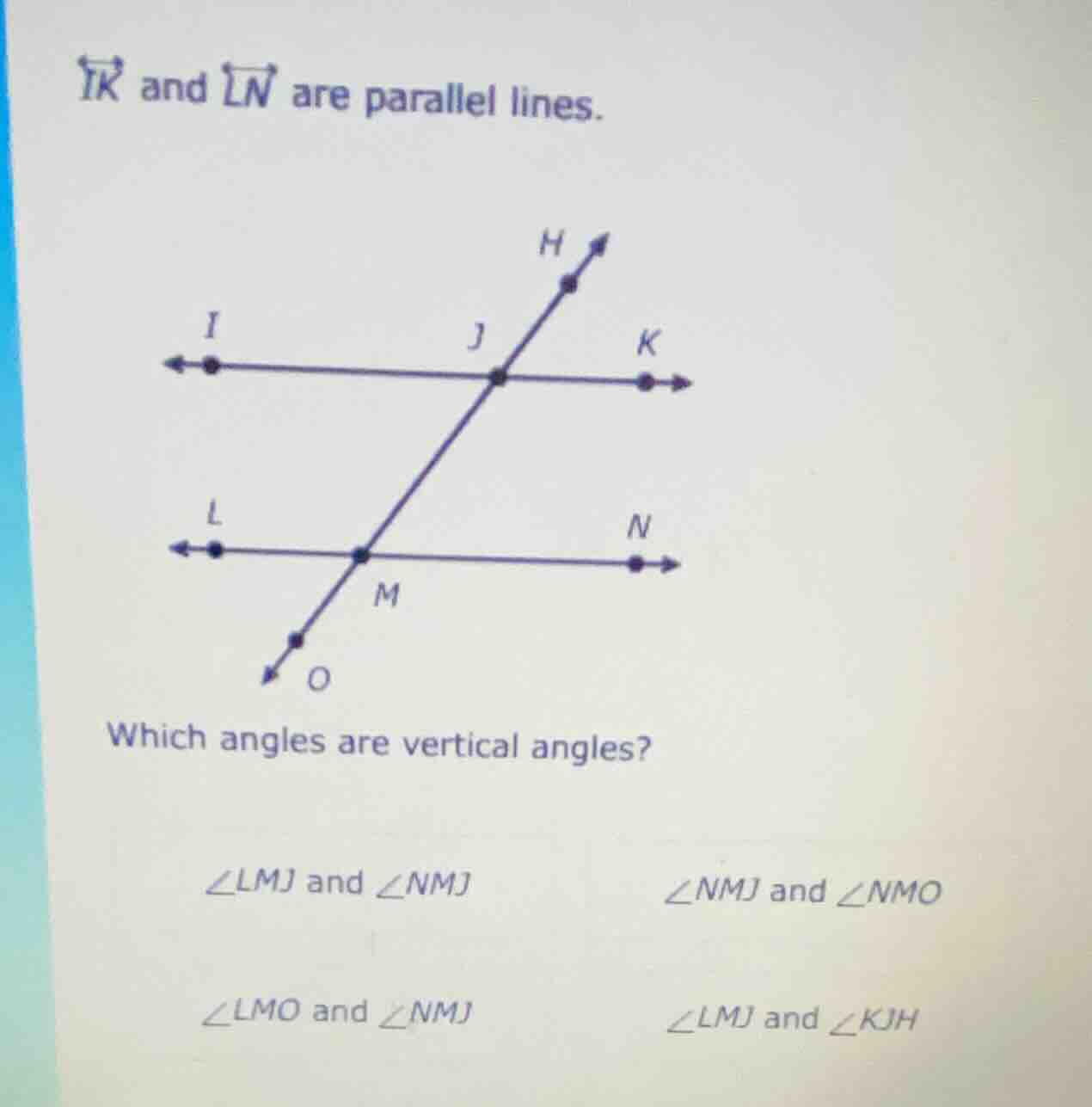
ir and ln are parallel lines.
which angles are vertical angles?
∠lmj and ∠nmj ∠nmj and ∠nmo
∠lmo and ∠nmj ∠lmj and ∠kjh
Step1: Recall vertical angles definition
Vertical angles are opposite angles formed by two intersecting lines, and they are equal in measure.
Step2: Analyze each option
- Option 1: $\angle LMJ$ and $\angle NMJ$: These two angles share a common side $MJ$ and their non - common sides are in a straight line (since $LN$ is a straight line), so they are supplementary (form a linear pair), not vertical angles.
- Option 2: $\angle NMJ$ and $\angle NMO$: These two angles share a common side $NM$ and their non - common sides are in a straight line (since $HO$ is a straight line), so they are supplementary (form a linear pair), not vertical angles.
- Option 3: $\angle LMO$ and $\angle NMJ$: When lines $HO$ and $LN$ intersect at $M$, $\angle LMO$ and $\angle NMJ$ are opposite angles formed by the intersection of the two lines. So they are vertical angles.
- Option 4: $\angle LMJ$ and $\angle KJH$: $\angle LMJ$ is at point $M$ and $\angle KJH$ is at point $J$, and they are not formed by the same pair of intersecting lines, so they are not vertical angles.

Snap & solve any problem in the app
Get step-by-step solutions on Sovi AI
Photo-based solutions with guided steps
Explore more problems and detailed explanations
$\angle LMO$ and $\angle NMJ$