QUESTION IMAGE
Question
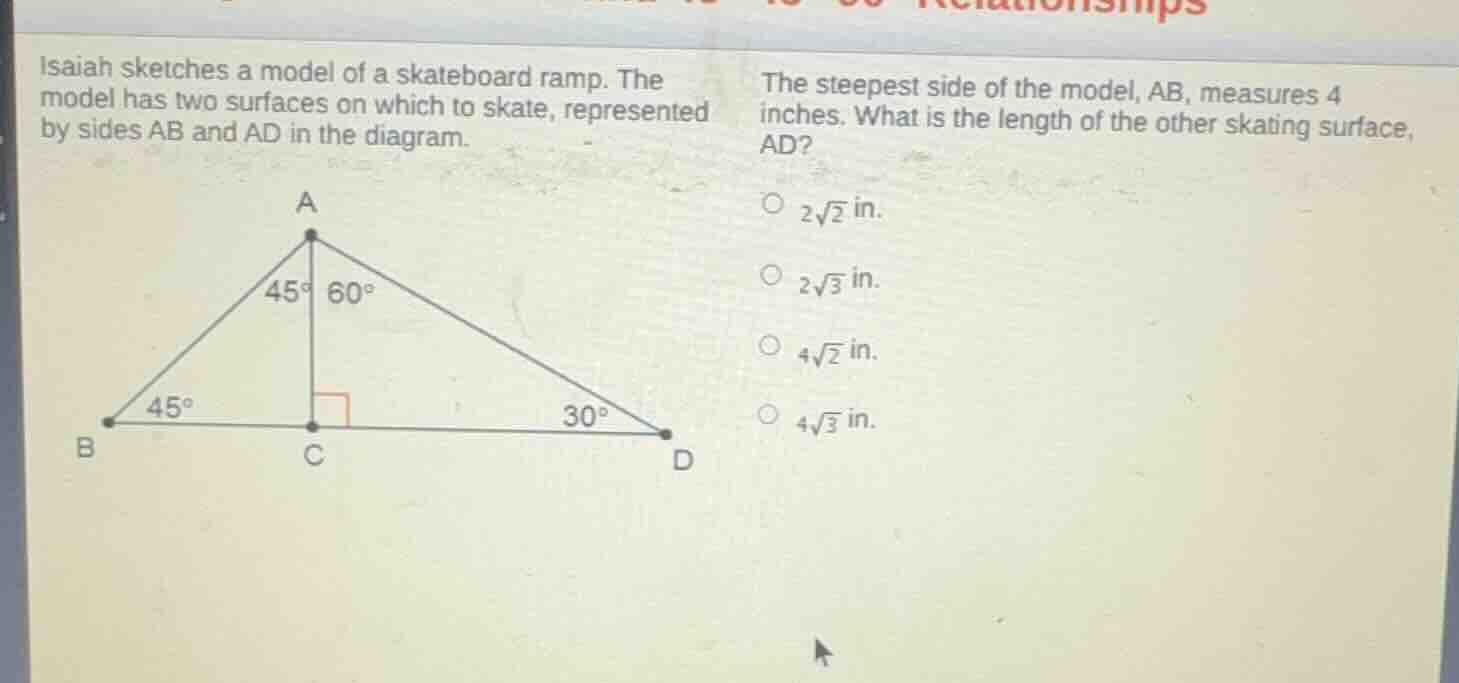
isaiah sketches a model of a skateboard ramp. the model has two surfaces on which to skate, represented by sides ab and ad in the diagram. the steepest side of the model, ab, measures 4 inches. what is the length of the other skating surface, ad? 2√2 in. 2√3 in. 4√2 in. 4√3 in. diagram: triangle with points a, b, c, d. ac is perpendicular to bd (right angle at c). angle at b is 45°, angle at a between ab and ac is 45°, angle at a between ac and ad is 60°, angle at d is 30°.
Step1: Find AC using triangle ABC
In triangle \(ABC\), \(\angle B = 45^\circ\), \(\angle ACB = 90^\circ\), so it's an isosceles right triangle. \(\cos(45^\circ)=\frac{AC}{AB}\). Given \(AB = 4\) inches, \(\cos(45^\circ)=\frac{\sqrt{2}}{2}\), so \(AC = AB\times\cos(45^\circ)=4\times\frac{\sqrt{2}}{2}=2\sqrt{2}\)? Wait, no, wait. Wait, in triangle \(ABC\), \(\angle B = 45^\circ\), \(\angle A = 45^\circ\), so \(AC = BC\), and using \(\sin(45^\circ)=\frac{AC}{AB}\), so \(AC = AB\times\sin(45^\circ)=4\times\frac{\sqrt{2}}{2}=2\sqrt{2}\)? Wait, no, maybe better to use triangle \(ACD\) later. Wait, first, in triangle \(ABC\), right-angled at \(C\), \(\angle B = 45^\circ\), so \(\angle BAC = 45^\circ\), so \(AC = AB\times\sin(45^\circ)\)? Wait, no, \(\sin(45^\circ)=\frac{AC}{AB}\)? Wait, \(AB\) is the hypotenuse, \(AC\) is the opposite side to \(\angle B\). So \(\sin(45^\circ)=\frac{AC}{AB}\), so \(AC = AB\times\sin(45^\circ)=4\times\frac{\sqrt{2}}{2}=2\sqrt{2}\). Wait, but then in triangle \(ACD\), right-angled at \(C\), \(\angle D = 30^\circ\), so \(\sin(30^\circ)=\frac{AC}{AD}\), so \(AD = \frac{AC}{\sin(30^\circ)}\). Since \(\sin(30^\circ)=\frac{1}{2}\), then \(AD = \frac{2\sqrt{2}}{\frac{1}{2}}=4\sqrt{2}\)? Wait, no, that can't be. Wait, maybe I made a mistake. Wait, let's re-examine. Wait, in triangle \(ABC\), \(\angle B = 45^\circ\), \(\angle ACB = 90^\circ\), so \(\angle BAC = 45^\circ\), so \(AC = AB\times\cos(45^\circ)\)? Wait, \(\cos(45^\circ)=\frac{AC}{AB}\), so \(AC = AB\times\cos(45^\circ)=4\times\frac{\sqrt{2}}{2}=2\sqrt{2}\). Then in triangle \(ACD\), right-angled at \(C\), \(\angle D = 30^\circ\), so \(\sin(30^\circ)=\frac{AC}{AD}\), so \(AD = \frac{AC}{\sin(30^\circ)}=\frac{2\sqrt{2}}{\frac{1}{2}}=4\sqrt{2}\)? But that's one of the options (4√2 in). Wait, but let's check again. Wait, maybe I messed up the angle in triangle \(ACD\). Wait, in triangle \(ACD\), \(\angle CAD = 60^\circ\), \(\angle D = 30^\circ\), so right-angled at \(C\), so \(\sin(30^\circ)=\frac{AC}{AD}\), so \(AD = \frac{AC}{\sin(30^\circ)}\). But wait, maybe \(AC\) is calculated wrong. Wait, alternatively, in triangle \(ABC\), since it's a 45-45-90 triangle, \(AC = AB\times\sin(45^\circ)=4\times\frac{\sqrt{2}}{2}=2\sqrt{2}\). Then in triangle \(ACD\), 30-60-90 triangle, where \(\angle D = 30^\circ\), so the side opposite 30° is \(AC\), and the hypotenuse is \(AD\). So in a 30-60-90 triangle, the hypotenuse is twice the shorter leg (opposite 30°). Wait, no: in 30-60-90, the sides are in ratio \(1 : \sqrt{3} : 2\), where the side opposite 30° is the shortest, then opposite 60° is \(\sqrt{3}\) times that, and hypotenuse is twice the shortest. So here, \(AC\) is opposite 30°? Wait, no, \(\angle D = 30^\circ\), so the side opposite \(\angle D\) is \(AC\), so \(AC\) is the shorter leg, so hypotenuse \(AD = 2\times AC\). Wait, but earlier I thought \(AC = 2\sqrt{2}\), so \(AD = 4\sqrt{2}\), which is one of the options (4√2 in). So that must be it. Wait, let's confirm again. In triangle \(ABC\): right-angled at \(C\), \(\angle B = 45^\circ\), so \(AC = AB \times \sin(45^\circ) = 4 \times \frac{\sqrt{2}}{2} = 2\sqrt{2}\). In triangle \(ACD\): right-angled at \(C\), \(\angle D = 30^\circ\), so \(\sin(30^\circ) = \frac{AC}{AD}\) => \(AD = \frac{AC}{\sin(30^\circ)} = \frac{2\sqrt{2}}{\frac{1}{2}} = 4\sqrt{2}\). So the length of \(AD\) is \(4\sqrt{2}\) inches.
Step2: Verify with triangle ACD
Alternatively, in triangle \(ACD\), \(\angle CAD = 60^\circ\), \(\angle D = 30^\circ\), right-angled at \(C\). So \(\cos(60^\circ) = \frac{AC}{AD}\), but we found \(AC = 2\sqr…

Snap & solve any problem in the app
Get step-by-step solutions on Sovi AI
Photo-based solutions with guided steps
Explore more problems and detailed explanations
\(4\sqrt{2}\) in. (Option: \(4\sqrt{2}\) in.)