QUESTION IMAGE
Question
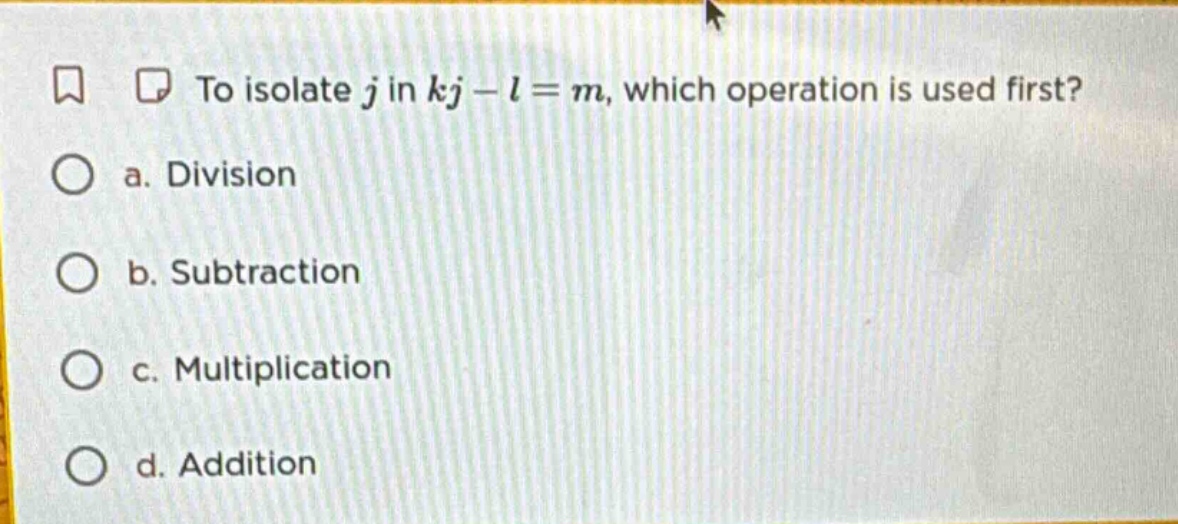
to isolate j in kj - l = m, which operation is used first?
a. division
b. subtraction
c. multiplication
d. addition
To isolate \( j \) in the equation \( kj - l = m \), we follow the order of inverse operations (reverse of PEMDAS, so SADMEP: Subtraction/Addition, then Multiplication/Division, etc.). First, we need to get rid of the \(-l\) term. The inverse of subtraction is addition, so we add \( l \) to both sides first. This is before dealing with the multiplication by \( k \) (which would be handled by division later). So the first operation is addition? Wait, no—wait, the term is \( -l \), so to cancel that, we add \( l \) to both sides. Wait, let's re-express: the equation is \( kj - l = m \). To isolate the term with \( j \) (which is \( kj \)), we need to move the \( -l \) to the other side. The inverse of subtracting \( l \) is adding \( l \), so we add \( l \) to both sides: \( kj - l + l = m + l \), which simplifies to \( kj = m + l \). Then we would divide by \( k \) to get \( j \). So the first operation is addition? Wait, no—wait, the options are division, subtraction, multiplication, addition. Wait, the original equation has \( kj - l = m \). To isolate \( kj \), we need to undo the subtraction of \( l \), which is done by adding \( l \) to both sides. So the first operation is addition? Wait, but let's check the options. Option d is addition. Wait, but maybe I made a mistake. Wait, let's think again. The equation is \( kj - l = m \). We want to solve for \( j \). The steps are:
- Add \( l \) to both sides (to undo the subtraction of \( l \)): \( kj = m + l \)
- Divide both sides by \( k \) (to undo the multiplication by \( k \)): \( j = \frac{m + l}{k} \)
So the first operation is addition? Wait, but the term is \( -l \), so adding \( l \) is the inverse. So the first operation is addition, which is option d. Wait, but let's check the options again. The options are a. Division, b. Subtraction, c. Multiplication, d. Addition. So the correct answer is d. Addition. Wait, but maybe I confused the operation. Wait, the original equation has \( kj - l = m \). To get \( kj \) by itself, we need to add \( l \) to both sides. So the first operation is addition. So the correct option is d. Addition.
Wait, but let's confirm. Let's take an example. Let \( k = 2 \), \( l = 3 \), \( m = 5 \). Then the equation is \( 2j - 3 = 5 \). To solve for \( j \), first we add 3 to both sides: \( 2j = 8 \), then divide by 2: \( j = 4 \). So the first operation is adding 3 (which is \( l \)), so addition. So the first operation is addition, so option d.

Snap & solve any problem in the app
Get step-by-step solutions on Sovi AI
Photo-based solutions with guided steps
Explore more problems and detailed explanations
d. Addition