QUESTION IMAGE
Question
the isosceles triangle theorem says if two sides of a triangle are congruent, then the angles opposite those sides are congruent.
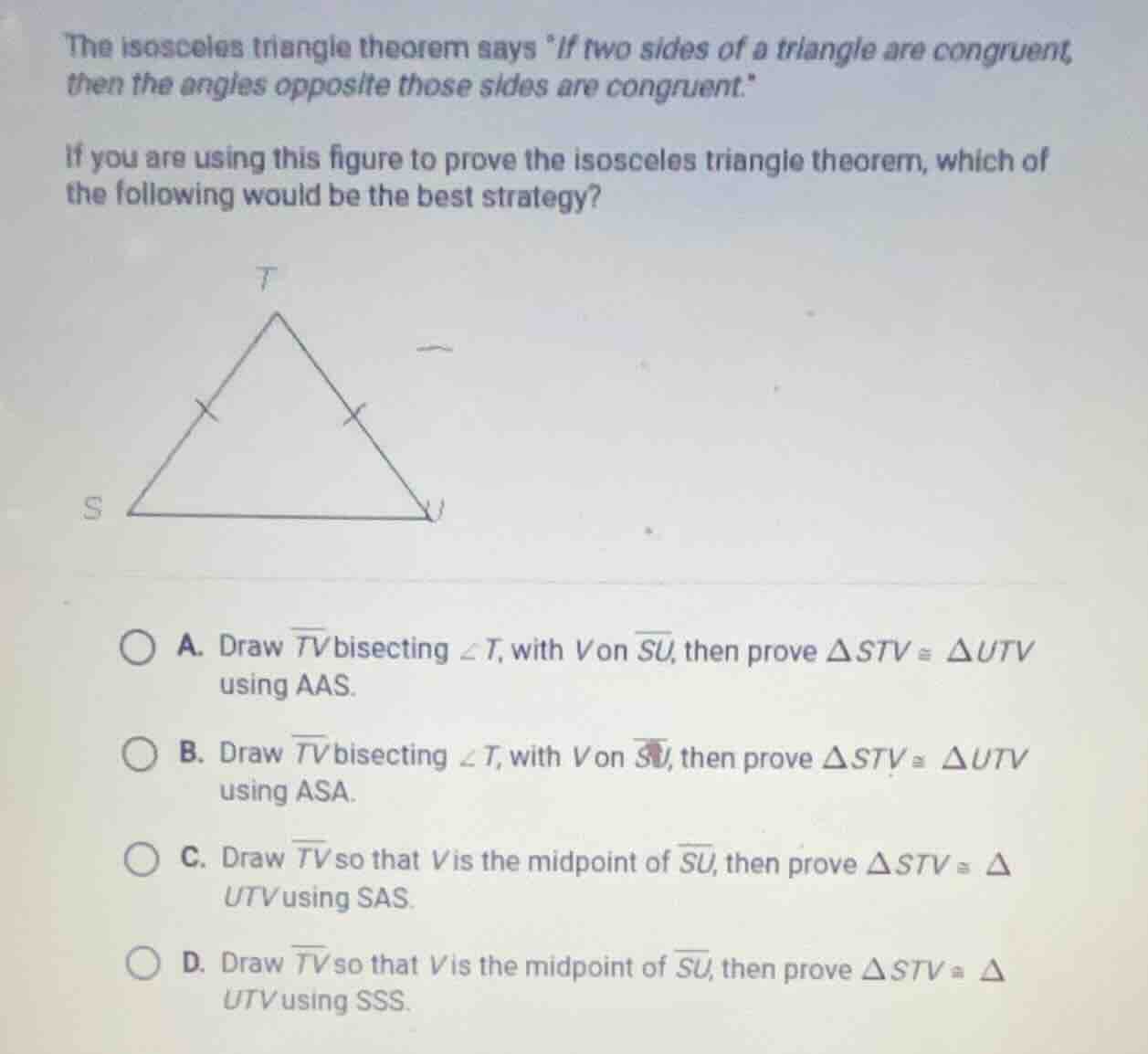
if you are using this figure to prove the isosceles triangle theorem, which of the following would be the best strategy?
a. draw $overline{tv}$ bisecting $angle t$, with $v$ on $overline{su}$, then prove $\triangle stv \cong \triangle utv$ using aas.
b. draw $overline{tv}$ bisecting $angle t$, with $v$ on $overline{su}$, then prove $\triangle stv \cong \triangle utv$ using asa.
c. draw $overline{tv}$ so that $v$ is the midpoint of $overline{su}$, then prove $\triangle stv \cong \triangle utv$ using sas.
d. draw $overline{tv}$ so that $v$ is the midpoint of $overline{su}$, then prove $\triangle stv \cong \triangle utv$ using sss.
Step1: Analyze given triangle
We have $\triangle STU$ with $\overline{ST} \cong \overline{UT}$.
Step2: Evaluate Option A
Bisecting $\angle T$ gives $\angle STV \cong \angle UTV$, $\overline{ST} \cong \overline{UT}$, $\overline{TV} \cong \overline{TV}$. This is not AAS, so invalid.
Step3: Evaluate Option B
Bisecting $\angle T$ gives $\angle STV \cong \angle UTV$, $\overline{ST} \cong \overline{UT}$, $\overline{TV} \cong \overline{TV}$. This is SAS, not ASA, so invalid.
Step4: Evaluate Option C
If $V$ is midpoint of $\overline{SU}$, $\overline{SV} \cong \overline{VU}$, $\overline{ST} \cong \overline{UT}$, $\overline{TV} \cong \overline{TV}$. This is SSS, not SAS, so invalid.
Step5: Evaluate Option D
If $V$ is midpoint of $\overline{SU}$, $\overline{SV} \cong \overline{VU}$. Given $\overline{ST} \cong \overline{UT}$, and $\overline{TV} \cong \overline{TV}$ (reflexive property). This fits SSS congruence, which proves $\triangle STV \cong \triangle UTV$, then corresponding angles $\angle S \cong \angle U$.

Snap & solve any problem in the app
Get step-by-step solutions on Sovi AI
Photo-based solutions with guided steps
Explore more problems and detailed explanations
D. Draw $\overline{TV}$ so that $V$ is the midpoint of $\overline{SU}$, then prove $\Delta STV \cong \Delta UTV$ using SSS.