QUESTION IMAGE
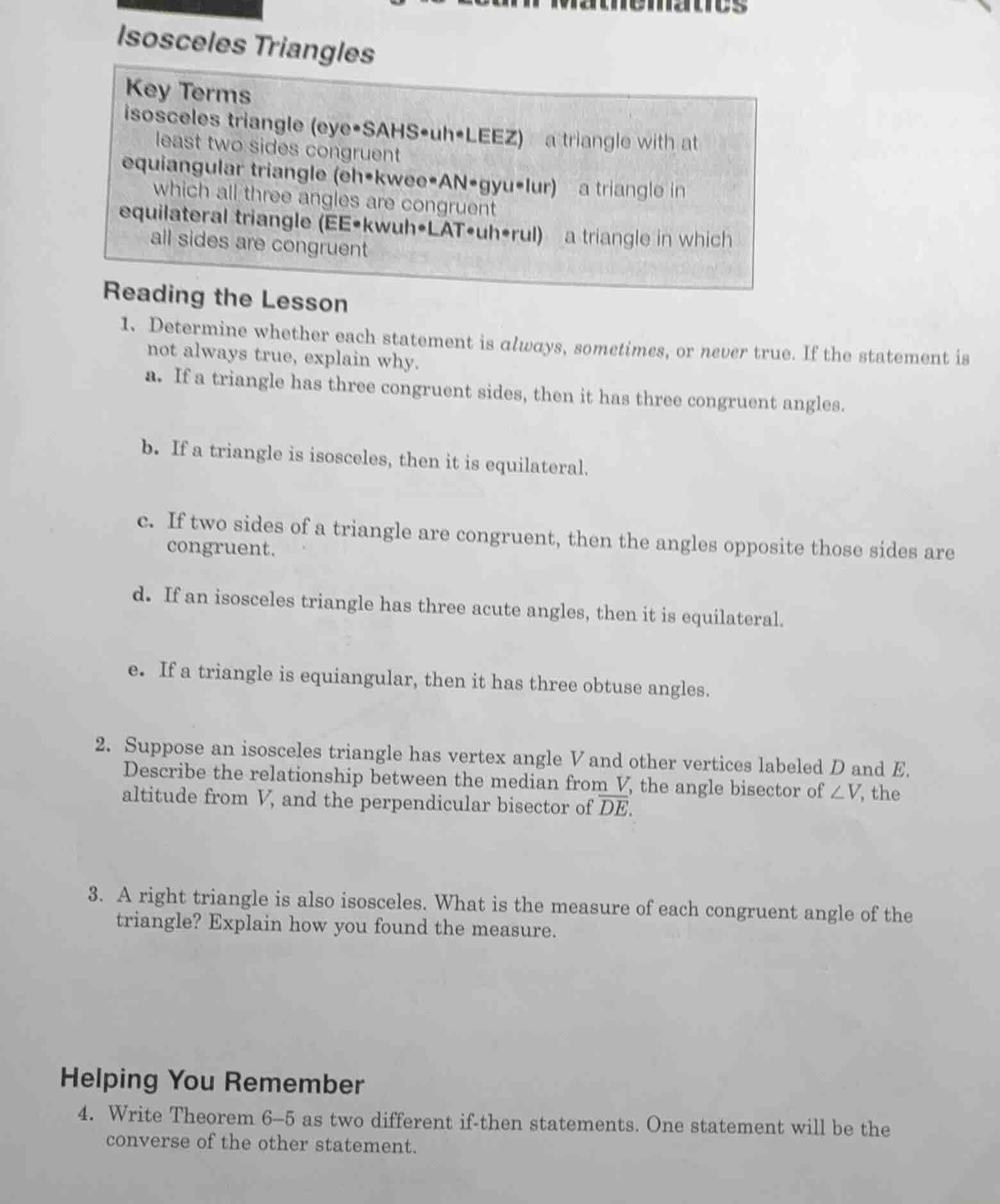
Question
isosceles triangles
key terms
isosceles triangle (eye•sahs•uh•leez) a triangle with at least two sides congruent
equiangular triangle (oh•kwee•an•gyu•lur) a triangle in which all three angles are congruent
equilateral triangle (ee•kwuh•lat•uh•rul) a triangle in which all sides are congruent
reading the lesson
- determine whether each statement is always, sometimes, or never true. if the statement is not always true, explain why.
a. if a triangle has three congruent sides, then it has three congruent angles.
b. if a triangle is isosceles, then it is equilateral.
c. if two sides of a triangle are congruent, then the angles opposite those sides are congruent.
d. if an isosceles triangle has three acute angles, then it is equilateral.
e. if a triangle is equiangular, then it has three obtuse angles.
- suppose an isosceles triangle has vertex angle ( v ) and other vertices labeled ( d ) and ( e ). describe the relationship between the median from ( v ), the angle bisector of ( angle v ), the altitude from ( v ), and the perpendicular bisector of ( overline{de} ).
- a right triangle is also isosceles. what is the measure of each congruent angle of the triangle? explain how you found the measure.
helping you remember
- write theorem 6–5 as two different if - then statements. one statement will be the converse of the other statement.
Step1: Address 1a (Always/Sometimes/Never)
An equilateral triangle (3 congruent sides) is always equiangular, so this is always true by the definition of equilateral/equiangular triangles.
Step2: Address 1b (Always/Sometimes/Never)
Isosceles triangles only need 2 congruent sides; equilateral needs 3. So this is sometimes true (only when the isosceles triangle has all 3 sides congruent).
Step3: Address 1c (Always/Sometimes/Never)
This is the Isosceles Triangle Theorem, a fundamental geometric rule, so this is always true.
Step4: Address 1d (Always/Sometimes/Never)
An isosceles triangle can have 3 acute angles without being equilateral (e.g., angles 70°, 70°, 40°). So this is sometimes true.
Step5: Address 1e (Always/Sometimes/Never)
An equiangular triangle has three 60° angles (acute, not obtuse). Obtuse angles are >90°, so this is never true.
Step6: Address Question 2
In an isosceles triangle, the median, angle bisector, altitude from the vertex angle, and perpendicular bisector of the base are the same line segment (they coincide).
Step7: Address Question 3
Sum of triangle angles is $180^\circ$. Right angle = $90^\circ$, so remaining two congruent angles sum to $180^\circ - 90^\circ = 90^\circ$. Each angle is $\frac{90^\circ}{2} = 45^\circ$.
Step8: Address Question 4
Theorem 6-5 refers to the Isosceles Triangle Theorem and its converse:
- If two sides of a triangle are congruent, then the angles opposite those sides are congruent.
- If two angles of a triangle are congruent, then the sides opposite those angles are congruent.

Snap & solve any problem in the app
Get step-by-step solutions on Sovi AI
Photo-based solutions with guided steps
Explore more problems and detailed explanations
1.
a. Always true: An equilateral triangle (3 congruent sides) is always equiangular.
b. Sometimes true: An isosceles triangle only needs 2 congruent sides, so it is only equilateral if all 3 sides are congruent.
c. Always true: This is the Isosceles Triangle Theorem.
d. Sometimes true: An isosceles triangle can have 3 acute angles (e.g., 70°, 70°, 40°) without being equilateral.
e. Never true: An equiangular triangle has three 60° acute angles, not obtuse angles.
- The median from $V$, the angle bisector of $\angle V$, the altitude from $V$, and the perpendicular bisector of $\overline{DE}$ are all the same line segment (they coincide).
- $45^\circ$. The right angle is $90^\circ$, so the remaining two congruent angles sum to $180^\circ - 90^\circ = 90^\circ$. Dividing this by 2 gives $45^\circ$ for each congruent angle.
4.
- If two sides of a triangle are congruent, then the angles opposite those sides are congruent.
- If two angles of a triangle are congruent, then the sides opposite those angles are congruent.