QUESTION IMAGE
Question
item 1
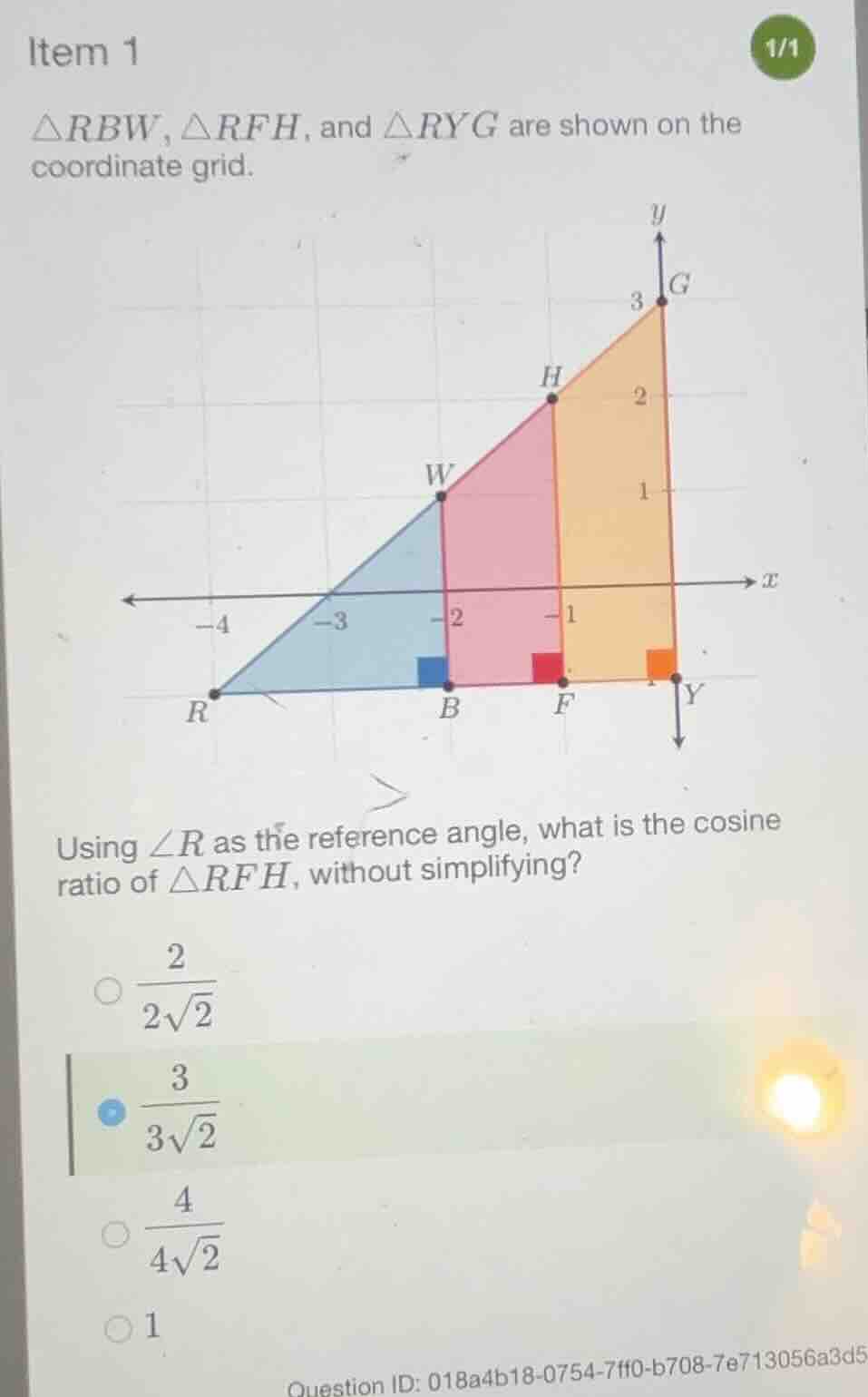
$\triangle rbw$, $\triangle rfh$, and $\triangle ryg$ are shown on the
coordinate grid.
using $\angle r$ as the reference angle, what is the cosine
ratio of $\triangle rfh$, without simplifying?
\\(\frac{2}{2\sqrt{2}}\\)
\\(\frac{3}{3\sqrt{2}}\\)
\\(\frac{4}{4\sqrt{2}}\\)
\\(1\\)
Step1: Recall cosine ratio definition
In a right triangle, the cosine of an acute angle (reference angle \( \angle R \)) is defined as the ratio of the length of the adjacent side to the length of the hypotenuse, i.e., \( \cos(\theta)=\frac{\text{Adjacent}}{\text{Hypotenuse}} \).
Step2: Identify sides for \( \triangle RFH \)
- Adjacent side to \( \angle R \): The horizontal distance from \( R \) to \( F \). From the coordinate grid, \( R \) is at some point, \( F \) is at \( x = - 1 \), and \( R \) seems to be at \( x=-4 \) (since the base length from \( R \) to \( Y \) can be inferred, but for \( \triangle RFH \), the adjacent side length: Let's check the horizontal segments. The length of \( RF \): from \( R \) to \( F \), the horizontal distance. Looking at the triangles, \( \triangle RBW \), \( \triangle RFH \), \( \triangle RYG \) are similar? Wait, for \( \triangle RFH \), the adjacent side (along the x - axis from \( R \) to \( F \)): Let's count the grid units. From \( R \) (let's assume \( R \) is at \( (-4, - 1) \) or similar, but actually, the base of \( \triangle RFH \): the horizontal leg (adjacent to \( \angle R \)): the length from \( R \) to \( F \) is \( 3 \) units? Wait, no, let's see the hypotenuse and opposite side. Wait, \( \triangle RFH \) is a right triangle with right angle at \( F \). So, the legs: vertical leg (opposite to \( \angle R \)) is the length of \( FH \), which is \( 2 \) (from \( y = - 1 \) to \( y = 1 \)? Wait, no, the coordinates: \( H \) is at \( (-1, 2) \), \( F \) is at \( (-1, - 1) \)? Wait, no, the grid: \( G \) is at \( (0,3) \), \( H \) at \( (-1,2) \), \( F \) at \( (-1, - 1) \)? Wait, maybe better to calculate the lengths.
Wait, actually, for \( \triangle RFH \), right - angled at \( F \):
- Adjacent side to \( \angle R \): \( RF \). Let's find the length of \( RF \). Let's assume \( R \) is at \( (-4, - 1) \), \( F \) is at \( (-1, - 1) \), so the length of \( RF \) is \( |-1-(-4)|=3 \).
- Opposite side: \( FH \). \( H \) is at \( (-1, 2) \), \( F \) is at \( (-1, - 1) \), so length of \( FH \) is \( |2 - (-1)| = 3 \)? Wait, no, \( H \) is at \( (-1, 2) \), \( F \) is at \( (-1, - 1) \)? Wait, the y - coordinate of \( F \): looking at the red square, \( F \) is at \( (-1, - 1) \), \( H \) is at \( (-1, 2) \), so \( FH = 3 \)? Wait, no, the original problem's options: the cosine ratio is \( \frac{3}{3\sqrt{2}} \). Let's calculate the hypotenuse of \( \triangle RFH \). Using Pythagoras, hypotenuse \( RH=\sqrt{RF^{2}+FH^{2}} \). If \( RF = 3 \) and \( FH = 3 \) (wait, no, if \( FH = 2 \), no, the option has \( 3\sqrt{2} \) as hypotenuse. Wait, if \( RF = 3 \) and \( FH = 3 \), then hypotenuse \(=\sqrt{3^{2}+3^{2}}=\sqrt{9 + 9}=\sqrt{18}=3\sqrt{2} \). Then cosine of \( \angle R \) is \( \frac{\text{Adjacent}}{\text{Hypotenuse}}=\frac{RF}{RH}=\frac{3}{3\sqrt{2}} \).
So, the adjacent side to \( \angle R \) is \( 3 \), hypotenuse is \( 3\sqrt{2} \), so \( \cos(\angle R)=\frac{3}{3\sqrt{2}} \).

Snap & solve any problem in the app
Get step-by-step solutions on Sovi AI
Photo-based solutions with guided steps
Explore more problems and detailed explanations
\(\boldsymbol{\frac{3}{3\sqrt{2}}}\) (corresponding to the option \(\frac{3}{3\sqrt{2}}\))