QUESTION IMAGE
Question
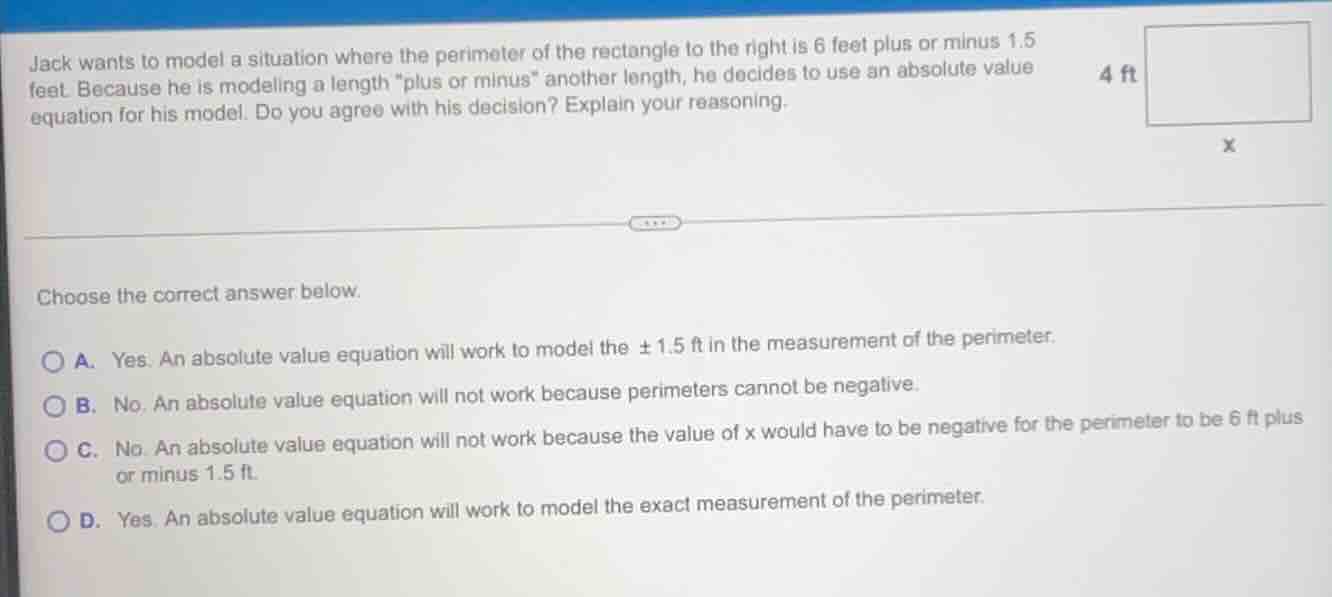
jack wants to model a situation where the perimeter of the rectangle to the right is 6 feet plus or minus 1.5 feet. because he is modeling a length \plus or minus\ another length, he decides to use an absolute value equation for his model. do you agree with his decision? explain your reasoning. choose the correct answer below. a. yes. an absolute value equation will work to model the ±1.5 ft in the measurement of the perimeter. b. no. an absolute value equation will not work because perimeters cannot be negative. c. no. an absolute value equation will not work because the value of x would have to be negative for the perimeter to be 6 ft plus or minus 1.5 ft. d. yes. an absolute value equation will work to model the exact measurement of the perimeter.
Absolute value equations are used to model situations where a quantity deviates by a fixed amount from a target value, which matches the "plus or minus 1.5 feet" deviation from the 6-foot perimeter. The perimeter itself being non-negative does not invalidate the absolute value model, as the equation will only yield valid positive perimeter values. Option B is incorrect because absolute value equations do not produce negative perimeters here. Option C is incorrect because solving the equation will give valid positive values for x. Option D is incorrect because the model accounts for the deviation, not just the exact measurement.

Snap & solve any problem in the app
Get step-by-step solutions on Sovi AI
Photo-based solutions with guided steps
Explore more problems and detailed explanations
A. Yes. An absolute value equation will work to model the ± 1.5 ft in the measurement of the perimeter.