QUESTION IMAGE
Question
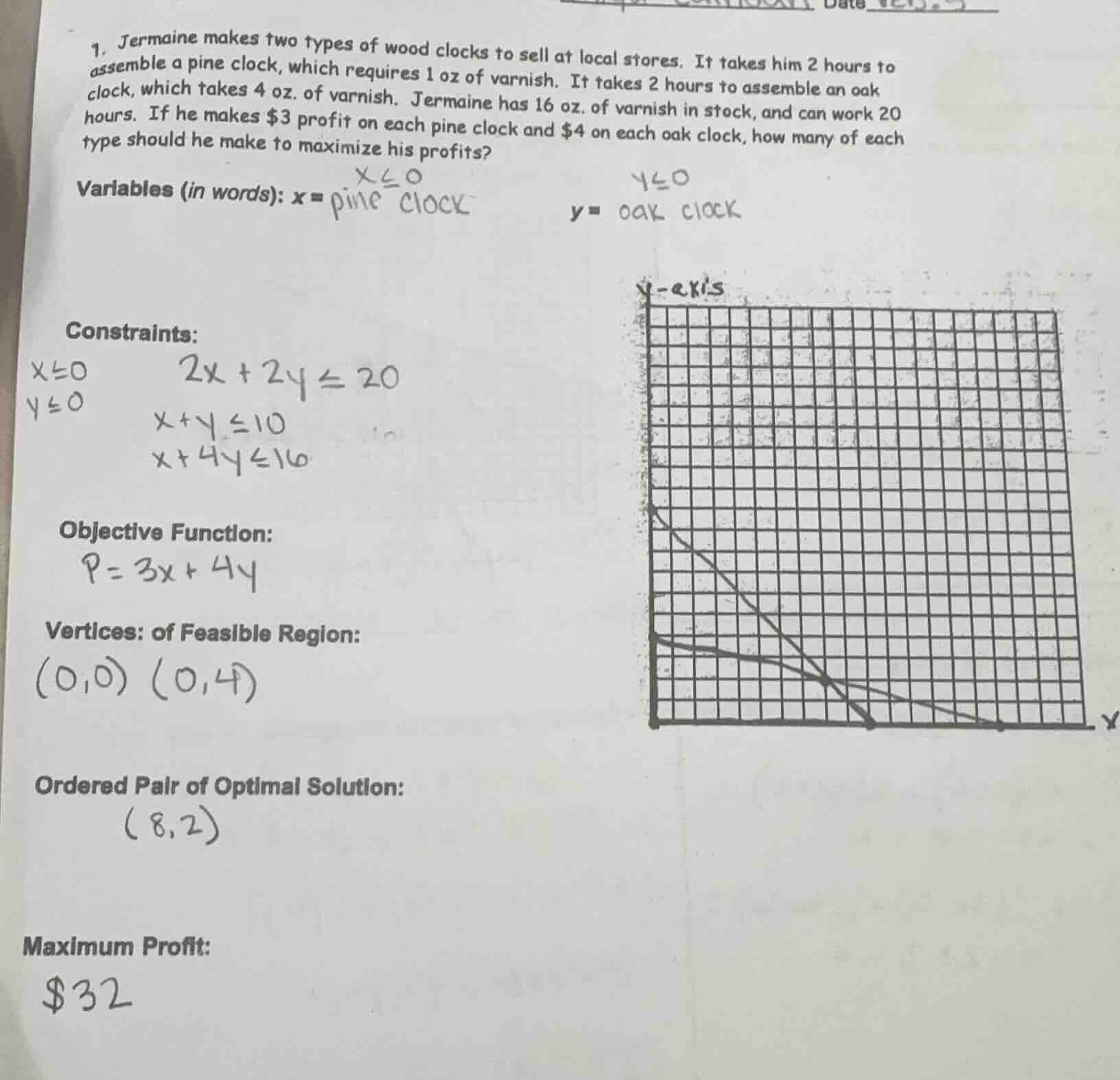
- jermaine makes two types of wood clocks to sell at local stores. it takes him 2 hours to assemble a pine clock, which requires 1 oz of varnish. it takes 2 hours to assemble an oak clock, which takes 4 oz. of varnish. jermaine has 16 oz. of varnish in stock, and can work 20 hours. if he makes $3 profit on each pine clock and $4 on each oak clock, how many of each type should he make to maximize his profits?
variables (in words): x = pine clock y = oak clock
constraints:
x ≥ 0 2x + 2y ≤ 20
y ≥ 0 x + y ≤ 10
x + 4y ≤ 16
objective function:
p = 3x + 4y
vertices: of feasible region:
(0,0) (0,4)
ordered pair of optimal solution:
(8,2)
maximum profit:
$32
Step1: List all feasible vertices
Feasible vertices: $(0,0)$, $(0,4)$, $(8,2)$, $(10,0)$
Step2: Calculate profit for (0,0)
Substitute into $P=3x+4y$:
$P=3(0)+4(0)=0$
Step3: Calculate profit for (0,4)
Substitute into $P=3x+4y$:
$P=3(0)+4(4)=16$
Step4: Calculate profit for (8,2)
Substitute into $P=3x+4y$:
$P=3(8)+4(2)=24+8=32$
Step5: Calculate profit for (10,0)
Substitute into $P=3x+4y$:
$P=3(10)+4(0)=30$
Step6: Identify maximum profit
Compare all profit values: $0, 16, 32, 30$

Snap & solve any problem in the app
Get step-by-step solutions on Sovi AI
Photo-based solutions with guided steps
Explore more problems and detailed explanations
Jermaine should make 8 pine clocks and 2 oak clocks to maximize his profit of $\$32$.