QUESTION IMAGE
Question
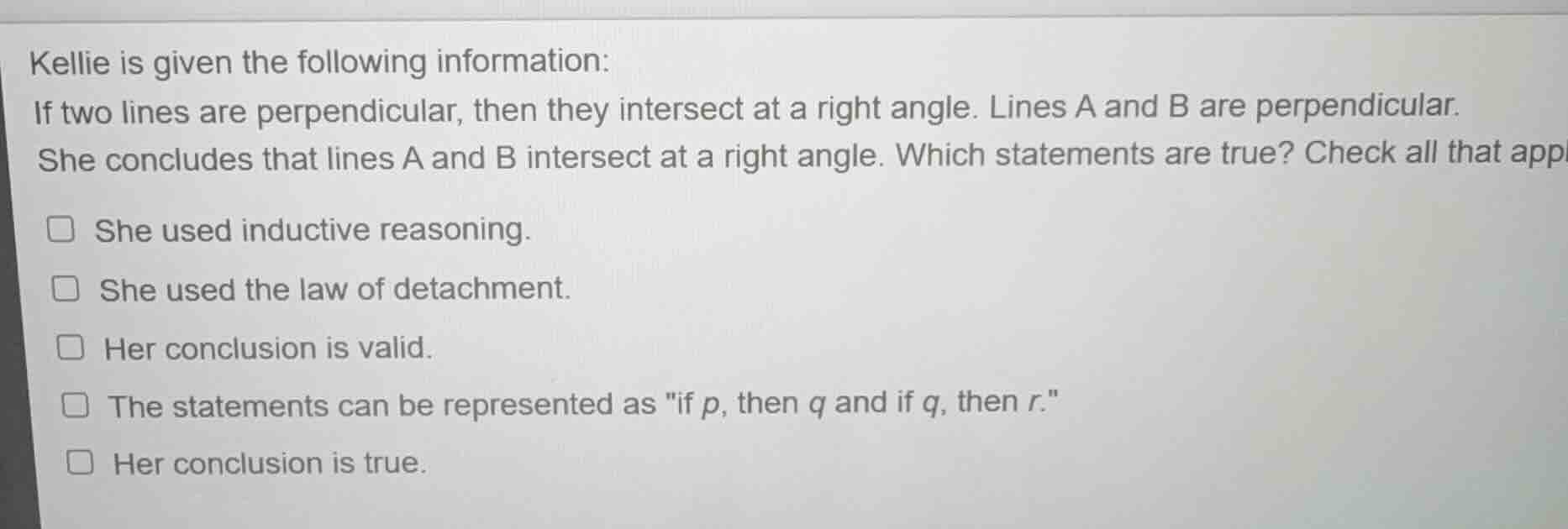
kellie is given the following information:
if two lines are perpendicular, then they intersect at a right angle. lines a and b are perpendicular.
she concludes that lines a and b intersect at a right angle. which statements are true? check all that apply
□ she used inductive reasoning.
□ she used the law of detachment.
□ her conclusion is valid.
□ the statements can be represented as \if p, then q and if q, then r.\
□ her conclusion is true.
Brief Explanations
- Inductive reasoning uses specific observations to make general conclusions, which is not the case here.
- The law of detachment (modus ponens) follows the structure: If p, then q; p is true; therefore q is true. This matches Kellie's reasoning (p: two lines are perpendicular, q: they intersect at a right angle; p is true for lines A and B, so q is concluded).
- Since she correctly applied a valid logical rule, her conclusion is valid.
- The given statements do not follow "if p, then q and if q, then r" (this is the law of syllogism structure), so this is false.
- The original conditional is a definition of perpendicular lines, so if lines A and B are perpendicular, the conclusion that they intersect at a right angle is factually true.

Snap & solve any problem in the app
Get step-by-step solutions on Sovi AI
Photo-based solutions with guided steps
Explore more problems and detailed explanations
- She used the law of detachment.
- Her conclusion is valid.
- Her conclusion is true.