QUESTION IMAGE
Question
kinetic and potential energy
kinetic energy is the energy of motion and is affected by the mass and speed of an object.
potential energy is the energy stored in an object based on its position and is affected by the
mass of the object and its height in relation to a surface. a student investigates potential and
kinetic energy by performing three investigations using a car, a ramp, and a box. in each
investigation, a car is rolled down a ramp into a box, and the student observes how far the box
moves.
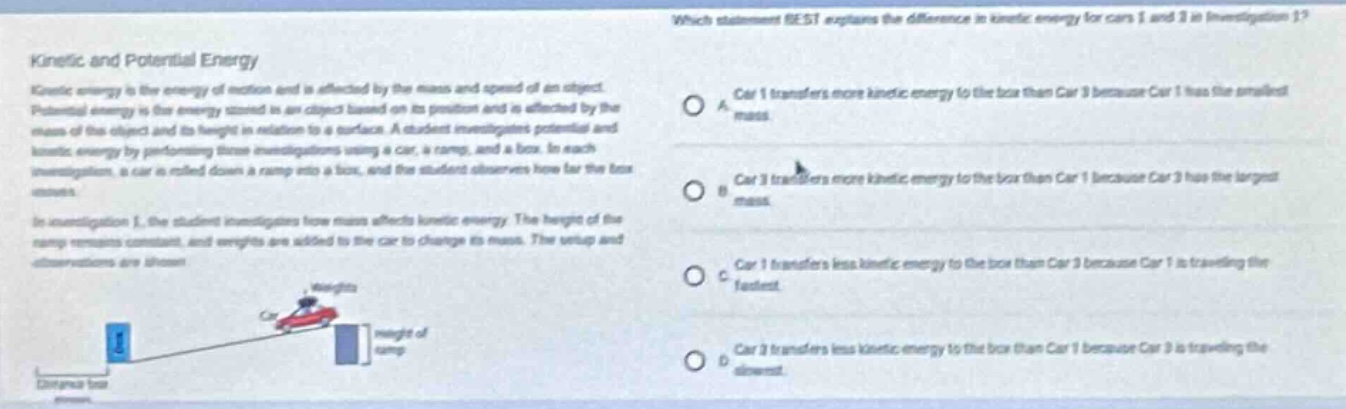
in investigation 1, the student investigates how mass affects kinetic energy. the height of the
ramp remains constant, and weights are added to the car to change its mass. the setup and
observations are shown
which statement best explains the difference in kinetic energy for cars 1 and 3 in investigation 1?
a. car 1 transfers more kinetic energy to the box than car 3 because car 1 has the smallest
mass.
b. car 3 transfers more kinetic energy to the box than car 1 because car 3 has the largest
mass.
c. car 1 transfers less kinetic energy to the box than car 3 because car 1 is traveling the
fastest.
d. car 3 transfers less kinetic energy to the box than car 1 because car 3 is traveling the
slowest.
To determine the correct statement, we use the concept of kinetic energy (\(KE = \frac{1}{2}mv^2\)), where \(m\) is mass and \(v\) is speed. In Investigation 1, the height of the ramp is constant, so the speed of the car (when it hits the box) depends on the height (which is constant here), meaning speed is the same for both cars. Kinetic energy depends on mass (since speed is constant). A larger mass means more kinetic energy. So Car 3 (with larger mass) transfers more kinetic energy to the box than Car 1.
- Option A: Incorrect. Smaller mass means less KE transfer, not more.
- Option B: Correct. Larger mass (with same speed) means more KE, so more transfer.
- Option C: Incorrect. Speed is same (ramp height constant), so Car 1 isn’t traveling fastest.
- Option D: Incorrect. Speed is same, and larger mass (Car 3) has more KE, so it transfers more, not less.

Snap & solve any problem in the app
Get step-by-step solutions on Sovi AI
Photo-based solutions with guided steps
Explore more problems and detailed explanations
B. Car 3 transfers more kinetic energy to the box than Car 1 because Car 3 has the largest mass.