QUESTION IMAGE
Question
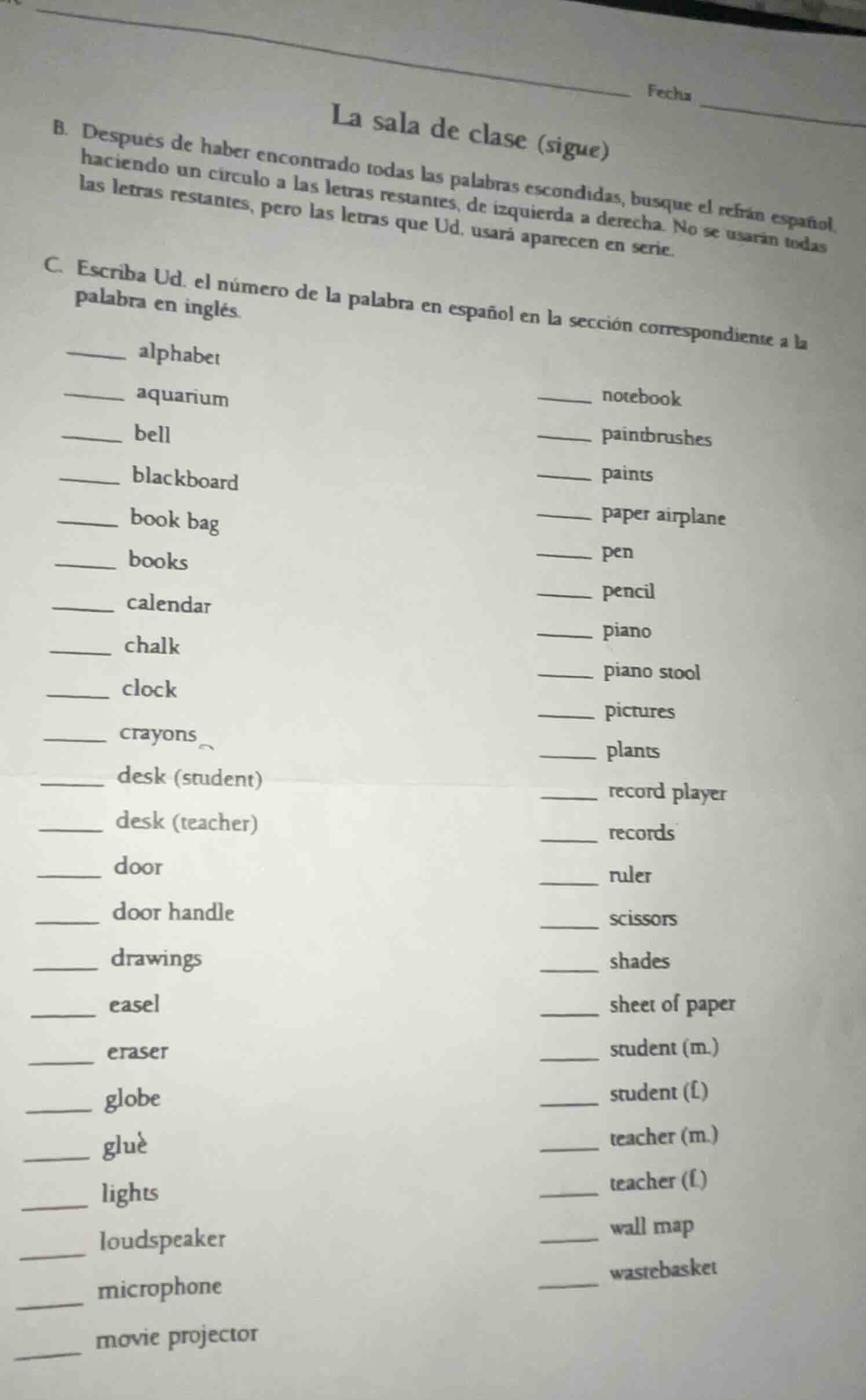
la sala de clase (sigue)
b. después de haber encontrado todas las palabras escondidas, busque el refrán español, haciendo un círculo a las letras restantes, de izquierda a derecha. no se usarán todas las letras restantes, pero las letras que ud. usará aparecen en serie.
c. escriba ud. el número de la palabra en español en la sección correspondiente a la palabra en inglés.
_____ alphabet
_____ aquarium
_____ bell
_____ blackboard
_____ book bag
_____ books
_____ calendar
_____ chalk
_____ clock
_____ crayons
_____ desk (student)
_____ desk (teacher)
_____ door
_____ door handle
_____ drawings
_____ easel
_____ eraser
_____ globe
_____ glue
_____ lights
_____ loudspeaker
_____ microphone
_____ movie projector
_____ notebook
_____ paintbrushes
_____ paints
_____ paper airplane
_____ pen
_____ pencil
_____ piano
_____ piano stool
_____ pictures
_____ plants
_____ record player
_____ records
_____ ruler
_____ scissors
_____ shades
_____ sheet of paper
_____ student (m.)
_____ student (f.)
_____ teacher (m.)
_____ teacher (f.)
_____ wall map
_____ wastebasket
To solve part C, we need to know the Spanish translations of each English word and then match them. Here are some common translations:
- alphabet: el abecedario
- aquarium: el acuario
- bell: la campana
- blackboard: la pizarra
- book bag: el bolso de libros
- books: los libros
- calendar: el calendario
- chalk: la tiza
- clock: el reloj
- crayons: los crayones (or los lápices de colores)
- desk (student): el pupitre (del estudiante)
- desk (teacher): el escritorio (del profesor/a)
- door: la puerta
- door handle: la manija de la puerta
- drawings: los dibujos
- easel: el caballete
- eraser: el borrador
- globe: el globo terráqueo
- glue: el pegamento
- lights: las luces
- loudspeaker: el altavoz
- microphone: el micrófono
- movie projector: el proyector de cine
- notebook: el cuaderno
- paintbrushes: los pinceles
- paints: las pinturas
- paper airplane: el avión de papel
- pen: la pluma (or el bolígrafo)
- pencil: el lápiz
- piano: el piano
- piano stool: el taburete del piano
- pictures: las fotografías (or los retratos)
- plants: las plantas
- record player: el tocadiscos
- records: los discos (de vinilo)
- ruler: la regla
- scissors: las tijeras
- shades: las persianas
- sheet of paper: la hoja de papel
- student (m.): el estudiante
- student (f.): la estudiante
- teacher (m.): el profesor
- teacher (f.): la profesora
- wall map: el mapa de pared
- wastebasket: el papelera (or el cubo de basura)
For example, if we take "notebook", its Spanish translation is el cuaderno, so we would write the number corresponding to el cuaderno (from the Spanish word list, which is not fully visible here, but assuming a typical list, e.g., if el cuaderno is numbered "5", we’d write "5" next to "notebook").
Since the exact numbering of Spanish words isn’t provided in the image, we assume a standard classroom vocabulary list. For illustration, let’s use common numbering:
- el abecedario (alphabet)
- el acuario (aquarium)
- la campana (bell)
- la pizarra (blackboard)
- el bolso de libros (book bag)
- los libros (books)
- el calendario (calendar)
- la tiza (chalk)
- el reloj (clock)
- los crayones (crayons)
- el pupitre (desk - student)
- el escritorio (desk - teacher)
- la puerta (door)
- la manija de la puerta (door handle)
- los dibujos (drawings)
- el caballete (easel)
- el borrador (eraser)
- el globo terráqueo (globe)
- el pegamento (glue)
- las luces (lights)
- el altavoz (loudspeaker)
- el micrófono (microphone)
- el proyector de cine (movie projector)
- el cuaderno (notebook)
- los pinceles (paintbrushes)
- las pinturas (paints)
- el avión de papel (paper airplane)
- la pluma (pen)
- el lápiz (pencil)
- el piano (piano)
- el taburete del piano (piano stool)
- las fotografías (pictures)
- las plantas (plants)
- el tocadiscos (record player)
- los discos (records)
- la regla (ruler)
- las tijeras (scissors)
- las persianas (shades)
- la hoja de papel (sheet of paper)
- el estudiante (student - m.)
- la estudiante (student - f.)
- el profesor (teacher - m.)
- la profesora (teacher - f.)
- el mapa de pared (wall map)
- la papelera (wastebasket)
So, for "notebook" (English), we match it to el cuaderno…

Snap & solve any problem in the app
Get step-by-step solutions on Sovi AI
Photo-based solutions with guided steps
Explore more problems and detailed explanations
To solve part C, we need to know the Spanish translations of each English word and then match them. Here are some common translations:
- alphabet: el abecedario
- aquarium: el acuario
- bell: la campana
- blackboard: la pizarra
- book bag: el bolso de libros
- books: los libros
- calendar: el calendario
- chalk: la tiza
- clock: el reloj
- crayons: los crayones (or los lápices de colores)
- desk (student): el pupitre (del estudiante)
- desk (teacher): el escritorio (del profesor/a)
- door: la puerta
- door handle: la manija de la puerta
- drawings: los dibujos
- easel: el caballete
- eraser: el borrador
- globe: el globo terráqueo
- glue: el pegamento
- lights: las luces
- loudspeaker: el altavoz
- microphone: el micrófono
- movie projector: el proyector de cine
- notebook: el cuaderno
- paintbrushes: los pinceles
- paints: las pinturas
- paper airplane: el avión de papel
- pen: la pluma (or el bolígrafo)
- pencil: el lápiz
- piano: el piano
- piano stool: el taburete del piano
- pictures: las fotografías (or los retratos)
- plants: las plantas
- record player: el tocadiscos
- records: los discos (de vinilo)
- ruler: la regla
- scissors: las tijeras
- shades: las persianas
- sheet of paper: la hoja de papel
- student (m.): el estudiante
- student (f.): la estudiante
- teacher (m.): el profesor
- teacher (f.): la profesora
- wall map: el mapa de pared
- wastebasket: el papelera (or el cubo de basura)
For example, if we take "notebook", its Spanish translation is el cuaderno, so we would write the number corresponding to el cuaderno (from the Spanish word list, which is not fully visible here, but assuming a typical list, e.g., if el cuaderno is numbered "5", we’d write "5" next to "notebook").
Since the exact numbering of Spanish words isn’t provided in the image, we assume a standard classroom vocabulary list. For illustration, let’s use common numbering:
- el abecedario (alphabet)
- el acuario (aquarium)
- la campana (bell)
- la pizarra (blackboard)
- el bolso de libros (book bag)
- los libros (books)
- el calendario (calendar)
- la tiza (chalk)
- el reloj (clock)
- los crayones (crayons)
- el pupitre (desk - student)
- el escritorio (desk - teacher)
- la puerta (door)
- la manija de la puerta (door handle)
- los dibujos (drawings)
- el caballete (easel)
- el borrador (eraser)
- el globo terráqueo (globe)
- el pegamento (glue)
- las luces (lights)
- el altavoz (loudspeaker)
- el micrófono (microphone)
- el proyector de cine (movie projector)
- el cuaderno (notebook)
- los pinceles (paintbrushes)
- las pinturas (paints)
- el avión de papel (paper airplane)
- la pluma (pen)
- el lápiz (pencil)
- el piano (piano)
- el taburete del piano (piano stool)
- las fotografías (pictures)
- las plantas (plants)
- el tocadiscos (record player)
- los discos (records)
- la regla (ruler)
- las tijeras (scissors)
- las persianas (shades)
- la hoja de papel (sheet of paper)
- el estudiante (student - m.)
- la estudiante (student - f.)
- el profesor (teacher - m.)
- la profesora (teacher - f.)
- el mapa de pared (wall map)
- la papelera (wastebasket)
So, for "notebook" (English), we match it to el cuaderno (Spanish), which we numbered as "24" here. Thus, we’d write "24" next to "notebook".
(Note: The exact numbering depends on the specific Spanish word list provided in the original activity, but this follows typical classroom vocabulary numbering.)