QUESTION IMAGE
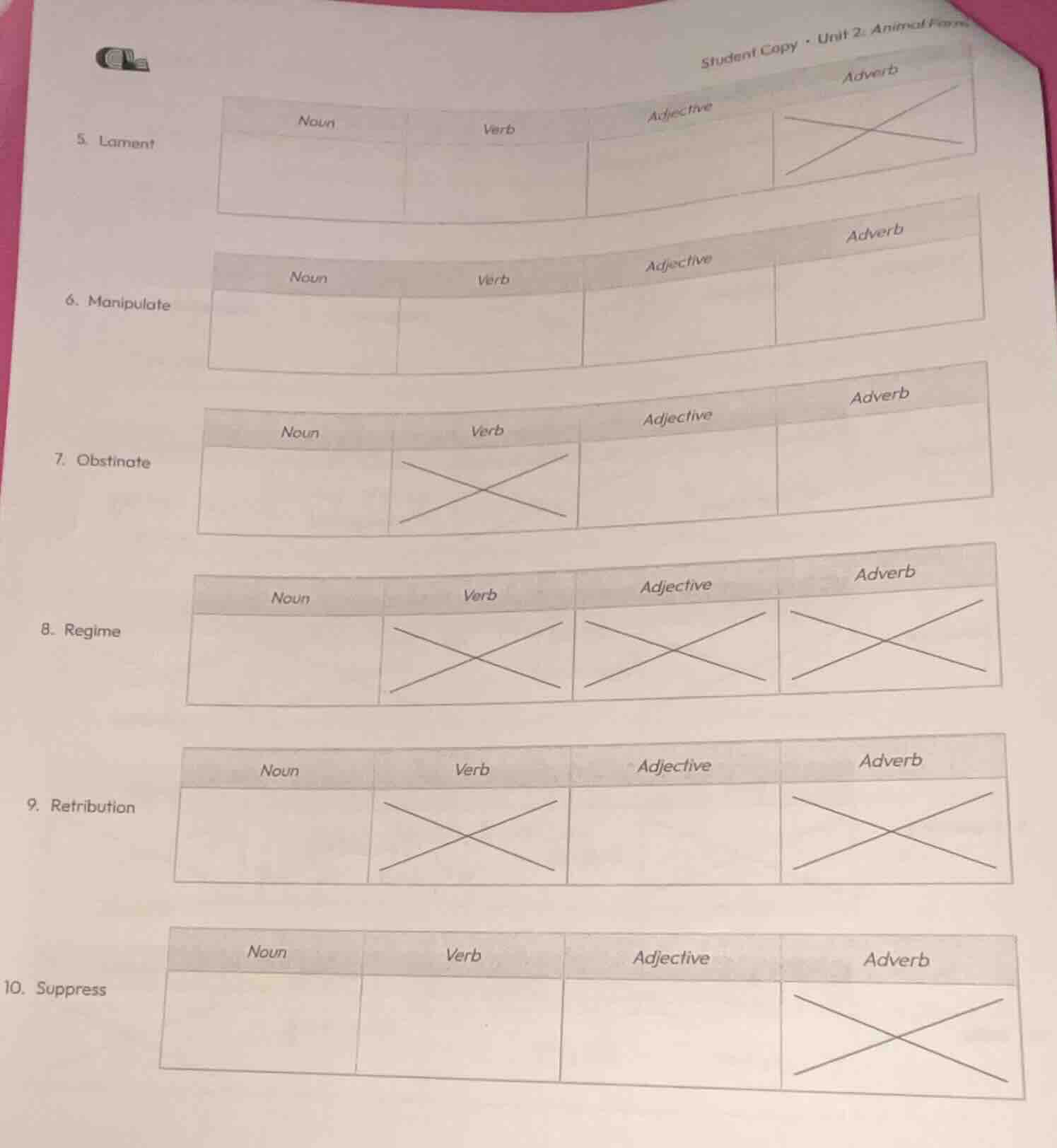
Question
- lament
noun verb adjective adverb
- manipulate
noun verb adjective adverb
- obstinate
noun verb adjective adverb
- regime
noun verb adjective adverb
- retribution
noun verb adjective adverb
- suppress
noun verb adjective adverb
Response
Question 5: Lament
Brief Explanations
- Noun: "Lament" can be a noun, referring to an expression of grief or sorrow (e.g., "His lament was heartfelt").
- Verb: "Lament" is also a verb, meaning to express sorrow or regret (e.g., "She lamented the loss").
- Adjective: There is no common adjectival form of "lament" (so the cell is empty or marked with a cross if needed, but in standard usage, it’s not an adjective).
- Adverb: No adverbial form (crossed out as per the table’s design).
Brief Explanations
- Noun: The noun form is "Manipulation" (e.g., "His manipulation of the data was unethical"), but the base word "Manipulate" is not a noun, so the noun cell would have "Manipulation" (or note the base word isn’t a noun, but if using the base, it’s not a noun; however, the task might expect the base word’s parts of speech, so "Manipulate" is a verb, noun form is derivative).
- Verb: "Manipulate" is a verb (e.g., "She manipulated the controls").
- Adjective: No common adjectival form of "Manipulate" (empty).
- Adverb: No adverbial form (empty).
Brief Explanations
- Noun: The noun form is "Obstinacy" (e.g., "His obstinacy was frustrating"), or "Obstinate" is not a noun (base word is adjective).
- Verb: "Obstinate" is not a verb (crossed out as per the table’s X).
- Adjective: "Obstinate" is an adjective, meaning stubborn (e.g., "He is obstinate").
- Adverb: The adverb form is "Obstinately" (e.g., "He refused obstinately").

Snap & solve any problem in the app
Get step-by-step solutions on Sovi AI
Photo-based solutions with guided steps
Explore more problems and detailed explanations
(Filled Table for Lament):
| Noun | Verb | Adjective | Adverb |
|---|