QUESTION IMAGE
Question
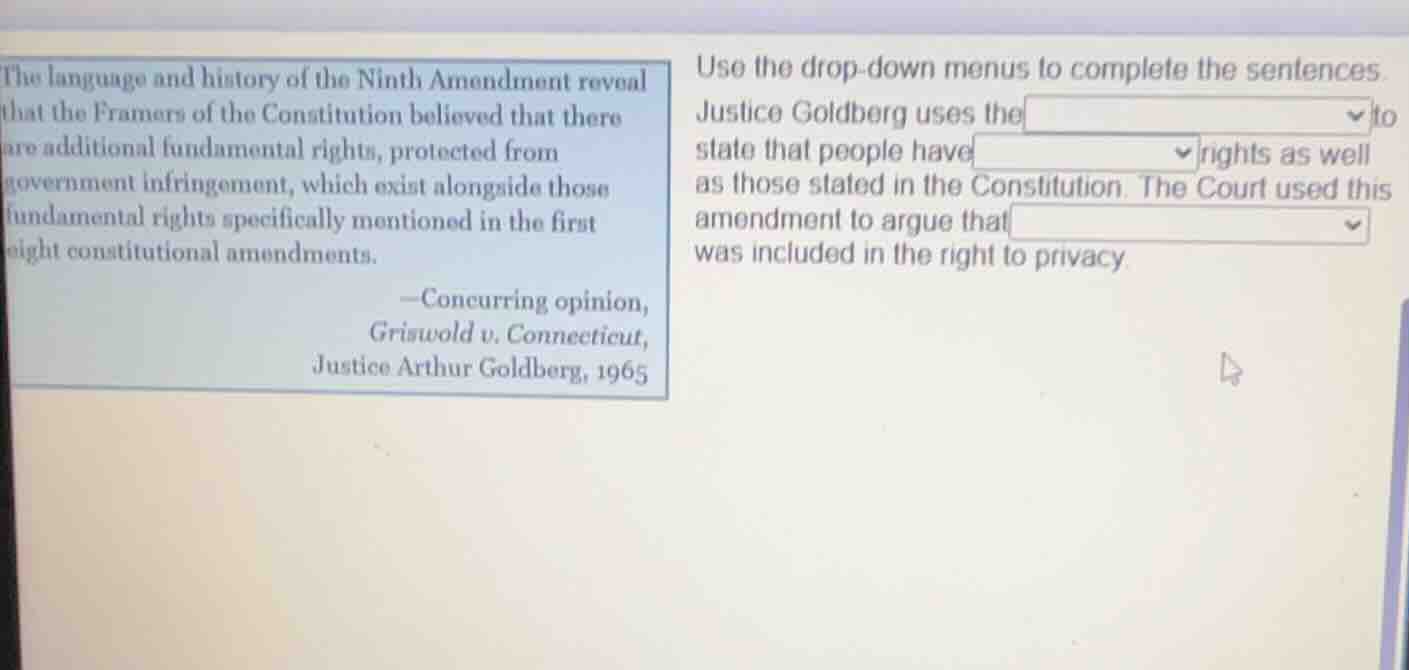
the language and history of the ninth amendment reveal that the framers of the constitution believed that there are additional fundamental rights, protected from government infringement, which exist alongside those fundamental rights specifically mentioned in the first eight constitutional amendments.
—concurring opinion,
griswold v. connecticut,
justice arthur goldberg, 1965
use the drop - down menus to complete the sentences.
justice goldberg uses the
to state that people have
rights as well as those stated in the constitution. the court used this amendment to argue that
was included in the right to privacy.
- For the first blank: Justice Goldberg used the Ninth Amendment (from the provided concurring opinion context) to support the idea of additional fundamental rights.
- For the second blank: The text says there are "additional fundamental rights" alongside those in the first eight amendments, so "fundamental" (or "additional fundamental") fits as people have rights beyond those stated (implied by the Ninth Amendment's intent).
- For the third blank: In Griswold v. Connecticut, the right to privacy was linked to marital privacy, and the First Amendment (or more contextually, the Ninth Amendment's support for unenumerated rights) was used, but a common right included in privacy here is "marital privacy" (or related, like the right to use contraception, but in the context of the case and amendments, the Ninth Amendment's argument about unenumerated rights led to including rights like marital privacy in the right to privacy; also, the First Amendment's freedom of association or other, but more accurately, the Ninth Amendment's basis for unenumerated rights, and in Griswold, the right to marital privacy (or the right to use contraception) was part of privacy. However, based on the drop - down likely options (common in such questions), the first blank is "Ninth Amendment", second is "fundamental (additional)" (or "unenumerated"), third is "marital privacy" (or "the right to use contraception", but in the context of the case and the amendments, the Ninth Amendment is the key here for the first blank, second is "fundamental" (since the Framers believed in additional fundamental rights), and third is something like "the right to marital privacy" (or "the right to use contraception" which was the issue in Griswold).

Snap & solve any problem in the app
Get step-by-step solutions on Sovi AI
Photo-based solutions with guided steps
Explore more problems and detailed explanations
- First drop - down: Ninth Amendment
- Second drop - down: fundamental (or additional fundamental)
- Third drop - down: marital privacy (or the right to use contraception, depending on standard options for Griswold v. Connecticut and the Ninth Amendment's application)
(Note: Since the drop - down options aren't fully visible, these are the most logical answers based on the case (Griswold v. Connecticut) and the provided concurring opinion text. The first blank is the Ninth Amendment (from the left text), the second is about "fundamental" (or "additional") rights, and the third is a right included in privacy like marital privacy (related to the case's issue of contraception in marriage, which was part of the right to privacy argument).)