QUESTION IMAGE
Question
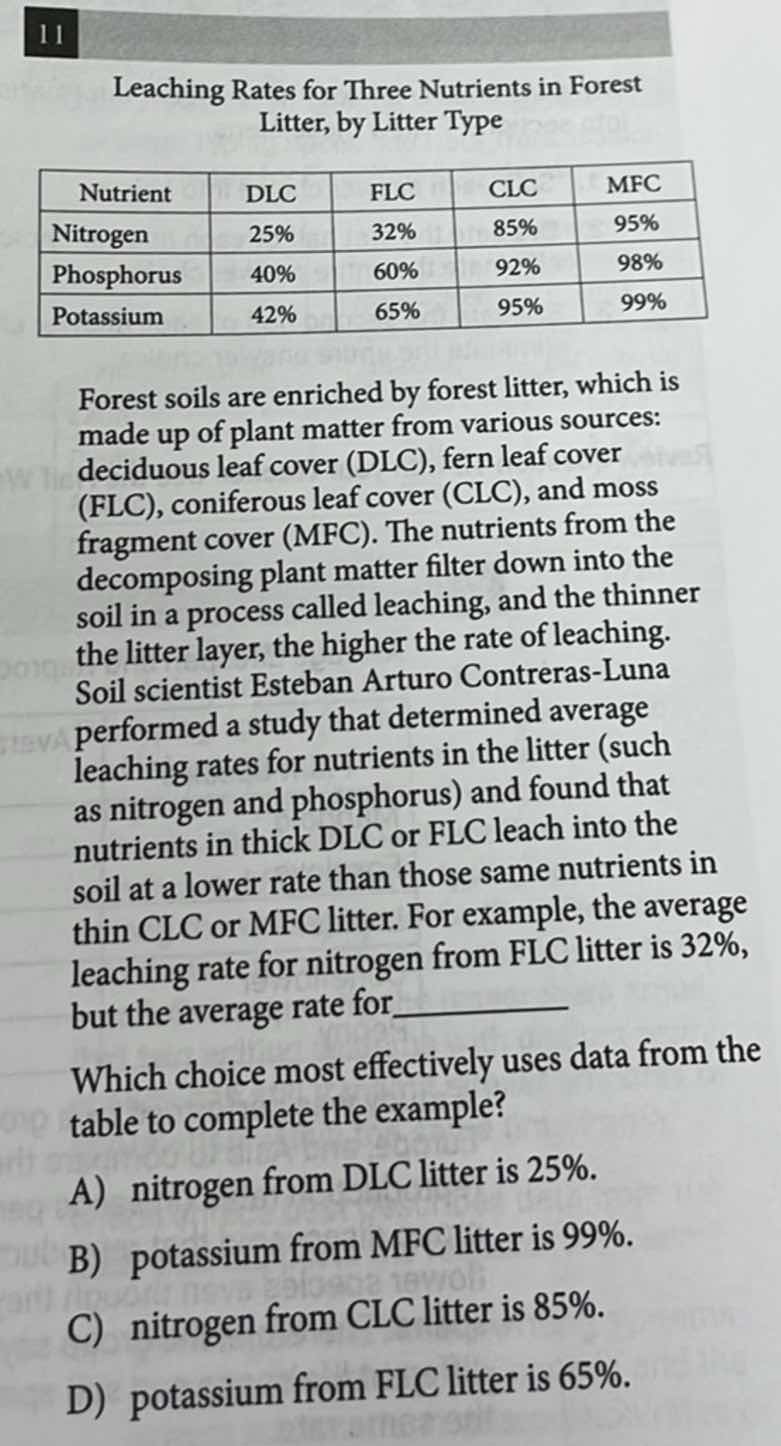
leaching rates for three nutrients in forest litter, by litter type
nutrient\tdlc\tflc\tclc\tmfc
nitrogen\t25%\t32%\t85%\t95%
phosphorus\t40%\t60%\t92%\t98%
potassium\t42%\t65%\t95%\t99%
forest soils are enriched by forest litter, which is made up of plant matter from various sources: deciduous leaf cover (dlc), fern leaf cover (flc), coniferous leaf cover (clc), and moss fragment cover (mfc). the nutrients from the decomposing plant matter filter down into the soil in a process called leaching, and the thinner the litter layer, the higher the rate of leaching. soil scientist esteban arturo contreras-luna performed a study that determined average leaching rates for nutrients in the litter (such as nitrogen and phosphorus) and found that nutrients in thick dlc or flc leach into the soil at a lower rate than those same nutrients in thin clc or mfc litter. for example, the average leaching rate for nitrogen from flc litter is 32%, but the average rate for_________
which choice most effectively uses data from the table to complete the example?
a) nitrogen from dlc litter is 25%.
b) potassium from mfc litter is 99%.
c) nitrogen from clc litter is 85%.
d) potassium from flc litter is 65%.
The example aims to contrast the lower leaching rate of nutrients in thick litter (like FLC) with the higher rate in thin litter (CLC or MFC). The given example uses nitrogen from FLC (32%), so we need to pair it with nitrogen from a thin litter type (CLC or MFC) to show the higher rate. Option C provides nitrogen from CLC litter (85%), which directly follows the study's finding that thin CLC has a higher leaching rate than thick FLC for the same nutrient.

Snap & solve any problem in the app
Get step-by-step solutions on Sovi AI
Photo-based solutions with guided steps
Explore more problems and detailed explanations
C) nitrogen from CLC litter is 85%.