QUESTION IMAGE
Question
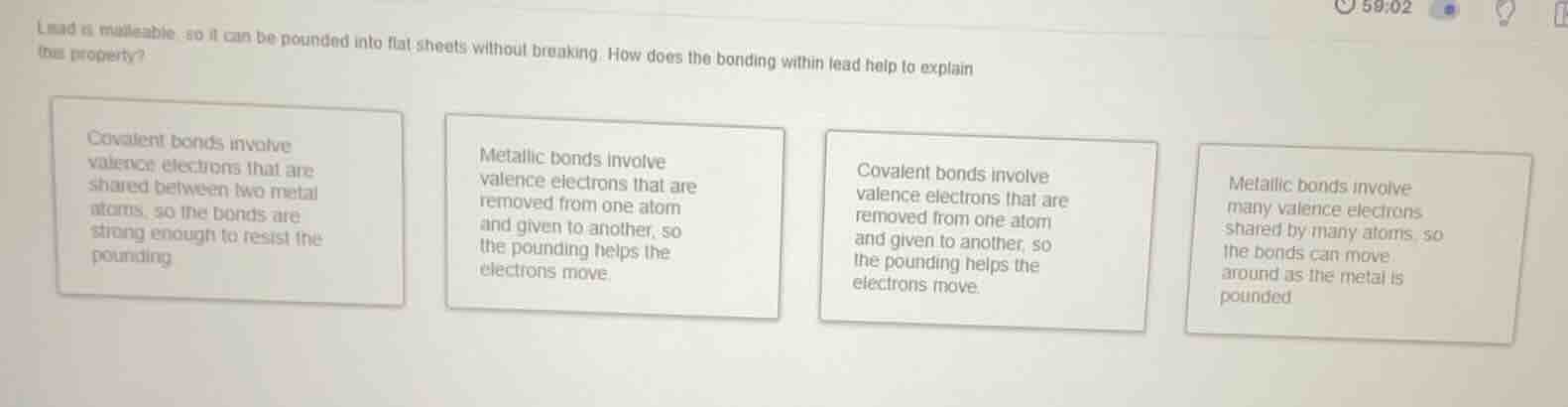
lead is malleable, so it can be pounded into flat sheets without breaking. how does the bonding within lead help to explain this property?
covalent bonds involve valence electrons that are shared between two metal atoms, so the bonds are strong enough to resist the pounding
metallic bonds involve valence electrons that are removed from one atom and given to another, so the pounding helps the electrons move
covalent bonds involve valence electrons that are removed from one atom and given to another, so the pounding helps the electrons move
metallic bonds involve many valence electrons shared by many atoms, so the bonds can move around as the metal is pounded

Snap & solve any problem in the app
Get step-by-step solutions on Sovi AI
Photo-based solutions with guided steps
Explore more problems and detailed explanations
Metallic bonds involve many valence electrons shared by many atoms, so the bonds can move around as the metal is pounded