QUESTION IMAGE
Question
lesson 12: systems of equations
cool down: milkshakes, revisited
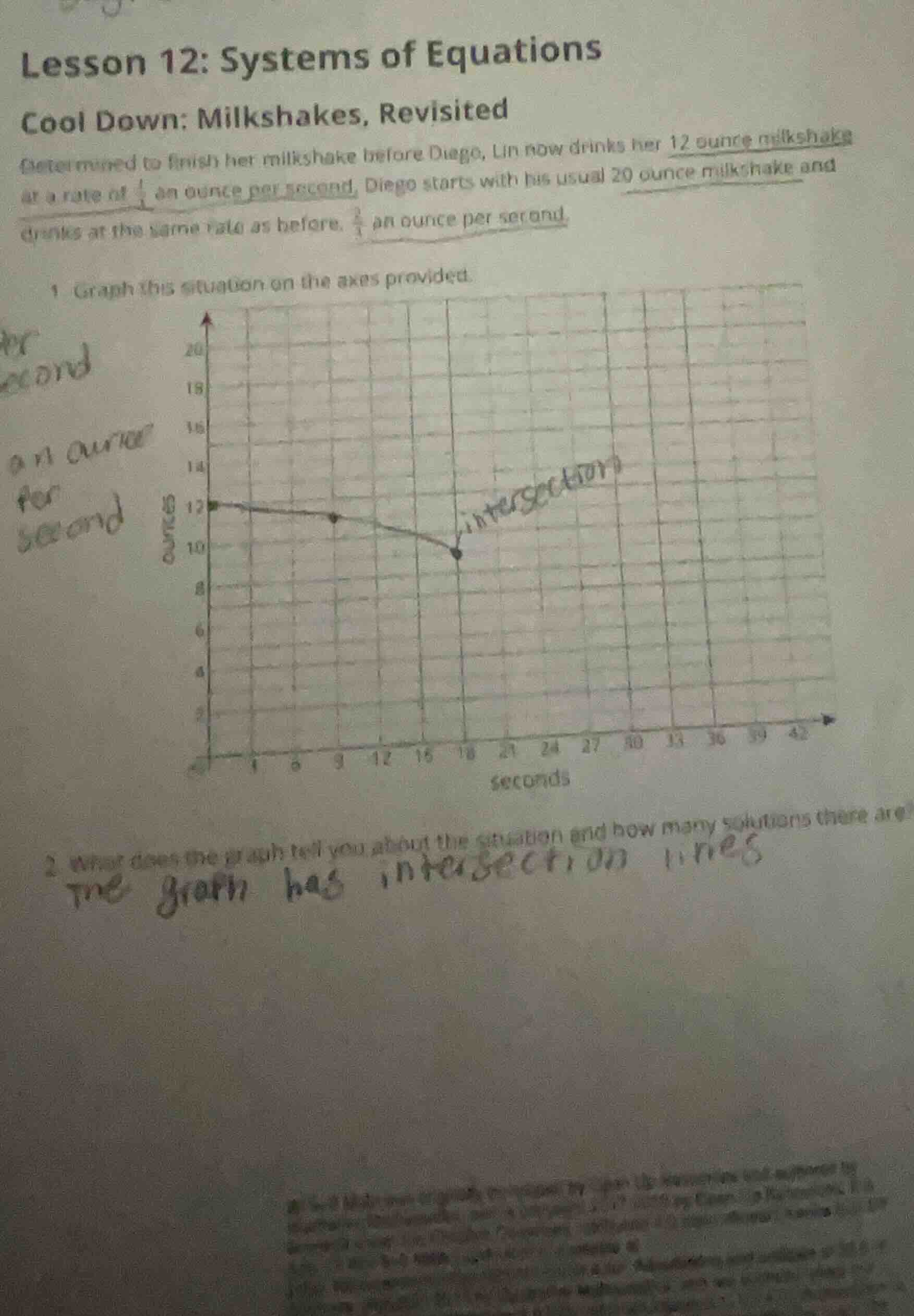
determined to finish her milkshake before diego, lin now drinks her 12 ounce milkshake at a rate of \\(\frac{1}{3}\\) an ounce per second. diego starts with his usual 20 ounce milkshake and drinks at the same rate as before, \\(\frac{2}{3}\\) an ounce per second.
- graph this situation on the axes provided.
- what does the graph tell you about the situation and how many solutions there are?
Problem 1: Graphing the Situation
To graph the situation, we first define the equations for the amount of milkshake remaining for Lin and Diego over time \( t \) (in seconds).
Lin's Milkshake:
- Initial amount: \( 12 \) ounces
- Drinking rate: \( \frac{1}{3} \) ounce per second
- Equation: \( L(t) = 12 - \frac{1}{3}t \)
Diego's Milkshake:
- Initial amount: \( 20 \) ounces
- Drinking rate: \( \frac{2}{3} \) ounce per second
- Equation: \( D(t) = 20 - \frac{2}{3}t \)
Step 1: Identify Key Points for Lin
- At \( t = 0 \), \( L(0) = 12 \) (y-intercept)
- When \( L(t) = 0 \), \( 12 - \frac{1}{3}t = 0 \Rightarrow t = 36 \) (x-intercept)
Step 2: Identify Key Points for Diego
- At \( t = 0 \), \( D(0) = 20 \) (y-intercept)
- When \( D(t) = 0 \), \( 20 - \frac{2}{3}t = 0 \Rightarrow t = 30 \) (x-intercept)
Step 3: Plot the Lines
- For Lin: Plot \( (0, 12) \) and \( (36, 0) \), then draw the line.
- For Diego: Plot \( (0, 20) \) and \( (30, 0) \), then draw the line.
Problem 2: Interpreting the Graph
The graph shows two lines representing the remaining milkshake for Lin and Diego over time. The intersection point of these lines represents the time when both have the same amount of milkshake left.
To find the number of solutions, we solve the system of equations:
\[
\]
Set \( L(t) = D(t) \):
\[
12 - \frac{1}{3}t = 20 - \frac{2}{3}t
\]
\[
\frac{2}{3}t - \frac{1}{3}t = 20 - 12
\]
\[
\frac{1}{3}t = 8
\]
\[
t = 24
\]
Substitute \( t = 24 \) into \( L(t) \):
\[
L(24) = 12 - \frac{1}{3}(24) = 12 - 8 = 4
\]
So, there is one solution at \( (24, 4) \), meaning at 24 seconds, both have 4 ounces of milkshake left. The graph tells us that initially, Diego has more milkshake, but Lin drinks faster. At 24 seconds, they have the same amount left, and after that, Lin will finish her milkshake before Diego (since Lin’s line reaches 0 at 36 seconds, but Diego’s reaches 0 at 30 seconds? Wait, no—wait, Diego’s rate is faster (\( \frac{2}{3} \) vs. Lin’s \( \frac{1}{3} \)), so actually, Diego should finish first. Wait, let's recalculate Diego’s time: \( 20 \div \frac{2}{3} = 30 \) seconds, Lin’s time: \( 12 \div \frac{1}{3} = 36 \) seconds. So Diego finishes at 30 seconds, Lin at 36 seconds. The intersection at \( t = 24 \), \( L(t) = D(t) = 4 \) means at 24 seconds, they have the same amount left. After 24 seconds, Diego has less milkshake than Lin until he finishes at 30 seconds, and then Lin continues until 36 seconds.

Snap & solve any problem in the app
Get step-by-step solutions on Sovi AI
Photo-based solutions with guided steps
Explore more problems and detailed explanations
s:
- The graph has two lines: one for Lin (starting at (0,12), ending at (36,0)) and one for Diego (starting at (0,20), ending at (30,0)), intersecting at (24,4).
- The graph shows the remaining milkshake over time for both. The intersection point (24,4) means at 24 seconds, both have 4 ounces left. There is 1 solution (the intersection point) to the system of equations representing their milkshake amounts over time.