QUESTION IMAGE
Question
lesson 27
understanding the four-quadrant
coordinate plane
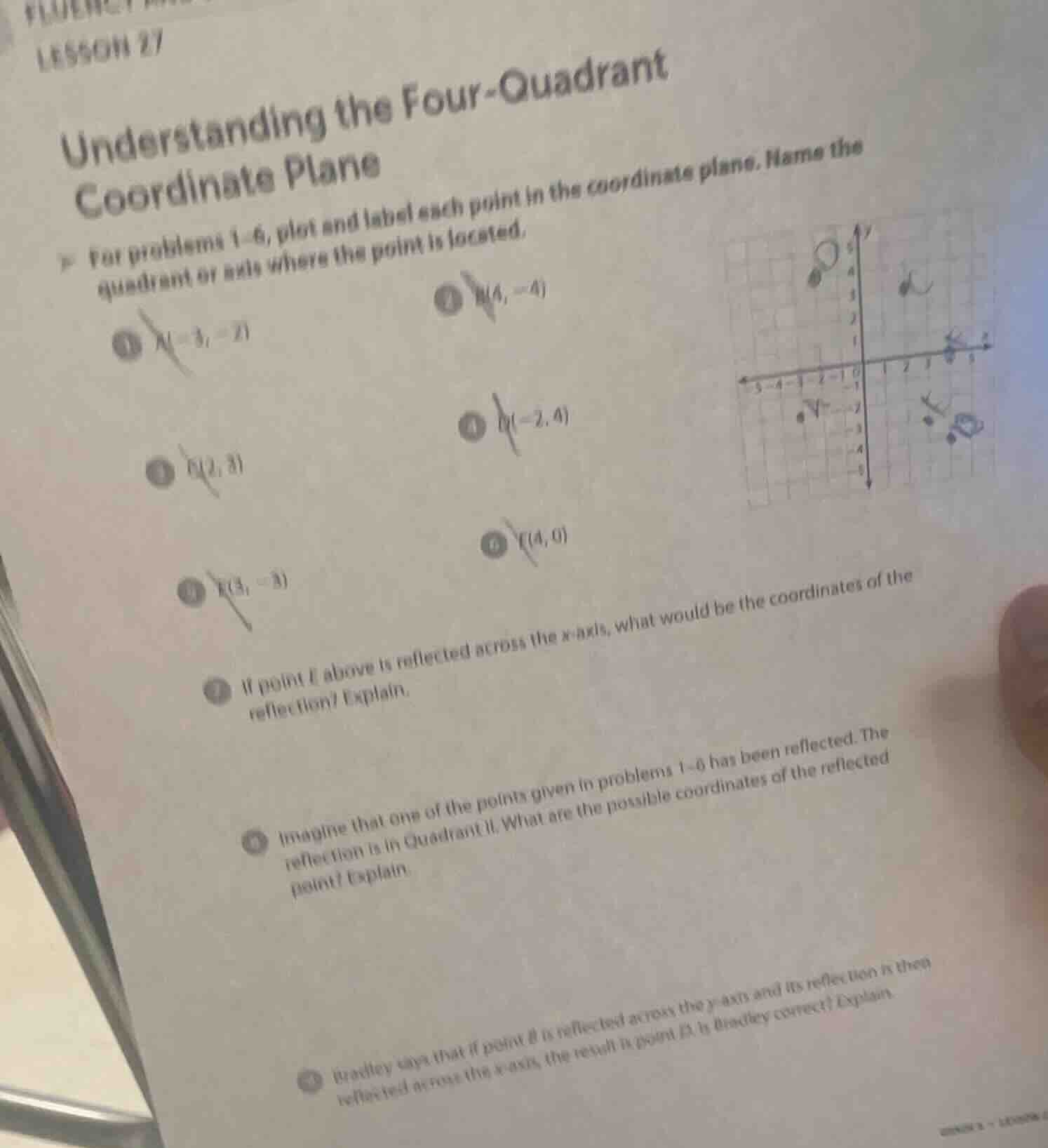
for problems 1-6, plot and label each point in the coordinate plane. name the quadrant or axis where the point is located.
- $a(-3, -2)$
- $b(4, -4)$
- $c(2, 3)$
- $d(-2, 4)$
- $e(3, -3)$
- $f(4, 0)$
- if point $e$ above is reflected across the $x$-axis, what would be the coordinates of the reflection? explain.
- imagine that one of the points given in problems 1-6 has been reflected. the reflection is in quadrant ii. what are the possible coordinates of the reflected point? explain.
- bradley says that if point $b$ is reflected across the $y$-axis and its reflection is then reflected across the $x$-axis, the result is point $d$. is bradley correct? explain.
Step1: Identify quadrant rules
A coordinate $(x,y)$ follows:
- Quadrant I: $x>0,y>0$
- Quadrant II: $x<0,y>0$
- Quadrant III: $x<0,y<0$
- Quadrant IV: $x>0,y<0$
- $x$-axis: $y=0$; $y$-axis: $x=0$
Step2: Analyze point $A(-3,-2)$
$x=-3<0$, $y=-2<0$ → Quadrant III
Step3: Analyze point $B(4,-4)$
$x=4>0$, $y=-4<0$ → Quadrant IV
Step4: Analyze point $C(2,3)$
$x=2>0$, $y=3>0$ → Quadrant I
Step5: Analyze point $D(-2,4)$
$x=-2<0$, $y=4>0$ → Quadrant II
Step6: Analyze point $E(3,-3)$
$x=3>0$, $y=-3<0$ → Quadrant IV
Step7: Analyze point $F(4,0)$
$y=0$ → $x$-axis
Step8: Reflect $E$ over $x$-axis
Rule: $(x,y)\to(x,-y)$. $E(3,-3)\to(3, 3)$
Step9: Find pre-images for Quadrant II reflection
Quadrant II: $x<0,y>0$. Possible reflections:
- From Quadrant I: $(x,y)\to(-x,y)$ → pre-image $(a,b),a>0,b>0$ (point $C(2,3)$ → $(-2,3)$)
- From Quadrant III: $(x,y)\to(x,-y)$ → pre-image $(a,b),a<0,b<0$ (point $A(-3,-2)$ → $(-3,2)$)
- From Quadrant IV: $(x,y)\to(-x,-y)$ → pre-image $(a,b),a>0,b<0$ (points $B(4,-4),E(3,-3)$ → $(-4,4),(-3,3)$)
- From $x$-axis: $(x,0)\to(-x,0)$ (not Quadrant II, discard)
Step10: Verify Bradley's claim
- Reflect $B(4,-4)$ over $y$-axis: $(x,y)\to(-x,y)$ → $(-4,-4)$
- Reflect $(-4,-4)$ over $x$-axis: $(x,y)\to(x,-y)$ → $(-4,4)$
Point $D$ is $(-2,4)$, not $(-4,4)$ → Bradley is wrong.

Snap & solve any problem in the app
Get step-by-step solutions on Sovi AI
Photo-based solutions with guided steps
Explore more problems and detailed explanations
- $A(-3,-2)$: Quadrant III
- $B(4,-4)$: Quadrant IV
- $C(2,3)$: Quadrant I
- $D(-2,4)$: Quadrant II
- $E(3,-3)$: Quadrant IV
- $F(4,0)$: $x$-axis
- Reflected $E$: $(3, 3)$; reflection over $x$-axis flips the $y$-sign.
- Possible coordinates: $(-2,3), (-3,2), (-4,4), (-3,3)$; these come from reflecting Quadrant I/III/IV points over $y$-axis, $x$-axis, or origin to reach Quadrant II.
- Bradley is incorrect; reflecting $B$ over $y$-axis then $x$-axis gives $(-4,4)$, not $D(-2,4)$.