QUESTION IMAGE
Question
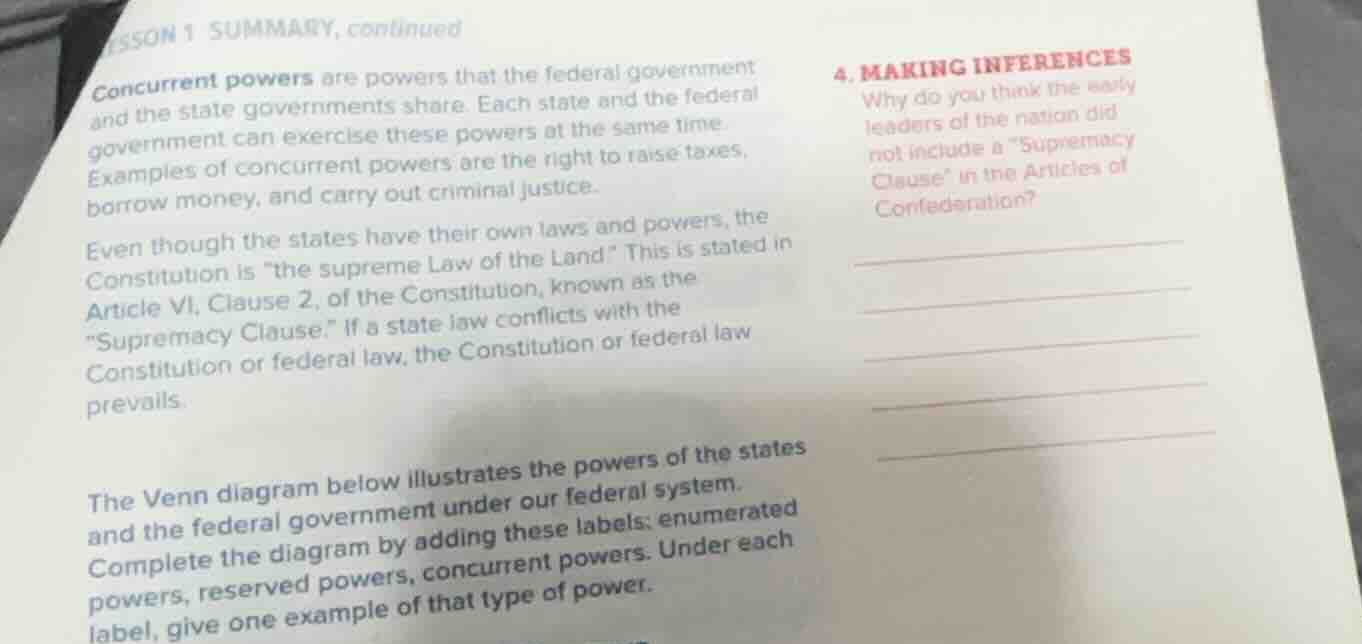
lesson 1 summary, continuedconcurrent powers are powers that the federal government and the state governments share. each state and the federal government can exercise these powers at the same time.examples of concurrent powers are the right to raise taxes, borrow money, and carry out criminal justice.even though the states have their own laws and powers, the constitution is \the supreme law of the land.\ this is stated in article vi, clause 2, of the constitution, known as the \supremacy clause.\ if a state law conflicts with the constitution or federal law, the constitution or federal law prevails.the venn diagram below illustrates the powers of the states and the federal government under our federal system.complete the diagram by adding these labels: enumerated powers, reserved powers, concurrent powers. under each label, give one example of that type of power.4. making inferenceswhy do you think the early leaders of the nation did not include a \supremacy clause\ in the articles of confederation?
For the Venn diagram task:
- Enumerated powers: These are powers only the federal government has, placed in the federal-only circle. An example is declaring war.
- Reserved powers: These are powers only state governments have, placed in the state-only circle. An example is establishing local schools.
- Concurrent powers: These are powers shared by both, placed in the overlapping section. An example is collecting taxes.
For the Supremacy Clause question:
The Articles of Confederation created a very weak federal government, with most power held by individual states. Early leaders feared a strong central government (like the British monarchy they had just overthrown), so they avoided a Supremacy Clause to preserve state autonomy and prevent federal overreach.

Snap & solve any problem in the app
Get step-by-step solutions on Sovi AI
Photo-based solutions with guided steps
Explore more problems and detailed explanations
Venn Diagram Completion:
- Federal-only circle: Enumerated powers, Example: Declare war
- State-only circle: Reserved powers, Example: Establish local schools
- Overlapping section: Concurrent powers, Example: Collect taxes
Supremacy Clause Question:
Early nation leaders did not include a Supremacy Clause in the Articles of Confederation because they wanted to prioritize state power and avoid creating a strong, overbearing federal government (a reaction to their experience with British royal authority).