QUESTION IMAGE
Question
in this lesson, you learned how americans on the home front dealt with the demands of world war i. you also learned how various groups in the united states were affected in different ways.
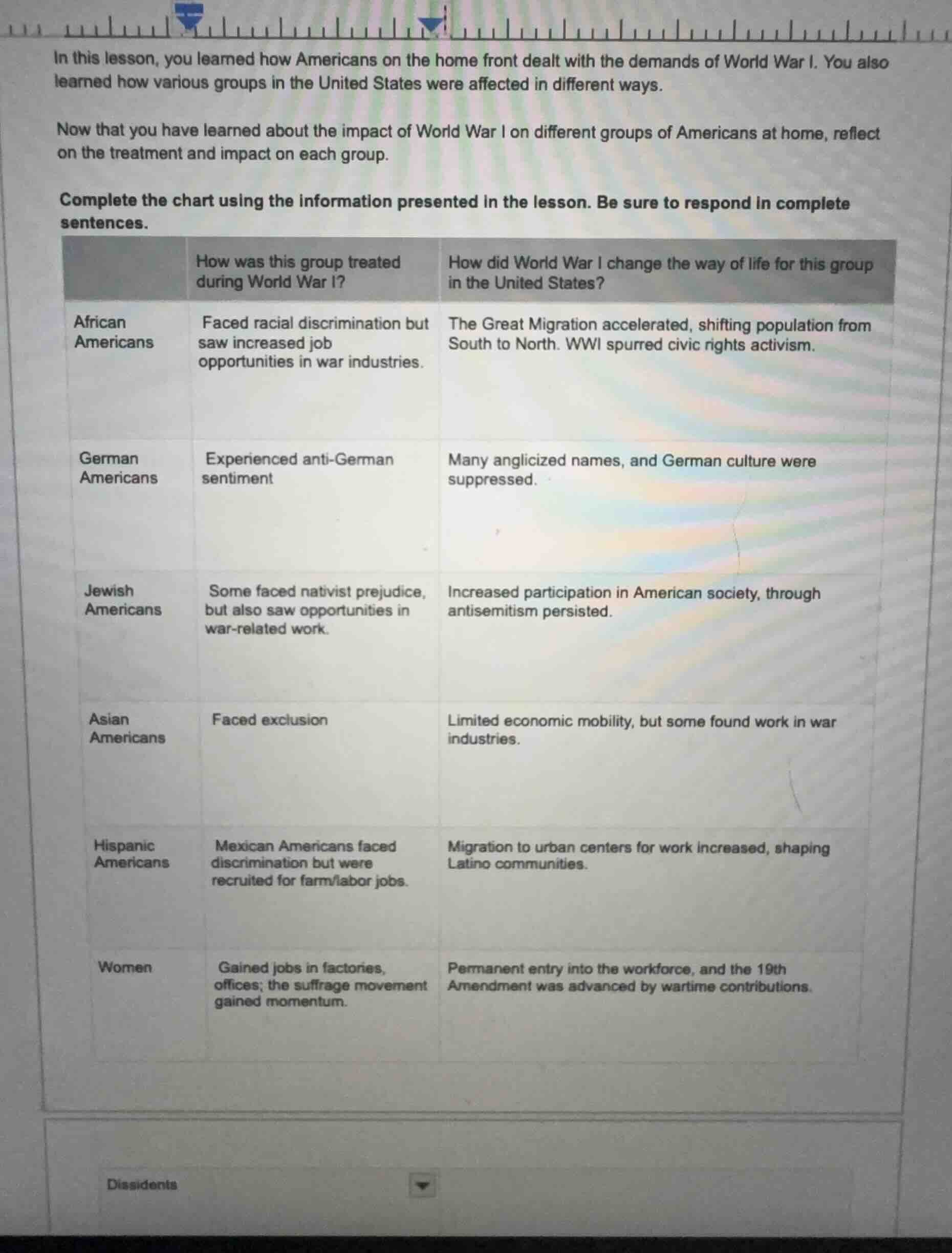
now that you have learned about the impact of world war i on different groups of americans at home, reflect on the treatment and impact on each group.
complete the chart using the information presented in the lesson. be sure to respond in complete sentences.
| how was this group treated during world war i? | how did world war i change the way of life for this group in the united states? | |
|---|---|---|
| german americans | experienced anti - german sentiment | many anglicized names, and german culture were suppressed. |
| jewish americans | some faced nativist prejudice, but also saw opportunities in war - related work. | increased participation in american society, through antisemitism persisted. |
| asian americans | faced exclusion | limited economic mobility, but some found work in war industries. |
| hispanic americans | mexican americans faced discrimination but were recruited for farm/labor jobs. | migration to urban centers for work increased, shaping latino communities. |
| women | gained jobs in factories, offices; the suffrage movement gained momentum. | permanent entry into the workforce, and the 19th amendment was advanced by wartime contributions. |
| dissidents |
To complete the chart for "Dissidents" (individuals who opposed the war or government policies during WWI), we analyze historical context:
Step 1: Treatment During WWI
Dissidents (e.g., pacifists, socialists, anti - war activists) faced suppression (censorship, arrest, or harassment) for opposing the war effort. Laws like the Espionage Act (1917) and Sedition Act (1918) targeted anti - war speech.
Step 2: Impact on Way of Life
Their civil liberties (free speech, assembly) were restricted, shaping debates about civil rights in the U.S. The crackdown on dissidents highlighted tensions between national security and individual freedoms, influencing later civil liberties movements.
| Group | How was this group treated during World War I? | How did World War I change the way of life for this group in the United States? |
|---|

Snap & solve any problem in the app
Get step-by-step solutions on Sovi AI
Photo-based solutions with guided steps
Explore more problems and detailed explanations
To complete the chart for "Dissidents" (individuals who opposed the war or government policies during WWI), we analyze historical context:
Step 1: Treatment During WWI
Dissidents (e.g., pacifists, socialists, anti - war activists) faced suppression (censorship, arrest, or harassment) for opposing the war effort. Laws like the Espionage Act (1917) and Sedition Act (1918) targeted anti - war speech.
Step 2: Impact on Way of Life
Their civil liberties (free speech, assembly) were restricted, shaping debates about civil rights in the U.S. The crackdown on dissidents highlighted tensions between national security and individual freedoms, influencing later civil liberties movements.
| Group | How was this group treated during World War I? | How did World War I change the way of life for this group in the United States? |
|---|