QUESTION IMAGE
Question
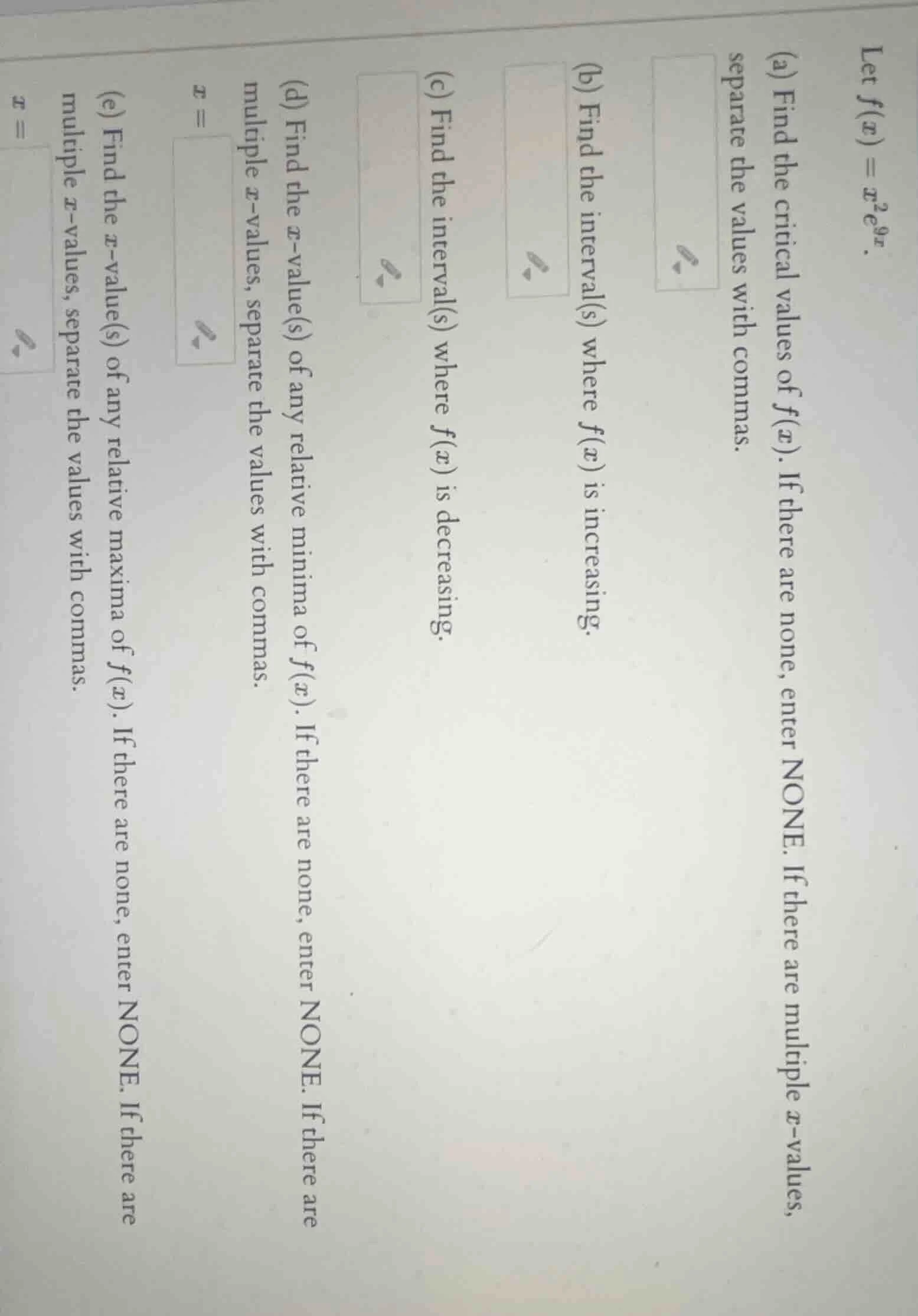
let $f(x) = x^2 e^{9x}$.
(a) find the critical values of $f(x)$. if there are none, enter none. if there are multiple $x$-values, separate the values with commas.
(b) find the interval(s) where $f(x)$ is increasing.
(c) find the interval(s) where $f(x)$ is decreasing.
(d) find the $x$-value(s) of any relative minima of $f(x)$. if there are none, enter none. if there are multiple $x$-values, separate the values with commas.
$x = $
(e) find the $x$-value(s) of any relative maxima of $f(x)$. if there are none, enter none. if there are multiple $x$-values, separate the values with commas.
$x = $
Part (a): Critical Values
Step 1: Find the derivative of \( f(x) \)
We use the product rule: if \( f(x) = u(x)v(x) \), then \( f'(x) = u'(x)v(x) + u(x)v'(x) \). Let \( u(x) = x^2 \) and \( v(x) = e^{9x} \). Then \( u'(x) = 2x \) and \( v'(x) = 9e^{9x} \). So,
\[
f'(x) = 2x \cdot e^{9x} + x^2 \cdot 9e^{9x} = e^{9x}(2x + 9x^2)
\]
Step 2: Set \( f'(x) = 0 \)
Since \( e^{9x} \) is never zero (exponential function is always positive), we solve \( 2x + 9x^2 = 0 \). Factor out \( x \):
\[
x(9x + 2) = 0
\]
This gives \( x = 0 \) or \( 9x + 2 = 0 \implies x = -\frac{2}{9} \).
Step 1: Analyze the sign of \( f'(x) \)
We have \( f'(x) = e^{9x}x(9x + 2) \). \( e^{9x} > 0 \) for all \( x \), so we analyze \( x(9x + 2) \). The critical points are \( x = -\frac{2}{9} \) and \( x = 0 \), which divide the real line into three intervals: \( (-\infty, -\frac{2}{9}) \), \( (-\frac{2}{9}, 0) \), and \( (0, \infty) \).
- For \( x < -\frac{2}{9} \) (e.g., \( x = -1 \)): \( x = -1 < 0 \), \( 9x + 2 = -7 < 0 \), so \( x(9x + 2) = (-1)(-7) = 7 > 0 \). Thus, \( f'(x) > 0 \), so \( f(x) \) is increasing.
- For \( -\frac{2}{9} < x < 0 \) (e.g., \( x = -\frac{1}{9} \)): \( x = -\frac{1}{9} < 0 \), \( 9x + 2 = 1 > 0 \), so \( x(9x + 2) = (-\frac{1}{9})(1) = -\frac{1}{9} < 0 \). Thus, \( f'(x) < 0 \), so \( f(x) \) is decreasing.
- For \( x > 0 \) (e.g., \( x = 1 \)): \( x = 1 > 0 \), \( 9x + 2 = 11 > 0 \), so \( x(9x + 2) = (1)(11) = 11 > 0 \). Thus, \( f'(x) > 0 \), so \( f(x) \) is increasing.
From the analysis in part (b), we saw that for \( -\frac{2}{9} < x < 0 \), \( f'(x) < 0 \), so \( f(x) \) is decreasing.

Snap & solve any problem in the app
Get step-by-step solutions on Sovi AI
Photo-based solutions with guided steps
Explore more problems and detailed explanations
\( -\frac{2}{9}, 0 \)