QUESTION IMAGE
Question
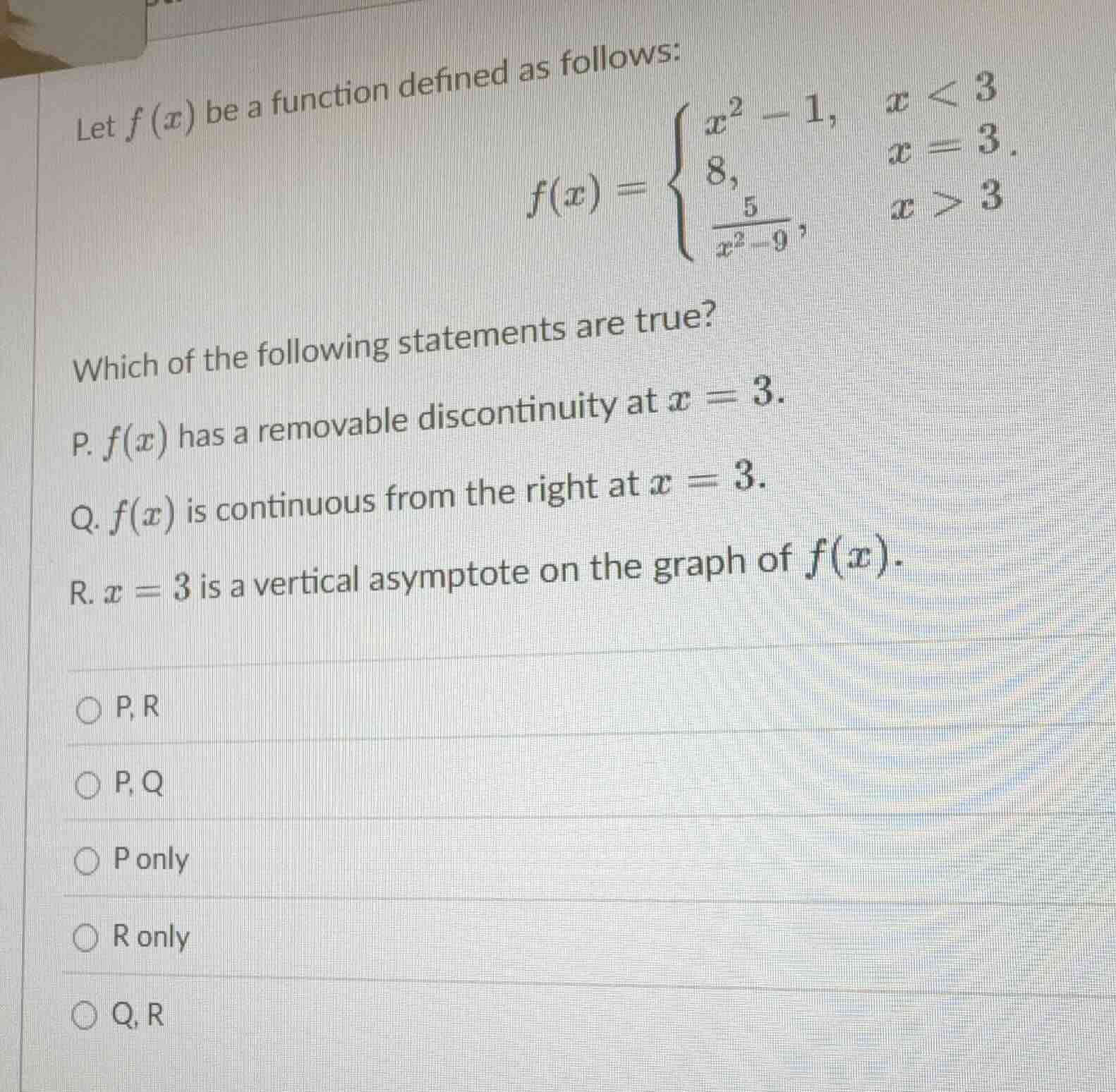
let $f(x)$ be a function defined as follows:
$f(x) = \
$
which of the following statements are true?
p. $f(x)$ has a removable discontinuity at $x = 3$.
q. $f(x)$ is continuous from the right at $x = 3$.
r. $x = 3$ is a vertical asymptote on the graph of $f(x)$.
\bigcirc p, r
\bigcirc p, q
\bigcirc p only
\bigcirc r only
\bigcirc q, r
Step1: Analyze Statement P (Removable Discontinuity)
To check for a removable discontinuity at \( x = 3 \), we need to find the left - hand limit (\( \lim_{x
ightarrow3^{-}}f(x) \)) and the right - hand limit (\( \lim_{x
ightarrow3^{+}}f(x) \)) and compare with \( f(3) \).
For \( x<3 \), \( f(x)=x^{2}-1 \). So, \( \lim_{x
ightarrow3^{-}}f(x)=\lim_{x
ightarrow3^{-}}(x^{2}-1) \). Substitute \( x = 3 \) into \( x^{2}-1 \), we get \( 3^{2}-1=9 - 1=8 \).
For \( x>3 \), \( f(x)=\frac{5}{x^{2}-9}=\frac{5}{(x - 3)(x + 3)} \). The right - hand limit \( \lim_{x
ightarrow3^{+}}f(x)=\lim_{x
ightarrow3^{+}}\frac{5}{(x - 3)(x + 3)} \). As \( x
ightarrow3^{+} \), \( x-3
ightarrow0^{+} \) and \( x + 3
ightarrow6 \), so \( \lim_{x
ightarrow3^{+}}\frac{5}{(x - 3)(x + 3)}=\infty \).
Since the left - hand limit is \( 8 \), \( f(3) = 8 \), but the right - hand limit is \( \infty \), the function does not have a removable discontinuity at \( x = 3 \) (a removable discontinuity requires that \( \lim_{x
ightarrow a^{-}}f(x)=\lim_{x
ightarrow a^{+}}f(x)
eq f(a) \) or \( f(a) \) is undefined, but here the one - sided limits are not equal). Wait, we made a mistake above. Wait, let's re - calculate the right - hand limit. Wait, \( \frac{5}{x^{2}-9}=\frac{5}{(x - 3)(x + 3)} \). When \( x
ightarrow3^{+} \), \( x-3
ightarrow0^{+} \), \( x + 3
ightarrow6 \), so the denominator approaches \( 0 \) from the positive side, so the function \( \frac{5}{(x - 3)(x + 3)} \) approaches \(+\infty \). The left - hand limit: \( \lim_{x
ightarrow3^{-}}x^{2}-1=3^{2}-1 = 8 \), and \( f(3)=8 \). But the right - hand limit is not equal to the left - hand limit. Wait, maybe we misapplied the removable discontinuity. A removable discontinuity occurs when \( \lim_{x
ightarrow a}f(x) \) exists (i.e., \( \lim_{x
ightarrow a^{-}}f(x)=\lim_{x
ightarrow a^{+}}f(x) \)) but \( \lim_{x
ightarrow a}f(x)
eq f(a) \) or \( f(a) \) is undefined. Since \( \lim_{x
ightarrow3^{-}}f(x) = 8 \), \( f(3)=8 \), but \( \lim_{x
ightarrow3^{+}}f(x)=\infty \), so \( \lim_{x
ightarrow3}f(x) \) does not exist. So statement P is false? Wait, no, maybe we made a mistake. Wait, let's re - examine the function.
Wait, the function is defined as:
\( f(x)=
\)
Left - hand limit as \( x
ightarrow3^{-} \): \( \lim_{x
ightarrow3^{-}}f(x)=\lim_{x
ightarrow3^{-}}(x^{2}-1)=9 - 1 = 8 \)
Right - hand limit as \( x
ightarrow3^{+} \): \( \lim_{x
ightarrow3^{+}}f(x)=\lim_{x
ightarrow3^{+}}\frac{5}{x^{2}-9}=\lim_{x
ightarrow3^{+}}\frac{5}{(x - 3)(x + 3)} \). As \( x
ightarrow3^{+} \), \( x - 3
ightarrow0^{+} \), \( x+3
ightarrow6 \), so the limit is \(+\infty \)
\( f(3)=8 \)
Now, statement Q: Continuous from the right at \( x = 3 \). A function is continuous from the right at \( x=a \) if \( \lim_{x
ightarrow a^{+}}f(x)=f(a) \). Here, \( \lim_{x
ightarrow3^{+}}f(x)=\infty \) and \( f(3) = 8 \), so \( \lim_{x
ightarrow3^{+}}f(x)
eq f(3) \), so Q is false.
Statement R: \( x = 3 \) is a vertical asymptote. A vertical asymptote at \( x=a \) occurs if at least one of \( \lim_{x
ightarrow a^{-}}f(x) \), \( \lim_{x
ightarrow a^{+}}f(x) \) is \( \pm\infty \). Since \( \lim_{x
ightarrow3^{+}}f(x)=\infty \), \( x = 3 \) is a vertical asymptote. Wait, but earlier we thought P was true, but it's not. Wait, maybe we messed up the initial analysis.
Wait, let's start over:
- Analyze P: Removable discontinuity at \( x = 3 \)
A removable discontinuity exists when \( \lim_{x
ightarrow3}f(x) \) exists (i.e., \( \lim_{x
ightarrow3^{-}}f(x)=\lim_{x
ightarro…

Snap & solve any problem in the app
Get step-by-step solutions on Sovi AI
Photo-based solutions with guided steps
Explore more problems and detailed explanations
R only