QUESTION IMAGE
Question
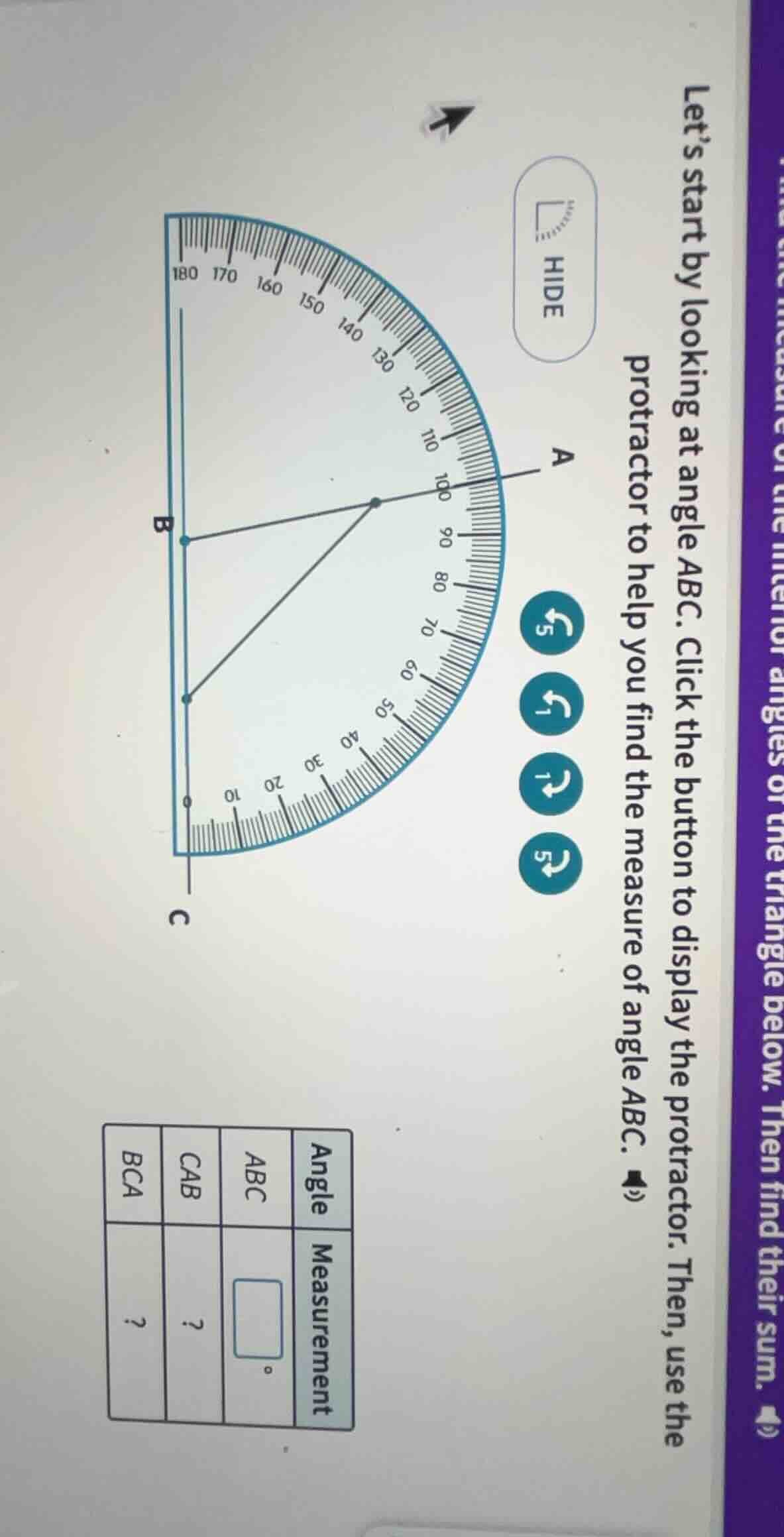
let’s start by looking at angle abc. click the button to display the protractor. then, use the protractor to help you find the measure of angle abc.
angle | abc | cab | bca
measurement | |? |?
Step1: Identify the angle vertex and sides
The angle \( \angle ABC \) has vertex at \( B \), with one side along \( BC \) (the vertical line) and the other side \( BA \). The protractor is placed with its center at \( B \), and the baseline along \( BC \).
Step2: Read the protractor scale
Looking at the protractor, the side \( BA \) aligns with the \( 100^\circ \) mark? Wait, no, wait. Wait, the baseline is along \( BC \) (the left - most line, which is at \( 180^\circ \) on the outer scale? Wait, no, let's check the protractor. The protractor has two scales: the outer scale (from \( 0^\circ \) to \( 180^\circ \) clockwise) and the inner scale (from \( 0^\circ \) to \( 180^\circ \) counter - clockwise). Wait, the side \( BC \) is along the left - hand side of the protractor (the \( 180^\circ \) mark on the outer scale, or \( 0^\circ \) on the inner scale? Wait, no, the angle at \( B \): the side \( BC \) is a straight line (from \( B \) down to \( C \)), and the side \( BA \) is a line from \( B \) to \( A \). Let's look at the protractor's markings. The center of the protractor is at \( B \). The side \( BC \) is along the \( 0^\circ - 180^\circ \) line (the vertical line on the left). The side \( BA \): let's see the angle between \( BC \) (the vertical line) and \( BA \). Wait, maybe I made a mistake. Wait, the protractor's outer scale: when the baseline is along the left - hand side ( \( 180^\circ \) mark), the angle is measured from the baseline. Wait, no, actually, when measuring \( \angle ABC \), the vertex is \( B \), so we place the center of the protractor at \( B \), one side ( \( BC \)) along the \( 0^\circ \) (or \( 180^\circ \)) line, and then read the angle of the other side ( \( BA \)). Wait, looking at the protractor, the line \( BA \) is at \( 100^\circ \) from the \( 180^\circ \) line? No, wait, maybe the inner scale. Wait, the inner scale: the left - hand side is \( 180^\circ \), and as we move clockwise, the inner scale decreases. Wait, no, let's think again. The angle \( \angle ABC \): points \( A \), \( B \), \( C \) with \( B \) in the middle. So \( BC \) is a ray going down from \( B \), and \( BA \) is a ray going from \( B \) to \( A \). The protractor is placed so that the center is at \( B \), and the \( 0^\circ - 180^\circ \) line (the straight edge) is along \( BC \). Then, the ray \( BA \) intersects the protractor at a certain mark. Wait, looking at the protractor, the line \( BA \) is at \( 80^\circ \) from \( BC \)? Wait, no, maybe I messed up. Wait, let's check the protractor's scale. The outer scale: from \( 0^\circ \) (bottom) to \( 180^\circ \) (top) counter - clockwise. The inner scale: from \( 0^\circ \) (top) to \( 180^\circ \) (bottom) clockwise. Wait, the side \( BC \) is along the bottom - left line (the line that goes from the bottom of the protractor up to \( B \)). Wait, maybe the correct way: the angle \( \angle ABC \) is an acute angle? Wait, no, looking at the diagram, the line \( BA \) is going towards the \( 100^\circ \) mark? No, wait, maybe the angle is \( 80^\circ \)? Wait, no, let's count the degrees. Wait, the protractor has markings every \( 10^\circ \) and then smaller markings for \( 1^\circ \). Wait, the line \( BA \): if we take the inner scale (the one that goes from \( 0^\circ \) at the top ( \( 180^\circ \) outer) to \( 180^\circ \) at the bottom ( \( 0^\circ \) outer)). Wait, the side \( BC \) is at the bottom (along the \( 0^\circ \) outer scale, \( 180^\circ \) inner scale). The side \( BA \): looking at the inner scale, from \( 180^\circ \) (at \( BC \)) mov…

Snap & solve any problem in the app
Get step-by-step solutions on Sovi AI
Photo-based solutions with guided steps
Explore more problems and detailed explanations
\( 80^\circ \)