QUESTION IMAGE
Question
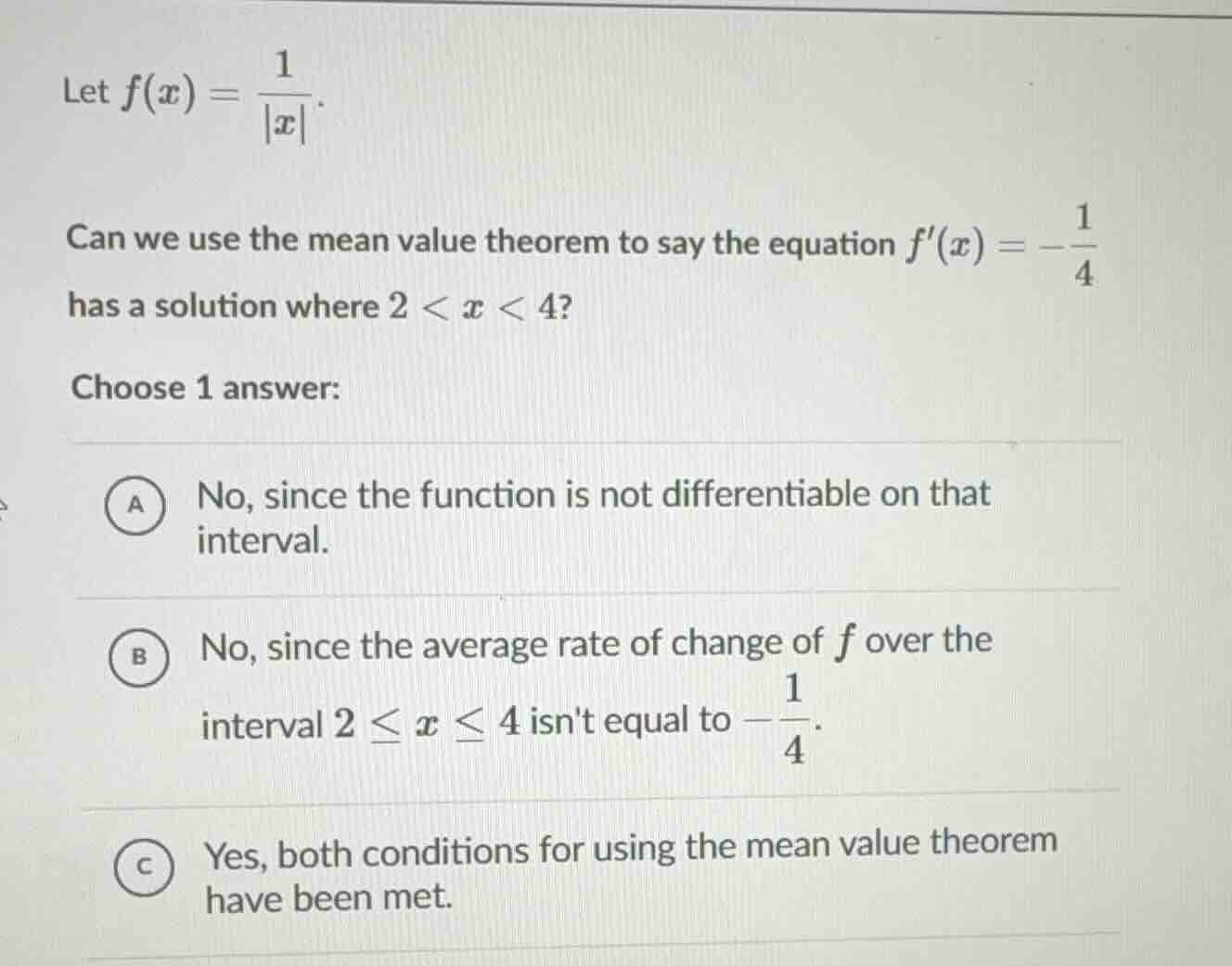
let $f(x) = \frac{1}{|x|}$.
can we use the mean value theorem to say the equation $f(x) = -\frac{1}{4}$ has a solution where $2 < x < 4$?
choose 1 answer:
a no, since the function is not differentiable on that interval.
b no, since the average rate of change of $f$ over the interval $2 \leq x \leq 4$ isnt equal to $-\frac{1}{4}$.
c yes, both conditions for using the mean value theorem have been met.
To apply the Mean Value Theorem (MVT), a function must be continuous on \([a,b]\) and differentiable on \((a,b)\). For \(f(x)=\frac{1}{|x|}\), on the interval \((2,4)\), \(x>0\), so \(f(x)=\frac{1}{x}\) (since \(|x| = x\) for \(x>0\)). The function \(y = \frac{1}{x}\) is continuous on \([2,4]\) and differentiable on \((2,4)\) (derivative \(f'(x)=-\frac{1}{x^2}\)). Now, check the average rate of change over \([2,4]\): \(\frac{f(4)-f(2)}{4 - 2}=\frac{\frac{1}{4}-\frac{1}{2}}{2}=\frac{-\frac{1}{4}}{2}=-\frac{1}{8}\)? Wait, no—wait, the question is about \(f'(x)=-\frac{1}{4}\). Wait, no, let's recalculate: \(f(4)=\frac{1}{4}\), \(f(2)=\frac{1}{2}\). So \(\frac{f(4)-f(2)}{4 - 2}=\frac{\frac{1}{4}-\frac{1}{2}}{2}=\frac{-\frac{1}{4}}{2}=-\frac{1}{8}\)? But wait, the MVT says there exists \(c\) in \((2,4)\) such that \(f'(c)=\frac{f(4)-f(2)}{4 - 2}\). Wait, but the question is about \(f'(x)=-\frac{1}{4}\). Wait, no, maybe I made a mistake. Wait, \(f(x)=\frac{1}{|x|}\), for \(x>0\), \(f(x)=\frac{1}{x}\), derivative \(f'(x)=-\frac{1}{x^2}\). Let's check if the average rate of change is \(-\frac{1}{4}\). Wait, \(\frac{f(4)-f(2)}{4 - 2}=\frac{\frac{1}{4}-\frac{1}{2}}{2}=\frac{-\frac{1}{4}}{2}=-\frac{1}{8}\), which is not \(-\frac{1}{4}\). Wait, but the options: Option B says "No, since the average rate of change... isn't equal to \(-\frac{1}{4}\)". Wait, but wait, the MVT requires that the average rate of change (slope of secant) equals \(f'(c)\) for some \(c\). So if we want to say there's a \(c\) with \(f'(c)=-\frac{1}{4}\), we need the average rate of change to be \(-\frac{1}{4}\). Let's calculate the average rate of change: \(\frac{f(4)-f(2)}{4 - 2}=\frac{\frac{1}{4}-\frac{1}{2}}{2}=\frac{-\frac{1}{4}}{2}=-\frac{1}{8}\), which is not \(-\frac{1}{4}\). So the average rate of change over \([2,4]\) is \(-\frac{1}{8}\), not \(-\frac{1}{4}\). Therefore, the reason is that the average rate of change isn't equal to \(-\frac{1}{4}\), so we can't use MVT to say \(f'(x)=-\frac{1}{4}\) has a solution? Wait, no—wait, the MVT says that \(f'(c)\) equals the average rate of change. So if the average rate of change is not \(-\frac{1}{4}\), then there's no \(c\) with \(f'(c)=-\frac{1}{4}\) by MVT. Wait, but let's check the function's differentiability: for \(x>0\), \(f(x)=\frac{1}{x}\) is differentiable on \((2,4)\) (since derivative exists there). So the function is differentiable on \((2,4)\) (because for \(x>0\), \(|x|=x\), so \(f(x)=\frac{1}{x}\), which is differentiable). Wait, so why is option A wrong? Wait, no—wait, \(f(x)=\frac{1}{|x|}\) is differentiable on \((2,4)\) (since \(x>0\) there, so \(|x|=x\), and \(\frac{1}{x}\) is differentiable). So the problem is that the average rate of change over \([2,4]\) is \(-\frac{1}{8}\), not \(-\frac{1}{4}\), so the MVT can't guarantee a solution for \(f'(x)=-\frac{1}{4}\) because the average rate of change isn't equal to \(-\frac{1}{4}\). So option B is correct? Wait, but wait, let's re-express: The MVT states that if \(f\) is continuous on \([a,b]\) and differentiable on \((a,b)\), then there exists \(c\in(a,b)\) such that \(f'(c)=\frac{f(b)-f(a)}{b - a}\). So to use MVT to say \(f'(x)=k\) has a solution, \(k\) must equal \(\frac{f(b)-f(a)}{b - a}\). Here, \(k = -\frac{1}{4}\), and \(\frac{f(4)-f(2)}{4 - 2}=\frac{\frac{1}{4}-\frac{1}{2}}{2}=-\frac{1}{8}
eq-\frac{1}{4}\). Therefore, the average rate of change isn't equal to \(-\frac{1}{4}\), so we can't use MVT to say \(f'(x)=-\frac{1}{4}\) has a solution. So option B is correct. Wait, but earlier I thought maybe option A, but no—for \(x>0\), \(f(x)=\frac{1}{…

Snap & solve any problem in the app
Get step-by-step solutions on Sovi AI
Photo-based solutions with guided steps
Explore more problems and detailed explanations
B. No, since the average rate of change of \( f \) over the interval \( 2 \leq x \leq 4 \) isn't equal to \( -\frac{1}{4} \).