QUESTION IMAGE
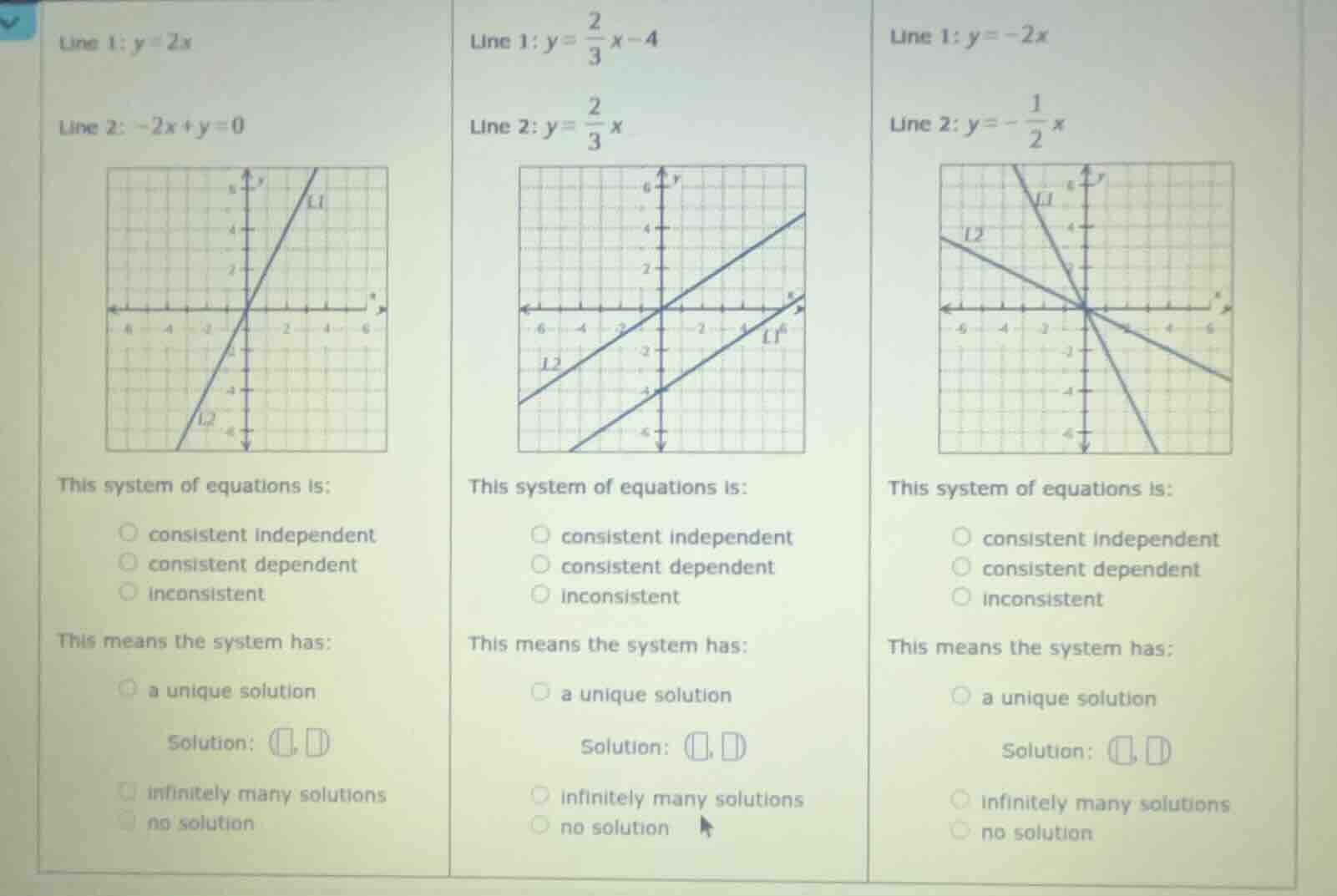
Question
line 1: ( y = 2x )
line 2: ( -2x + y = 0 )
this system of equations is:
consistent independent
consistent dependent
inconsistent
this means the system has:
a unique solution
solution: ( , )
infinitely many solutions
no solution
line 1: ( y = \frac{2}{3}x - 4 )
line 2: ( y = \frac{2}{3}x )
this system of equations is:
consistent independent
consistent dependent
inconsistent
this means the system has:
a unique solution
solution: ( , )
infinitely many solutions
no solution
line 1: ( y = -2x )
line 2: ( y = -\frac{1}{2}x )
this system of equations is:
consistent independent
consistent dependent
inconsistent
this means the system has:
a unique solution
solution: ( , )
infinitely many solutions
no solution
First System (Line 1: \( y = 2x \), Line 2: \( -2x + y = 0 \))
Step 1: Rewrite Line 2
Rewrite \( -2x + y = 0 \) as \( y = 2x \). Now both lines have the same equation.
Step 2: Determine System Type
Consistent dependent systems have the same line (infinitely many solutions). So this system is consistent dependent.
Step 3: Number of Solutions
Since the lines are identical, there are infinitely many solutions. The solution is all points on \( y = 2x \), but we can represent it as \( (x, 2x) \) for any \( x \), or note the system has infinitely many solutions.
Step 1: Compare Slopes and Intercepts
Both lines have slope \( \frac{2}{3} \), but different y - intercepts (\( - 4 \) vs \( 0 \)). Parallel lines have the same slope and different intercepts.
Step 2: Determine System Type
Inconsistent systems have parallel lines (no solution).
Step 3: Number of Solutions
Parallel lines never intersect, so no solution.
Step 1: Compare Slopes
Slope of Line 1: \( - 2 \), Slope of Line 2: \( -\frac{1}{2} \). Different slopes mean the lines intersect at one point.
Step 2: Determine System Type
Consistent independent systems have one unique solution (intersecting lines with different slopes).
Step 3: Find the Solution
Set \( -2x=-\frac{1}{2}x \). Add \( 2x \) to both sides: \( 0=\frac{3}{2}x \), so \( x = 0 \). Substitute \( x = 0 \) into \( y=-2x \), \( y = 0 \). So the solution is \( (0,0) \).

Snap & solve any problem in the app
Get step-by-step solutions on Sovi AI
Photo-based solutions with guided steps
Explore more problems and detailed explanations
This system of equations is: consistent dependent
This means the system has: infinitely many solutions
Solution: (All points on \( y = 2x \), e.g., for any \( x \), \( (x, 2x) \))