QUESTION IMAGE
Question
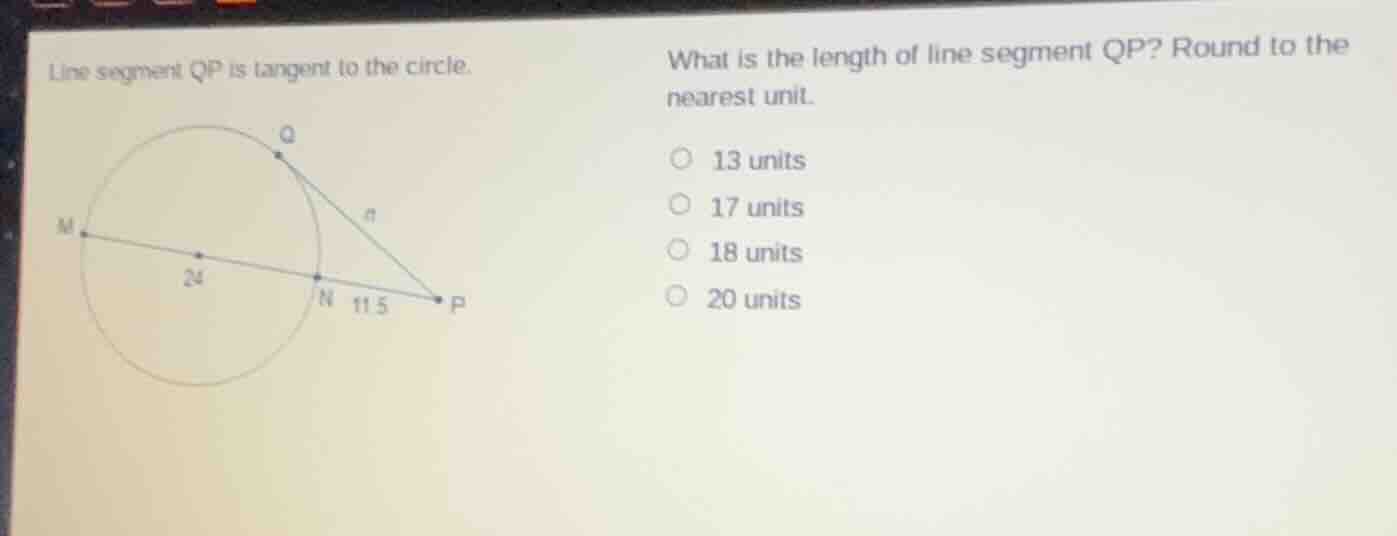
line segment qp is tangent to the circle. what is the length of line segment qp? round to the nearest unit. 13 units 17 units 18 units 20 units
Step1: Recall the tangent - secant theorem.
The tangent - secant theorem states that if a tangent segment \(QP\) and a secant segment \(PM\) are drawn from an external point \(P\) to a circle, then \(QP^{2}=PN\times PM\). First, we need to find the length of \(PM\). The diameter of the circle is \(24\), so the radius is \(\frac{24}{2} = 12\), and \(PM=PN + NM\), where \(NM = 24\) and \(PN=11.5\), so \(PM=11.5 + 24=35.5\)? Wait, no, the secant segment is \(PM\) where \(N\) is the point of intersection of the secant with the circle. Wait, actually, the formula is \(QP^{2}=PN\times(PN + 2r)\), where \(r\) is the radius. The diameter is \(24\), so the radius \(r = 12\), and the length from \(P\) to the center is not needed. Wait, the correct formula for a tangent \(QP\) and a secant \(P M\) (where \(M\) and \(N\) are the points of intersection of the secant with the circle, with \(N\) being the closer one to \(P\)) is \(QP^{2}=PN\times PM\), where \(PM=PN + MN\), and \(MN\) is the length of the chord, which is the diameter here, so \(MN = 24\). So \(PN = 11.5\), \(MN=24\), so \(PM=11.5 + 24=35.5\)? Wait, no, that's incorrect. Wait, the secant segment is \(P\) to \(M\), passing through \(N\), so the two - part of the secant are \(PN\) (the external part) and \(PM\) (the entire secant). Wait, no, the correct formula is \(QP^{2}=PN\times(PN + 2r)\) when the secant passes through the center? Wait, no, the general formula is \(QP^{2}=PN\times PM\), where \(PM\) is the length of the secant from \(P\) to the second intersection point \(M\), and \(PN\) is the length from \(P\) to the first intersection point \(N\). So here, \(PN = 11.5\), and \(PM=PN + MN\), where \(MN\) is the length of the chord, which is the diameter, so \(MN = 24\). So \(PM=11.5+24 = 35.5\)? Wait, that can't be. Wait, no, the radius is \(12\), so the distance from the center to \(N\) is \(12\) (since \(N\) is on the circle? Wait, no, \(N\) is a point on the circle? Wait, the line \(PM\) passes through the center, so \(M\) and the center and \(N\)? Wait, the diameter is \(24\), so the center is the mid - point of \(M\), so the radius is \(12\). So the distance from \(P\) to the center is \(PN +\) radius? Wait, \(PN = 11.5\), the radius is \(12\), so the distance from \(P\) to the center is \(11.5+12 = 23.5\). Then, since \(QP\) is tangent to the circle, triangle \(QOP\) (where \(O\) is the center) is a right triangle, with \(OQ\) (radius, \(12\)) perpendicular to \(QP\). So by Pythagoras, \(QP^{2}+OQ^{2}=OP^{2}\). \(OP=11.5 + 12=23.5\), \(OQ = 12\). Then \(QP^{2}=OP^{2}-OQ^{2}=(23.5)^{2}-(12)^{2}\). Let's calculate that: \((23.5)^{2}=23.5\times23.5 = 552.25\), \((12)^{2}=144\), so \(QP^{2}=552.25 - 144=408.25\), then \(QP=\sqrt{408.25}\approx20.2\), which rounds to \(20\)? Wait, no, that's not matching. Wait, maybe I misread the diagram. Wait, the length \(PN = 11.5\), and the diameter is \(24\), so the radius is \(12\), so the length from \(P\) to the center is \(PN+12 = 11.5 + 12=23.5\), and the radius \(OQ = 12\). Then \(QP\) is tangent, so \(OQ\perp QP\), so \(QP=\sqrt{OP^{2}-OQ^{2}}=\sqrt{(23.5)^{2}-12^{2}}=\sqrt{552.25 - 144}=\sqrt{408.25}\approx20.2\), which is approximately \(20\). Wait, but let's check the other way. Wait, maybe the formula is \(QP^{2}=PN\times(PN + 2r)\) where \(r = 12\), \(PN = 11.5\), so \(QP^{2}=11.5\times(11.5 + 24)=11.5\times35.5 = 408.25\), so \(QP=\sqrt{408.25}\approx20.2\), which rounds to \(20\).
Step2: Calculate the value of \(QP\).
We know that for a tangent \(QP\) and a secant \(P M\) (where \(M\) and \(N\) are the points of inters…

Snap & solve any problem in the app
Get step-by-step solutions on Sovi AI
Photo-based solutions with guided steps
Explore more problems and detailed explanations
20 units