QUESTION IMAGE
Question
linear & exponential functions unit test
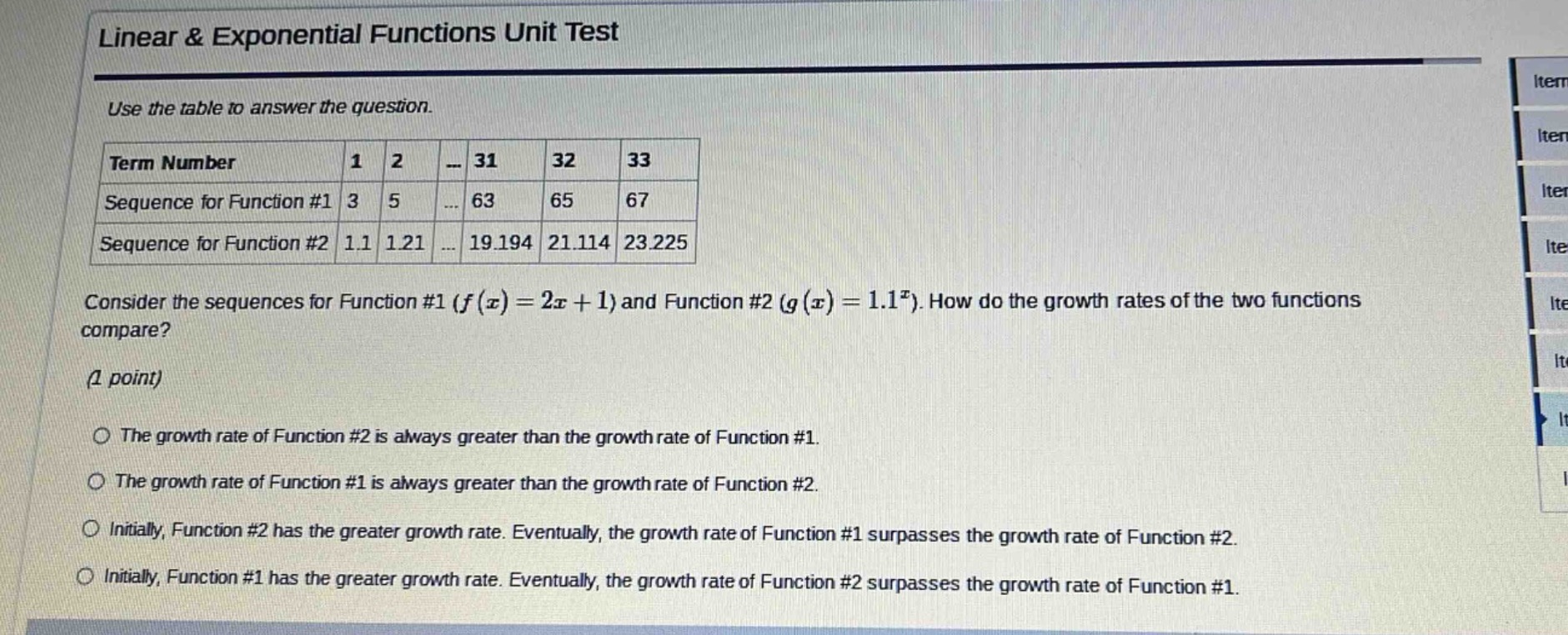
use the table to answer the question.
term number | 1 | 2 |... | 31 | 32 | 33
sequence for function #1 | 3 | 5 |... | 63 | 65 | 67
sequence for function #2 | 1.1 | 1.21 |... | 19.194 | 21.114 | 23.225
consider the sequences for function #1 ($f(x) = 2x + 1$) and function #2 ($g(x) = 1.1^x$). how do the growth rates of the two functions compare?
(1 point)
- the growth rate of function #2 is always greater than the growth rate of function #1.
- the growth rate of function #1 is always greater than the growth rate of function #2.
- initially, function #2 has the greater growth rate. eventually, the growth rate of function #1 surpasses the growth rate of function #2.
- initially, function #1 has the greater growth rate. eventually, the growth rate of function #2 surpasses the growth rate of function #1.
Step1: Analyze Function #1 (Linear)
Function #1 is \( f(x) = 2x + 1 \), a linear function. The growth rate of a linear function \( y = mx + b \) is the slope \( m \). Here, \( m = 2 \), so the growth rate is constant at 2.
Step2: Analyze Function #2 (Exponential)
Function #2 is \( g(x) = 1.1^x \), an exponential function. The growth rate of an exponential function \( y = a(b)^x \) (where \( b > 1 \)) is not constant; it increases over time. The derivative (or the rate of change) of \( g(x) = 1.1^x \) is \( g'(x) = \ln(1.1) \cdot 1.1^x \), which grows as \( x \) increases because \( 1.1^x \) grows exponentially.
Step3: Compare Initial and Long - Term Growth Rates
- Initial Growth Rate (Small \( x \)): Let's check the rate of change for small \( x \). For Function #1, the growth rate is always 2. For Function #2, when \( x = 1 \), the rate of change (using the difference quotient or derivative approximation) is \( g(2)-g(1)=1.21 - 1.1 = 0.11 \), which is less than 2. So initially, the growth rate of Function #1 (2) is greater than that of Function #2.
- Long - Term Growth Rate (Large \( x \)): As \( x \) becomes large, the exponential function \( g(x)=1.1^x \) has a growth rate (derivative) that will eventually exceed the constant growth rate of the linear function. Because the exponential function's rate of change grows exponentially, while the linear function's rate of change is constant. So eventually, the growth rate of Function #2 will surpass that of Function #1.

Snap & solve any problem in the app
Get step-by-step solutions on Sovi AI
Photo-based solutions with guided steps
Explore more problems and detailed explanations
Initially, Function #1 has the greater growth rate. Eventually, the growth rate of Function #2 surpasses the growth rate of Function #1.