QUESTION IMAGE
Question
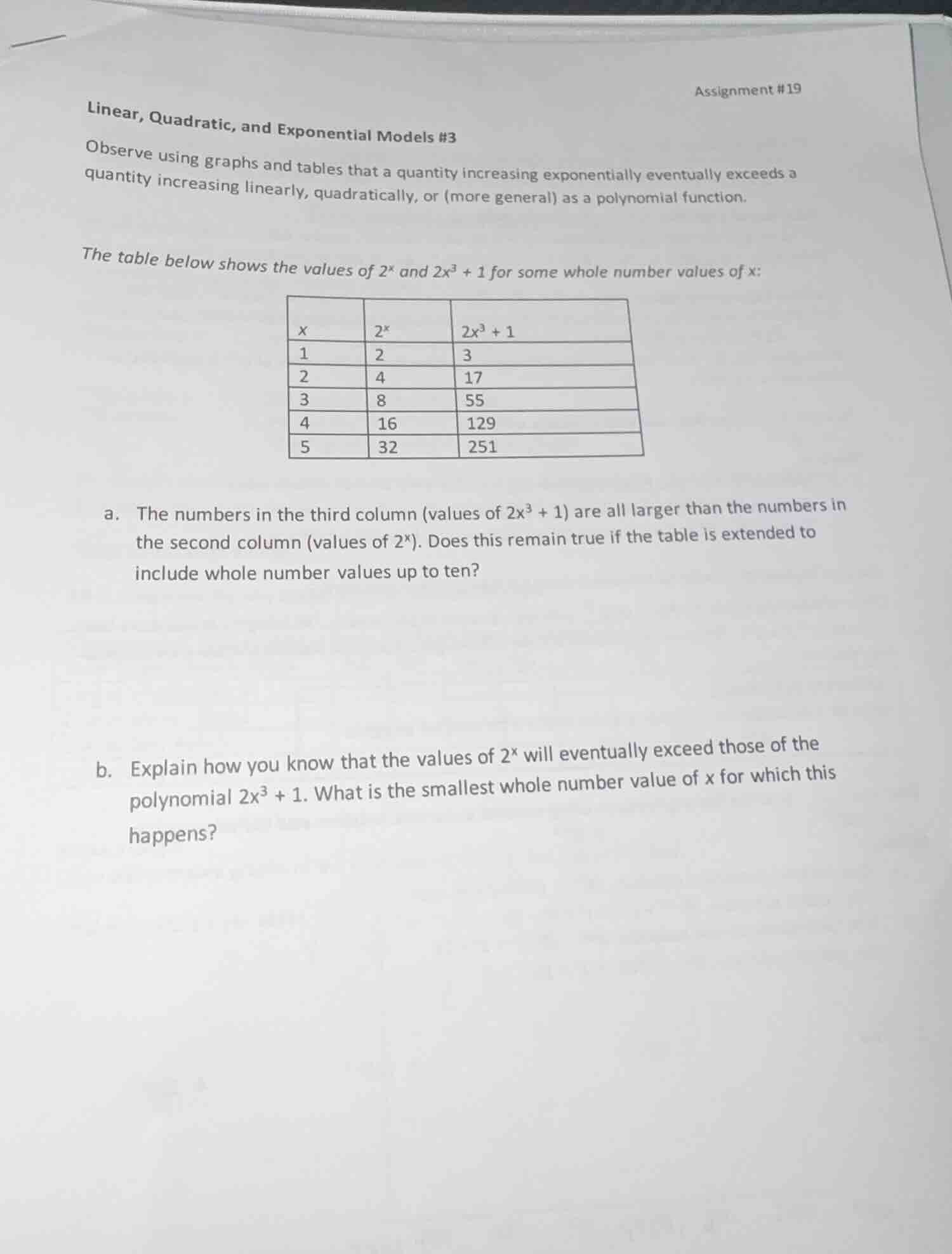
linear, quadratic, and exponential models #3
observe using graphs and tables that a quantity increasing exponentially eventually exceeds a quantity increasing linearly, quadratically, or (more general) as a polynomial function.
the table below shows the values of (2^x) and (2x^3 + 1) for some whole number values of (x):
| (x) | (2^x) | (2x^3 + 1) |
|---|---|---|
| 2 | 4 | 17 |
| 3 | 8 | 55 |
| 4 | 16 | 129 |
| 5 | 32 | 251 |
a. the numbers in the third column (values of (2x^3 + 1)) are all larger than the numbers in the second column (values of (2^x)). does this remain true if the table is extended to include whole number values up to ten?
b. explain how you know that the values of (2^x) will eventually exceed those of the polynomial (2x^3 + 1). what is the smallest whole number value of (x) for which this happens?
Part (a)
Step 1: Calculate for \( x = 6 \)
For \( 2^x \), when \( x = 6 \), \( 2^6 = 64 \). For \( 2x^3 + 1 \), when \( x = 6 \), \( 2(6)^3 + 1 = 2(216)+1 = 432 + 1 = 433 \). Here, \( 2x^3 + 1>2^x \).
Step 2: Calculate for \( x = 7 \)
For \( 2^x \), \( 2^7 = 128 \). For \( 2x^3 + 1 \), \( 2(7)^3 + 1 = 2(343)+1 = 686 + 1 = 687 \). Still, \( 2x^3 + 1>2^x \).
Step 3: Calculate for \( x = 8 \)
For \( 2^x \), \( 2^8 = 256 \). For \( 2x^3 + 1 \), \( 2(8)^3 + 1 = 2(512)+1 = 1024 + 1 = 1025 \). \( 2x^3 + 1>2^x \).
Step 4: Calculate for \( x = 9 \)
For \( 2^x \), \( 2^9 = 512 \). For \( 2x^3 + 1 \), \( 2(9)^3 + 1 = 2(729)+1 = 1458 + 1 = 1459 \). \( 2x^3 + 1>2^x \).
Step 5: Calculate for \( x = 10 \)
For \( 2^x \), \( 2^{10}=1024 \). For \( 2x^3 + 1 \), \( 2(10)^3 + 1 = 2(1000)+1 = 2000 + 1 = 2001 \). \( 2x^3 + 1>2^x \).
So, when we extend the table to \( x = 10 \), the values of \( 2x^3 + 1 \) are still larger than \( 2^x \).
Part (b)
Step 1: Recall Growth Rates
Exponential functions (like \( 2^x \)) have a growth rate that is proportional to their current value (the derivative of \( a^x \) is \( \ln(a)a^x \), which is an exponential function itself). Polynomial functions (like \( 2x^3 + 1 \)) have a growth rate proportional to a polynomial of one degree less (the derivative of \( 2x^3+1 \) is \( 6x^2 \), a quadratic function). As \( x \) becomes very large, the exponential function's growth rate will outpace the polynomial's growth rate because the exponential function's rate of increase accelerates faster than the polynomial's.
Step 2: Find the Smallest \( x \)
We continue calculating:
- For \( x = 11 \): \( 2^{11}=2048 \), \( 2(11)^3 + 1 = 2(1331)+1 = 2662 + 1 = 2663 \). \( 2x^3 + 1>2^x \).
- For \( x = 12 \): \( 2^{12}=4096 \), \( 2(12)^3 + 1 = 2(1728)+1 = 3456 + 1 = 3457 \). \( 2x^3 + 1>2^x \).
- For \( x = 13 \): \( 2^{13}=8192 \), \( 2(13)^3 + 1 = 2(2197)+1 = 4394 + 1 = 4395 \). Now, \( 2^x(8192)>2x^3 + 1(4395) \).

Snap & solve any problem in the app
Get step-by-step solutions on Sovi AI
Photo-based solutions with guided steps
Explore more problems and detailed explanations
(Part a):
Yes, the values of \( 2x^3 + 1 \) remain larger than \( 2^x \) when the table is extended to whole numbers up to ten.