QUESTION IMAGE
Question
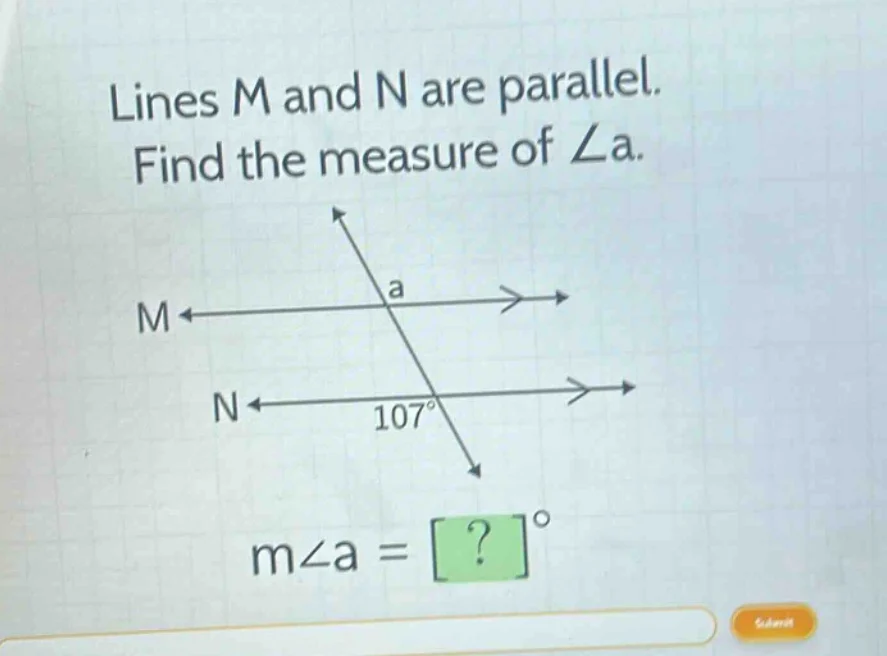
lines m and n are parallel. find the measure of ∠a. m← → n← → 107° m∠a = ?°
Step1: Identify angle relationship
Since lines M and N are parallel, and the transversal creates a 107° angle and ∠a, they are same - side interior angles or we can also consider the linear pair and corresponding angles. Wait, actually, ∠a and the 107° angle are same - side interior angles? No, wait, let's look at the diagram. The angle of 107° and the angle adjacent to ∠a (if we consider the vertical angles or corresponding angles) – actually, ∠a and the 107° angle are supplementary? Wait, no, let's think again. When two parallel lines are cut by a transversal, consecutive interior angles are supplementary. But also, the angle of 107° and ∠a: let's see, the angle with 107° and ∠a, since lines are parallel, ∠a and the angle that is supplementary to 107°? Wait, no, maybe ∠a and the 107° angle are same - side interior angles? Wait, no, let's use the property of parallel lines and transversal. The angle of 107° and ∠a: if we look at the vertical angle of the 107° angle, it is equal to 107°, and then ∠a and that vertical angle are same - side interior angles? No, wait, maybe I made a mistake. Wait, the correct approach: when two parallel lines are cut by a transversal, the consecutive interior angles are supplementary. But also, ∠a and the 107° angle: let's see, the angle of 107° and ∠a, since they are on the same side of the transversal and between the two parallel lines? No, wait, actually, ∠a and the 107° angle are supplementary? Wait, no, 180 - 107 = 73? No, that's not right. Wait, no, maybe ∠a and the 107° angle are corresponding angles? Wait, no, the diagram: line M and N are parallel, transversal cuts them. The angle at line N is 107°, and ∠a is at line M. So ∠a and the angle that is supplementary to 107°? Wait, no, let's use the fact that when two parallel lines are cut by a transversal, alternate interior angles are equal, corresponding angles are equal, and consecutive interior angles are supplementary. Wait, the angle of 107° and ∠a: let's see, the angle with 107° and ∠a, if we consider the linear pair. Wait, maybe the 107° angle and ∠a are same - side interior angles, so they are supplementary? Wait, no, 180 - 107 = 73? No, that can't be. Wait, no, I think I messed up. Wait, the angle of 107° and ∠a: actually, ∠a is equal to 107°? No, that doesn't make sense. Wait, no, let's look at the diagram again. The two parallel lines M and N, transversal crosses them. The angle marked 107° and ∠a: ∠a and the 107° angle are same - side interior angles? No, wait, consecutive interior angles are supplementary. Wait, no, maybe the angle of 107° and ∠a are corresponding angles? No, that would be equal. Wait, I think I made a mistake in the angle relationship. Wait, let's use the property: when two parallel lines are cut by a transversal, the sum of consecutive interior angles is 180 degrees. But also, the angle of 107° and ∠a: if we look at the vertical angle of the 107° angle, it is 107°, and then ∠a and that vertical angle are same - side interior angles, so they are supplementary? Wait, no, that would mean ∠a + 107°=180°, so ∠a = 180 - 107 = 73? No, that's not right. Wait, no, maybe the 107° angle and ∠a are corresponding angles? No, that would be equal. Wait, I think I need to re - examine the diagram. The line M and N are parallel, transversal cuts them. The angle at line N is 107°, and ∠a is at line M. So ∠a and the 107° angle are same - side interior angles? Wait, no, consecutive interior angles are supplementary. Wait, maybe the 107° angle and ∠a are supplementary. Wait, 180 - 107 = 73? No, that can't be. Wait, no, maybe I got th…

Snap & solve any problem in the app
Get step-by-step solutions on Sovi AI
Photo-based solutions with guided steps
Explore more problems and detailed explanations
73