QUESTION IMAGE
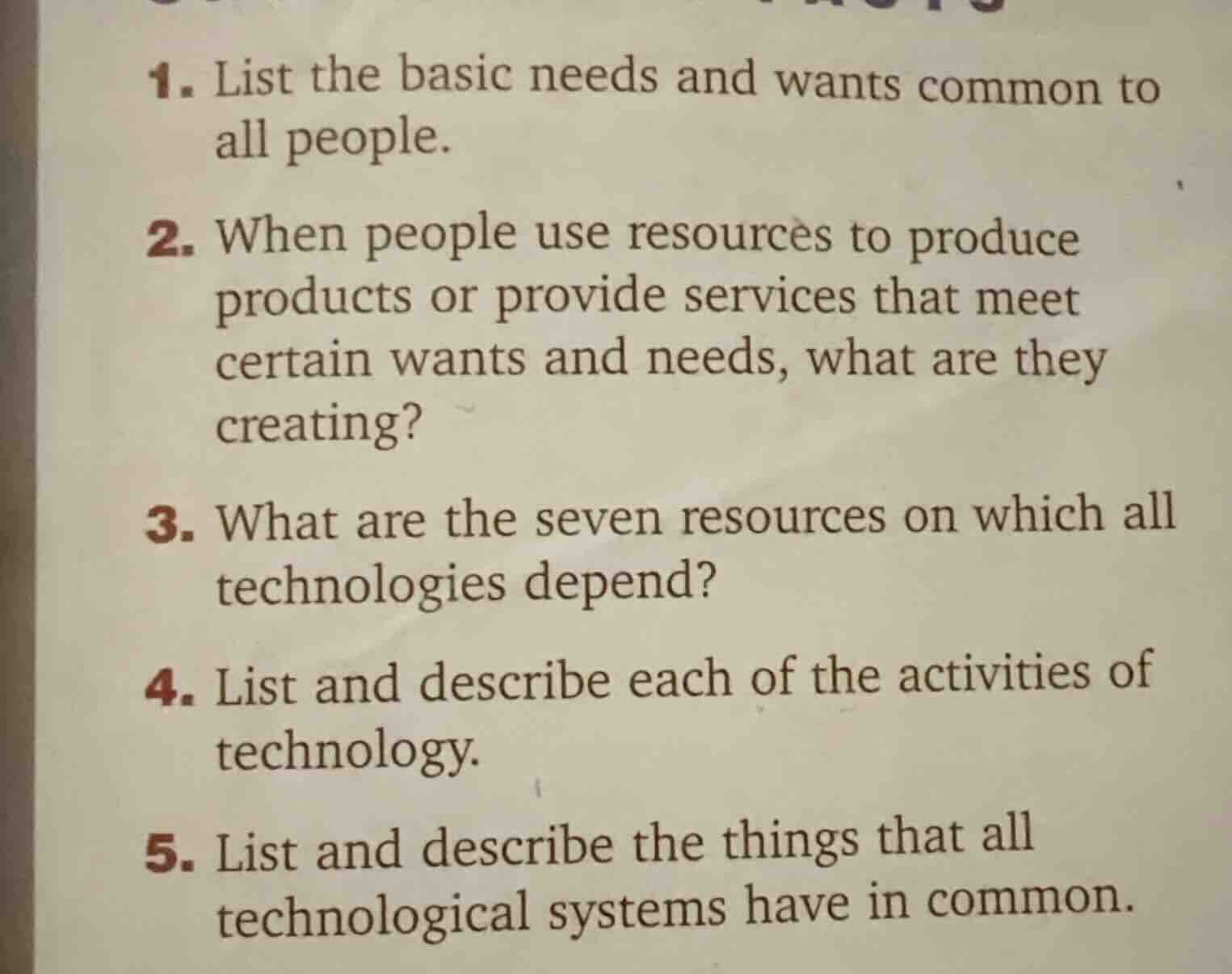
Question
- list the basic needs and wants common to all people.
- when people use resources to produce products or provide services that meet certain wants and needs, what are they creating?
- what are the seven resources on which all technologies depend?
- list and describe each of the activities of technology.
- list and describe the things that all technological systems have in common.
Brief Explanations
- Basic needs are essential for survival; wants are non-essential desires.
- This is the core definition of economic/productive output for needs/wants.
- These are the foundational inputs for all technological development.
- These are the core actions that define technological practice.
- These are shared structural/functional traits across all tech systems.

Snap & solve any problem in the app
Get step-by-step solutions on Sovi AI
Photo-based solutions with guided steps
Explore more problems and detailed explanations
- Basic Needs: Clean water, nutritious food, safe shelter, breathable air, clothing for protection.
Wants: Luxury clothing, entertainment (streaming, games), upscale housing, gourmet meals, leisure travel.
- They are creating goods and services (or value that satisfies human needs and wants).
- The seven resources are: people (labor/knowledge), information, materials, tools and machines, energy, capital, and time.
- - Identifying a Problem/Need: Recognizing a gap or issue that technology can address, e.g., identifying limited access to clean water in a community.
- Researching and Gathering Information: Collecting data, existing knowledge, and relevant data to inform solutions, e.g., studying water purification methods.
- Designing a Solution: Creating a plan or prototype for a technology to solve the problem, e.g., drafting a design for a low-cost water filter.
- Developing/Testing the Prototype: Building and testing a preliminary version to refine functionality, e.g., building the filter and testing its ability to remove contaminants.
- Producing the Technology: Manufacturing the final product or implementing the service at scale, e.g., mass-producing the water filters.
- Using the Technology: End users utilizing the product/service to meet the identified need, e.g., community members using the filters for clean water.
- Maintaining and Evaluating the Technology: Monitoring performance, making repairs, and assessing if it still meets the need over time, e.g., checking filters regularly and replacing parts as needed.
- - Goal-Oriented: All exist to fulfill a specific human need or solve a defined problem, e.g., a car system aims to provide transportation.
- Input-Output System: They take resources (inputs like energy, materials) and convert them into useful outputs (products, services), e.g., a solar panel system uses sunlight (input) to produce electricity (output).
- Interconnected Components: Made up of multiple parts that work together; if one component fails, the system may not function, e.g., a computer relies on a processor, memory, and power supply working in tandem.
- Feedback Mechanism: Have ways to adjust based on performance or changing conditions, e.g., a thermostat that adjusts heating based on measured room temperature.
- Life Cycle: Go through stages from design and production to use, maintenance, and eventual disposal/recycling, e.g., a smartphone is designed, manufactured, used, repaired, and eventually recycled.