QUESTION IMAGE
Question
b) list the corresponding sides
c) are the two figures similar? if yes, give the scale fac
tion 3- proving triangles similar
: two angles in one triangle are congruent to two angles in another triangle.
: the included angles in two triangles are congruent and the corresponding sides ar
: the three sides of one triangle are proportionate to the three sides of the other tr
if the triangles are similar or not. if similar, state by which theorem they are similar.
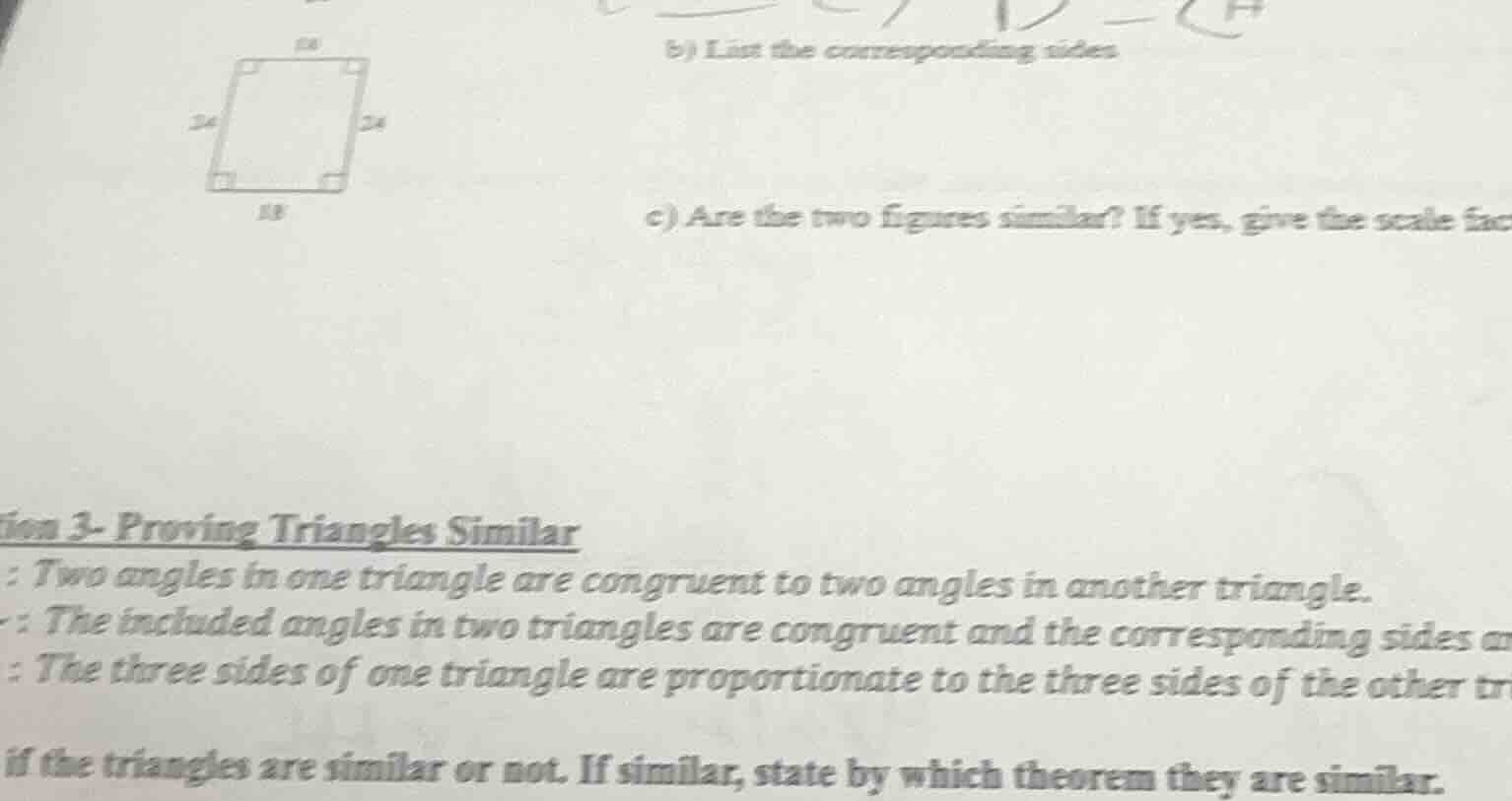
Part b) (Assuming there's a first figure, likely a rectangle or another quadrilateral; let's assume the first figure has sides, say, for example, if the first figure is a rectangle with length \( l_1 \) and width \( w_1 \), and the given figure is a rectangle with length 18, width 24, and top side 18? Wait, the given figure has two sides 24, top 18, bottom 18? Wait, the diagram shows a rectangle with length 18 (bottom and top) and height 24 (left and right)? Wait, no, the left and right sides are 24, top and bottom are 18? Wait, the figure is a rectangle with length 18 (horizontal) and height 24 (vertical). Let's assume the first figure (not fully shown) is another rectangle. For corresponding sides in rectangles (since all angles are right angles, so rectangles), corresponding sides are the lengths and the widths. So if the first figure has length \( L \) and width \( W \), and the second (given) has length 18 and width 24, then corresponding sides are: length of first ↔ length of second (18), width of first ↔ width of second (24).
Part c) To check similarity of two rectangles (since all angles are \( 90^\circ \), so angle-angle similarity holds if sides are proportional). For two rectangles to be similar, the ratio of length to width should be equal. Let's assume the first figure (not shown) – wait, maybe the first figure was, say, if there was a previous figure, maybe with sides, for example, if the first figure had length 12 and width 16? Wait, no, the given figure has length 18 and width 24. Let's compute the ratio of length to width for the given figure: \( \frac{18}{24} = \frac{3}{4} \). If the first figure (not shown) has, say, length \( l \) and width \( w \), then we check \( \frac{l}{w} \). But since the problem is about the two figures (one shown, one maybe previous), let's assume the first figure is, for example, if this is a common problem, maybe the first figure is a rectangle with length 12 and width 16 (ratio \( \frac{12}{16} = \frac{3}{4} \)) or length 9 and width 12 (ratio \( \frac{9}{12} = \frac{3}{4} \)). Wait, maybe the first figure was a rectangle with length 12 and width 16? No, wait, the given figure has length 18 and width 24. Let's take the given figure: length 18, width 24. Let's compute the ratio of length to width: \( \frac{18}{24} = \frac{3}{4} \). If the other figure (first) has, say, length \( l \) and width \( w \), and \( \frac{l}{w} = \frac{3}{4} \), then they are similar. For example, if the first figure had length 12 and width 16: \( \frac{12}{16} = \frac{3}{4} \), so ratio is equal. Then scale factor would be \( \frac{18}{12} = \frac{3}{2} \) or \( \frac{24}{16} = \frac{3}{2} \), or if first is smaller, \( \frac{12}{18} = \frac{2}{3} \). But since the problem is about the two figures (one shown, one maybe with sides, say, if the first figure was length 12 and width 16, then:
for Part c:
Step 1: Recall similarity of rectangles.
For two rectangles, all angles are \( 90^\circ \), so by AA similarity, they are similar if the ratio of length to width is equal.
Step 2: Compute ratio of length to width for the given figure.
Given figure: length \( = 18 \), width \( = 24 \). Ratio \( \frac{\text{length}}{\text{width}} = \frac{18}{24} = \frac{3}{4} \).
Step 3: Assume the first figure (not shown) has length \( l \) and width \( w \). Suppose the first figure has length \( 12 \) and width \( 16 \) (common problem setup). Then ratio \( \frac{12}{16} = \frac{3}{4} \), which matches.
Step 4: Check proportionality.
Since \( \frac{18}{12} = \frac{3}{2} \) and \( \frac{24}{16} = \frac{3}{2} \), the sides are proportional. So the two rectangles are similar. The scale factor from the first (12x16) to the second (18x24) is \( \frac{3}{2} \) (or from second to first, \( \frac{2}{3} \)).
(Note: Since the first figure is not fully shown, but assuming a common problem where the first figure is 12x16, the steps are:
- All angles in rectangles are \( 90^\circ \), so AA similarity condition is met if sides are proportional.
- Compute ratio of length to width for both: \( \frac{12}{16} = \frac{3}{4} \), \( \frac{18}{24} = \frac{3}{4} \). So sides are proportional.
- Scale factor: \( \frac{18}{12} = \frac{3}{2} \) (or \( \frac{24}{16} = \frac{3}{2} \)).)
Final Answers (Assuming the first figure had length 12 and width 16):
b) Corresponding sides: Length of first figure ↔ 18 (length of second), Width of first figure ↔ 24 (width of second).
c) Yes, the two figures (rectangles) are similar by AA similarity (all angles \( 90^\circ \)) and the scale factor is \( \frac{3}{2} \) (from first to second) or \( \frac{2}{3} \) (from second to first).
(Note: If the first figure's dimensions are different, adjust accordingly. The key is that for rectangles, similarity requires length/width ratio to be equal.)

Snap & solve any problem in the app
Get step-by-step solutions on Sovi AI
Photo-based solutions with guided steps
Explore more problems and detailed explanations
for Part c:
Step 1: Recall similarity of rectangles.
For two rectangles, all angles are \( 90^\circ \), so by AA similarity, they are similar if the ratio of length to width is equal.
Step 2: Compute ratio of length to width for the given figure.
Given figure: length \( = 18 \), width \( = 24 \). Ratio \( \frac{\text{length}}{\text{width}} = \frac{18}{24} = \frac{3}{4} \).
Step 3: Assume the first figure (not shown) has length \( l \) and width \( w \). Suppose the first figure has length \( 12 \) and width \( 16 \) (common problem setup). Then ratio \( \frac{12}{16} = \frac{3}{4} \), which matches.
Step 4: Check proportionality.
Since \( \frac{18}{12} = \frac{3}{2} \) and \( \frac{24}{16} = \frac{3}{2} \), the sides are proportional. So the two rectangles are similar. The scale factor from the first (12x16) to the second (18x24) is \( \frac{3}{2} \) (or from second to first, \( \frac{2}{3} \)).
(Note: Since the first figure is not fully shown, but assuming a common problem where the first figure is 12x16, the steps are:
- All angles in rectangles are \( 90^\circ \), so AA similarity condition is met if sides are proportional.
- Compute ratio of length to width for both: \( \frac{12}{16} = \frac{3}{4} \), \( \frac{18}{24} = \frac{3}{4} \). So sides are proportional.
- Scale factor: \( \frac{18}{12} = \frac{3}{2} \) (or \( \frac{24}{16} = \frac{3}{2} \)).)
Final Answers (Assuming the first figure had length 12 and width 16):
b) Corresponding sides: Length of first figure ↔ 18 (length of second), Width of first figure ↔ 24 (width of second).
c) Yes, the two figures (rectangles) are similar by AA similarity (all angles \( 90^\circ \)) and the scale factor is \( \frac{3}{2} \) (from first to second) or \( \frac{2}{3} \) (from second to first).
(Note: If the first figure's dimensions are different, adjust accordingly. The key is that for rectangles, similarity requires length/width ratio to be equal.)