QUESTION IMAGE
Question
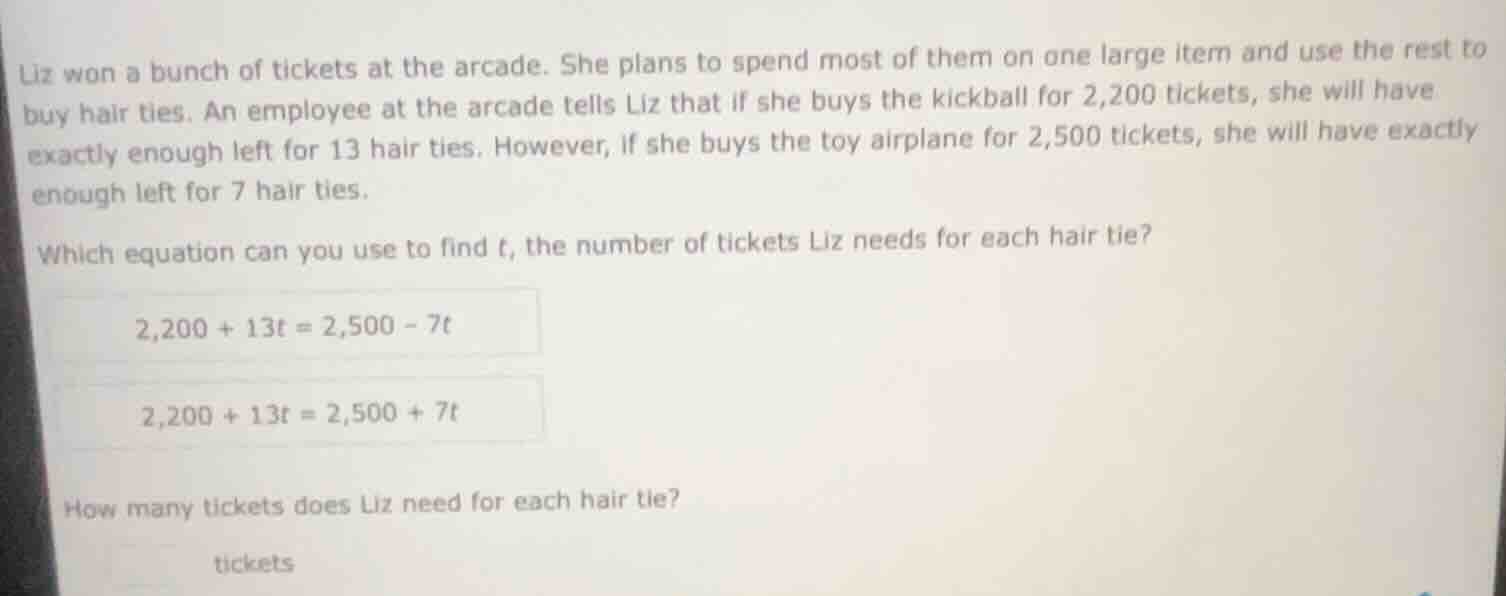
liz won a bunch of tickets at the arcade. she plans to spend most of them on one large item and use the rest to buy hair ties. an employee at the arcade tells liz that if she buys the kickball for 2,200 tickets, she will have exactly enough left for 13 hair ties. however, if she buys the toy airplane for 2,500 tickets, she will have exactly enough left for 7 hair ties. which equation can you use to find t, the number of tickets liz needs for each hair tie? 2,200 + 13t = 2,500 - 7t 2,200 + 13t = 2,500 + 7t how many tickets does liz need for each hair tie? tickets
Part 1: Finding the Correct Equation
Let \( t \) be the number of tickets per hair tie. The total number of tickets Liz has is constant. When she buys the kickball (2,200 tickets) and 13 hair ties, total tickets are \( 2200 + 13t \). When she buys the toy airplane (2,500 tickets) and 7 hair ties, total tickets are \( 2500 + 7t \)? No, wait—actually, if buying the kickball leaves enough for 13 hair ties, total tickets = 2200 + 13t. Buying the toy airplane (2500 tickets) leaves enough for 7 hair ties, so total tickets = 2500 + 7t? Wait, no, that's not right. Wait, if she spends 2200 on kickball, the remaining is 13t, so total tickets \( T = 2200 + 13t \). If she spends 2500 on toy airplane, remaining is 7t, so \( T = 2500 + 7t \)? But that would mean \( 2200 + 13t = 2500 + 7t \)? Wait, no, maybe I messed up. Wait, no—if she buys the kickball (2200), then the rest is 13t, so total tickets \( T = 2200 + 13t \). If she buys the toy airplane (2500), the rest is 7t, so \( T = 2500 + 7t \)? But that would be \( 2200 + 13t = 2500 + 7t \). Wait, but the first option is \( 2200 + 13t = 2500 - 7t \), which would be wrong. Wait, no—maybe I got the direction wrong. Wait, if she buys the kickball, she uses 2200, then has 13t left? No, no—she spends 2200 on kickball, then uses the rest (13t) on hair ties. So total tickets \( T = 2200 + 13t \). If she spends 2500 on toy airplane, then uses the rest (7t) on hair ties. So \( T = 2500 + 7t \). Therefore, \( 2200 + 13t = 2500 + 7t \). Wait, but let's check again. Wait, maybe the "left" is the remaining tickets after buying the large item, so total tickets \( T = 2200 + 13t \) (since 2200 for kickball, 13t for hair ties) and \( T = 2500 + 7t \) (2500 for toy airplane, 7t for hair ties). So the equation is \( 2200 + 13t = 2500 + 7t \), which is the second option. Wait, but let's see the options. The first option is \( 2200 + 13t = 2500 - 7t \), second is \( 2200 + 13t = 2500 + 7t \). Wait, maybe I made a mistake. Wait, no—if "left for 13 hair ties" means the remaining tickets after buying kickball is 13t, so \( T - 2200 = 13t \) → \( T = 2200 + 13t \). Similarly, \( T - 2500 = 7t \) → \( T = 2500 + 7t \). So setting them equal: \( 2200 + 13t = 2500 + 7t \). So the correct equation is \( 2200 + 13t = 2500 + 7t \).
Step 1: Start with the correct equation
We have the equation \( 2200 + 13t = 2500 + 7t \).
Step 2: Subtract \( 7t \) from both sides
\( 2200 + 13t - 7t = 2500 + 7t - 7t \)
\( 2200 + 6t = 2500 \)
Step 3: Subtract 2200 from both sides
\( 2200 + 6t - 2200 = 2500 - 2200 \)
\( 6t = 300 \)
Step 4: Divide both sides by 6
\( t = \frac{300}{6} \)
\( t = 50 \)

Snap & solve any problem in the app
Get step-by-step solutions on Sovi AI
Photo-based solutions with guided steps
Explore more problems and detailed explanations
\( 2,200 + 13t = 2,500 + 7t \)