QUESTION IMAGE
Question
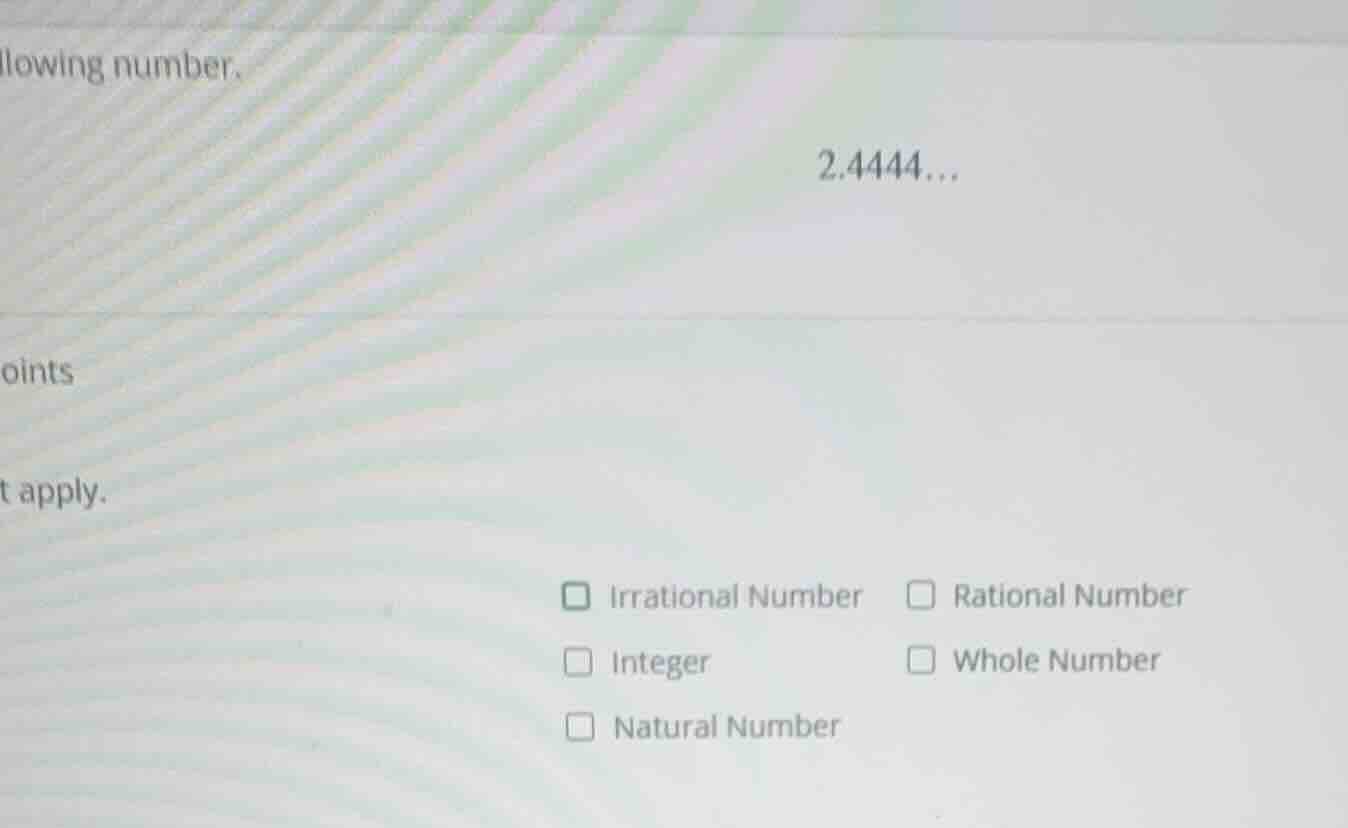
llowing number.
2.4444...
oints
t apply.
☐ irrational number ☐ rational number
☐ integer ☐ whole number
☐ natural number
Step1: Recall number definitions
- Natural Numbers: Positive integers (1, 2, 3, ...). \(2.4444...\) is not an integer, so not natural.
- Whole Numbers: Non - negative integers (0, 1, 2, ...). \(2.4444...\) is not an integer, so not whole.
- Integers: ..., -2, -1, 0, 1, 2, ... \(2.4444...\) has a decimal part, so not an integer.
- Irrational Numbers: Numbers that cannot be expressed as \(\frac{p}{q}\) (\(p,q\) integers, \(q
eq0\)) and have non - repeating, non - terminating decimals. \(2.4444...\) has a repeating decimal (4 repeats), so not irrational.
- Rational Numbers: Numbers that can be expressed as \(\frac{p}{q}\) (\(p,q\) integers, \(q
eq0\)). Let \(x = 2.4444...\)
Step2: Convert repeating decimal to fraction
Multiply \(x\) by 10: \(10x=24.4444...\)
Subtract \(x\) from \(10x\): \(10x - x=24.4444...-2.4444...\)
\(9x = 22\), so \(x=\frac{22}{9}\), which is in the form \(\frac{p}{q}\) (\(p = 22\), \(q = 9\), integers, \(q
eq0\)). So \(2.4444...\) is a rational number.

Snap & solve any problem in the app
Get step-by-step solutions on Sovi AI
Photo-based solutions with guided steps
Explore more problems and detailed explanations
Rational Number (and uncheck Irrational Number, Integer, Whole Number, Natural Number)