QUESTION IMAGE
Question
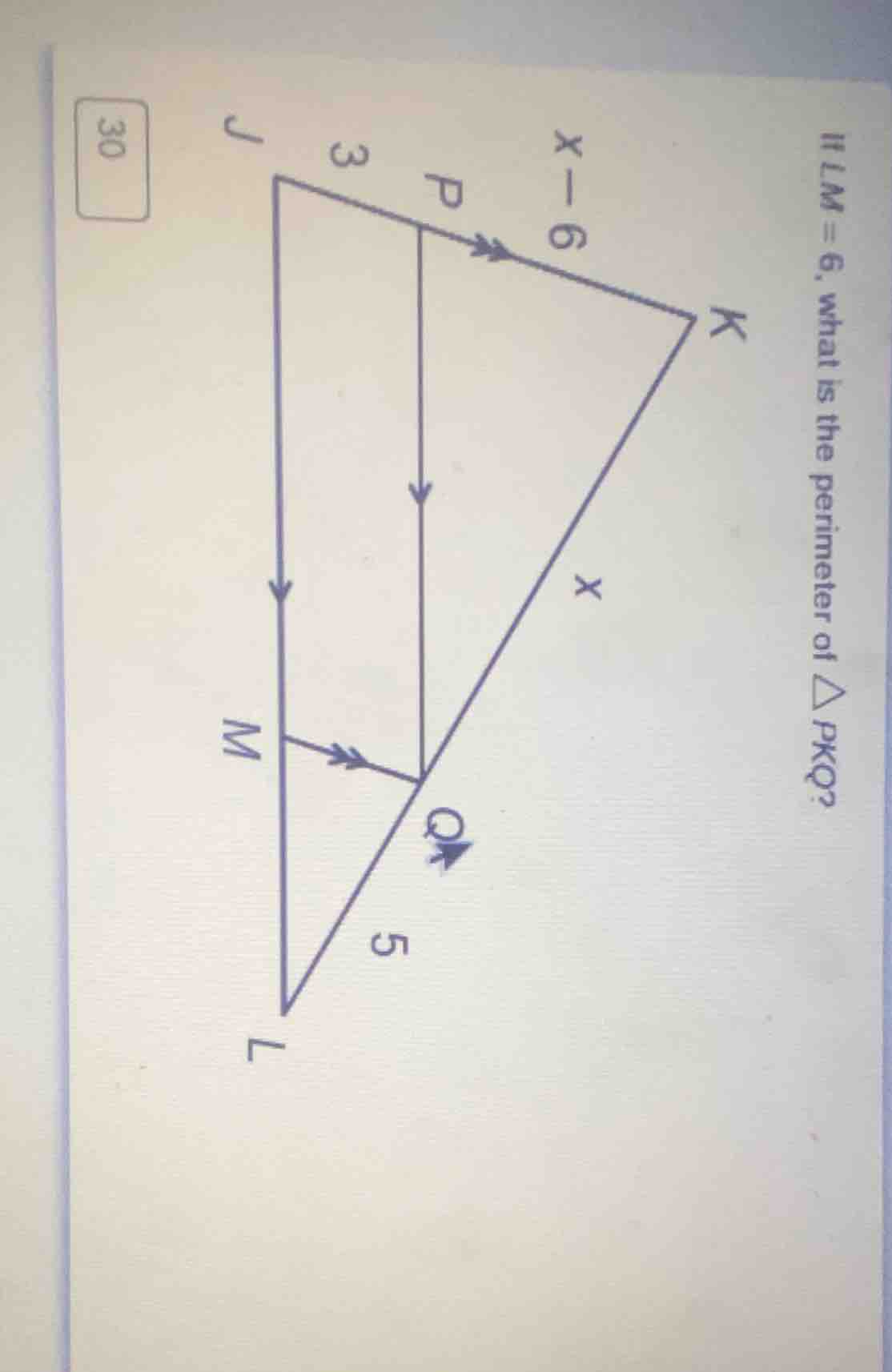
if lm = 6, what is the perimeter of △pkq?
Step1: Identify Similar Triangles
Since \( PM \parallel LK \) (assuming the parallel lines from the diagram), triangles \( \triangle JPM \) and \( \triangle JKL \) are similar, and also \( \triangle PQK \) and \( \triangle LQJ \)? Wait, maybe better to use the Basic Proportionality Theorem (Thales' theorem). Wait, the diagram shows \( JP = 3 \), \( PK = x - 6 \), \( LQ = 5 \), \( QK = x \), and \( LM = 6 \). Wait, maybe the segments are such that \( JP = 3 \), \( JL \) has \( JM \) and \( ML = 6 \)? Wait, maybe the key is that \( PQ \parallel JL \) or something. Wait, perhaps the ratio of segments: \( \frac{JP}{JK} = \frac{LM}{LK} \)? Wait, no, let's re-examine.
Wait, the problem says "If \( LM = 6 \), what is the perimeter of \( \triangle PKQ \)?" Let's assume that \( JP = 3 \), \( PK = x - 6 \), \( LQ = 5 \), \( QK = x \), and \( LM = 6 \). Also, since \( PM \parallel LQ \) (from the arrows), triangles \( \triangle JPM \) and \( \triangle JQL \) are similar? Wait, maybe the ratio of \( JP \) to \( JL \) is equal to the ratio of \( PM \) to \( LQ \). Wait, \( JP = 3 \), \( JL = JP + PL \)? No, maybe \( JP = 3 \), \( PK = x - 6 \), so \( JK = JP + PK = 3 + (x - 6) = x - 3 \). Similarly, \( LQ = 5 \), \( QK = x \), so \( LK = LQ + QK = 5 + x \). Wait, no, maybe the triangles \( \triangle PKQ \) and \( \triangle LKJ \) are similar? Wait, the parallel lines suggest that \( PQ \parallel JL \), so by Thales' theorem, \( \frac{PK}{JK} = \frac{QK}{LK} \). Wait, \( JK = 3 + (x - 6) = x - 3 \), \( PK = x - 6 \), \( LK = 5 + x \), \( QK = x \). So \( \frac{x - 6}{x - 3} = \frac{x}{x + 5} \)? Wait, that might not be right. Alternatively, maybe \( JP = 3 \), \( LM = 6 \), so the ratio of similarity is \( \frac{3}{3 + 6} = \frac{1}{3} \)? Wait, no, maybe \( JP = 3 \), \( JM = 3 \), \( ML = 6 \), so \( JL = 3 + 6 = 9 \). Then the ratio of \( JP \) to \( JL \) is \( \frac{3}{9} = \frac{1}{3} \). Then, if \( LQ = 5 \), then \( PQ = \frac{1}{3} \times 5 \)? No, that doesn't make sense. Wait, maybe the perimeter is calculated by finding \( x \) first.
Wait, let's assume that the triangles are similar with ratio \( \frac{JP}{JL} = \frac{PK}{QK} \). Wait, \( JP = 3 \), \( JL = 3 + 6 = 9 \) (since \( LM = 6 \)), so ratio \( \frac{3}{9} = \frac{1}{3} \). Then \( PK = x - 6 \), \( QK = x \), so \( \frac{x - 6}{x} = \frac{1}{3} \)? Wait, solving \( 3(x - 6) = x \) → \( 3x - 18 = x \) → \( 2x = 18 \) → \( x = 9 \). Then \( PK = x - 6 = 3 \), \( QK = x = 9 \), and \( PQ \) would be equal to \( LM = 6 \)? Wait, no, if \( x = 9 \), then \( PK = 3 \), \( QK = 9 \), and \( PQ = 6 \) (since \( LM = 6 \) and they are parallel, so \( PQ = LM = 6 \)? Wait, then the perimeter of \( \triangle PKQ \) is \( PK + QK + PQ = 3 + 9 + 6 = 18 \)? Wait, that doesn't seem right. Wait, maybe I made a mistake in the ratio.
Wait, another approach: The segments \( JP = 3 \), \( LM = 6 \), so the ratio of \( JP \) to \( LM \) is \( 3:6 = 1:2 \). So the ratio of similarity is \( 1:2 \). Then \( PK \) corresponds to \( QK \)? No, maybe \( JP = 3 \), \( PK = x - 6 \), \( LQ = 5 \), \( QK = x \), and the ratio of \( JP \) to \( JL \) (where \( JL = JP + PL = 3 + 6 = 9 \)) is \( 3:9 = 1:3 \), so \( PK = \frac{1}{3} QK \). So \( x - 6 = \frac{1}{3} x \). Solving: \( 3(x - 6) = x \) → \( 3x - 18 = x \) → \( 2x = 18 \) → \( x = 9 \). Then \( PK = 9 - 6 = 3 \), \( QK = 9 \), and \( PQ = LM = 6 \)? Wait, no, \( LM = 6 \), so \( PQ = 6 \). Then perimeter is \( 3 + 9 + 6 = 18 \)? Wait, but that seems low. Wait, maybe the ratio is \( JP:JL = 3:(3 + 6) = 1:3 \), so \( PK = \frac{1}{3} QK \),…

Snap & solve any problem in the app
Get step-by-step solutions on Sovi AI
Photo-based solutions with guided steps
Explore more problems and detailed explanations
18