QUESTION IMAGE
Question
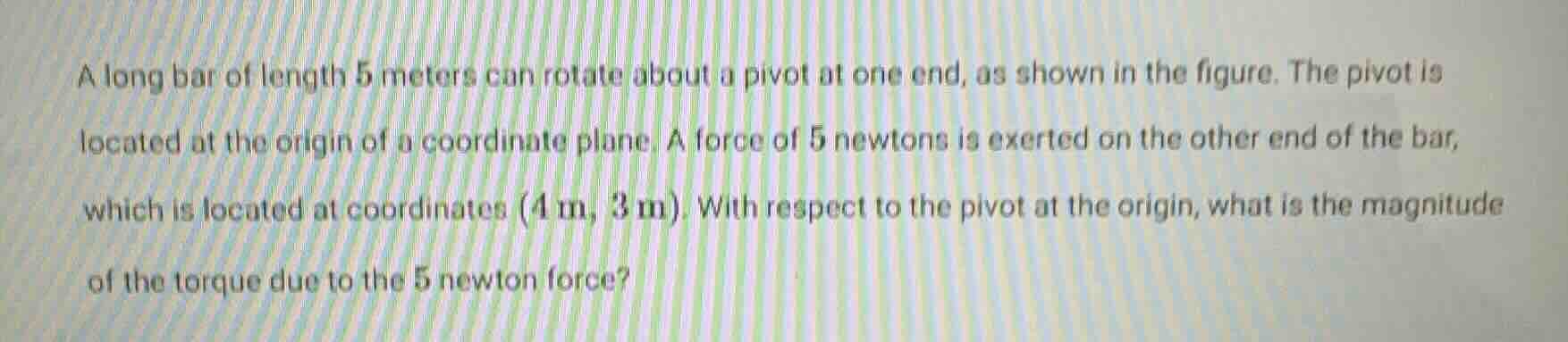
a long bar of length 5 meters can rotate about a pivot at one end, as shown in the figure. the pivot is located at the origin of a coordinate plane. a force of 5 newtons is exerted on the other end of the bar, which is located at coordinates (4 m, 3 m). with respect to the pivot at the origin, what is the magnitude of the torque due to the 5 newton force?
Step1: Recall the torque formula
Torque \(\tau\) is given by the cross - product of the position vector \(\vec{r}\) and the force vector \(\vec{F}\), \(\tau=\vec{r}\times\vec{F}=rF\sin\theta\), where \(r\) is the magnitude of the position vector, \(F\) is the magnitude of the force, and \(\theta\) is the angle between \(\vec{r}\) and \(\vec{F}\). Another way to calculate the magnitude of the torque when we know the position vector \((x,y)\) and the force is perpendicular to the position vector (or we can use the formula \(\tau = xF_y - yF_x\) if the force is along a certain direction, but in the case where the force is perpendicular to the position vector (or we can also use the fact that the lever arm \(d\) (the perpendicular distance from the pivot to the line of action of the force) can be calculated. First, find the magnitude of the position vector \(r\). The position vector \(\vec{r}\) has coordinates \((4\space m,3\space m)\), so \(r=\sqrt{x^{2}+y^{2}}=\sqrt{4^{2}+3^{2}}=\sqrt{16 + 9}=\sqrt{25}=5\space m\), which is equal to the length of the bar (as given, the bar length is 5 meters, so this checks out).
Step2: Determine the angle or the lever arm
We know that the force is exerted at the end of the bar. The line of action of the force: if we assume the force is perpendicular to the bar (since the bar can rotate about the pivot, and the force is exerted at the end, we can consider the force is perpendicular to the position vector for maximum torque, or we can calculate the lever arm. The lever arm \(d\) is the perpendicular distance from the pivot to the line of action of the force. Since the position vector is from \((0,0)\) to \((4,3)\), the slope of the position vector is \(m=\frac{3}{4}\). The force is perpendicular to the bar (assuming the force is applied perpendicular to the bar for rotational motion), so the lever arm can also be calculated as the length of the position vector times \(\sin\theta\), but we can also use the formula \(\tau = rF\sin\theta\). Alternatively, we can use the formula \(\tau=x F_y - yF_x\). But if the force is perpendicular to the position vector, and we know that the magnitude of the position vector \(r = 5\space m\), force \(F = 5\space N\). We can also calculate the angle \(\theta\) between the position vector and the x - axis. \(\cos\theta=\frac{x}{r}=\frac{4}{5}\), \(\sin\theta=\frac{y}{r}=\frac{3}{5}\). If the force is perpendicular to the bar (i.e., the force is tangential to the circular path of the end of the bar), then the angle between \(\vec{r}\) and \(\vec{F}\) is \(90^{\circ}\), so \(\sin\theta = 1\). Wait, another approach: the torque can also be calculated as the product of the force and the lever arm. The lever arm \(d\) is the perpendicular distance from the pivot to the line of action of the force. Since the position vector is \((4,3)\), and if the force is applied perpendicular to the bar, the lever arm is equal to the length of the bar? No, wait, the length of the bar is the magnitude of the position vector \(r = 5\space m\). If the force is applied perpendicular to the bar, then the torque \(\tau=rF\sin90^{\circ}\). But we can also calculate the torque using the components. Let's assume the force is perpendicular to the position vector. The position vector \(\vec{r}=4\hat{i}+3\hat{j}\), and if the force is perpendicular to \(\vec{r}\), the force vector \(\vec{F}\) can be, for example, \(- 3\hat{i}+4\hat{j}\) (since the dot product of \(\vec{r}\) and \(\vec{F}\) should be zero: \((4\hat{i}+3\hat{j})\cdot(-3\hat{i}+4\hat{j})=-12 + 12 = 0\)). The magnitude of \(\vec{F}\)…

Snap & solve any problem in the app
Get step-by-step solutions on Sovi AI
Photo-based solutions with guided steps
Explore more problems and detailed explanations
The magnitude of the torque is \(\boldsymbol{25}\space N\cdot m\)