QUESTION IMAGE
Question
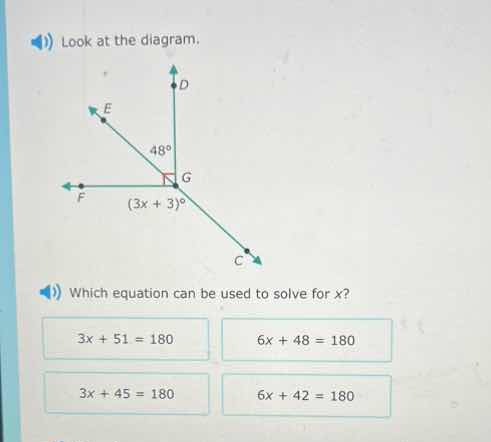
look at the diagram. which equation can be used to solve for x? 3x + 51 = 180; 6x + 48 = 180; 3x + 45 = 180; 6x + 42 = 180
Step1: Identify right angle and angles
Since \( \angle FGD \) is a right angle (\( 90^\circ \)), and the angles around point \( G \) on a straight line sum to \( 180^\circ \). Wait, actually, looking at the diagram, we have a right angle (from \( F \) to \( G \) to \( D \)) and angles \( 48^\circ \), \( (3x + 3)^\circ \), and another angle? Wait, no, actually, the angles \( \angle FGE \) is right angle? Wait, no, the diagram shows \( FG \perp GD \) (right angle at \( G \) between \( F \) and \( D \)), and the line \( EC \) passing through \( G \). So the sum of angles \( (3x + 3)^\circ \), \( 90^\circ \), and \( 48^\circ \) should be \( 180^\circ \)? Wait, no, maybe vertical angles or linear pair. Wait, actually, the angle opposite to \( (3x + 3)^\circ \) and \( 48^\circ \) with the right angle. Wait, let's re-express: the straight line, so the sum of \( (3x + 3)^\circ \), \( 90^\circ \), and \( 48^\circ \) is \( 180^\circ \)? Wait, no, maybe the two angles \( (3x + 3)^\circ \) and \( 48^\circ \) and the right angle form a straight line? Wait, no, the right angle is \( 90^\circ \), so \( (3x + 3) + 90 + 48 = 180 \)? Wait, solving that: \( 3x + 3 + 90 + 48 = 180 \) → \( 3x + 141 = 180 \) → \( 3x = 39 \) → \( x = 13 \). But the options are equations. Wait, maybe the diagram has two angles of \( (3x + 3)^\circ \) and \( 48^\circ \) and the right angle, but actually, maybe the angle \( (3x + 3)^\circ \) and its vertical angle, plus \( 48^\circ \) and the right angle. Wait, no, let's look at the options. The options are \( 3x + 51 = 180 \), \( 6x + 48 = 180 \), \( 3x + 45 = 180 \), \( 6x + 42 = 180 \). Wait, maybe the angle \( (3x + 3)^\circ \) and another angle \( (3x + 3)^\circ \) (vertical angles) and \( 48^\circ \) and another \( 48^\circ \)? No, maybe the sum of \( 2(3x + 3) + 48 = 180 \)? Wait, \( 2(3x + 3) + 48 = 6x + 6 + 48 = 6x + 54 = 180 \)? No, not matching. Wait, maybe the right angle is split, and the two angles \( (3x + 3)^\circ \) and \( 48^\circ \) are such that \( (3x + 3) + 48 + 90 = 180 \), but that would be \( 3x + 141 = 180 \) → \( 3x = 39 \) → \( x = 13 \). But the options: let's check the first option: \( 3x + 51 = 180 \). \( 3x = 129 \) → \( x = 43 \), no. Wait, maybe I made a mistake. Wait, the diagram: \( FG \) is horizontal, \( GD \) is vertical (right angle), \( EC \) is a line through \( G \), making angle \( 48^\circ \) with \( GD \), and angle \( (3x + 3)^\circ \) with \( FG \). Then, the angle between \( EC \) and \( FG \) is \( (3x + 3)^\circ \), and between \( EC \) and \( GD \) is \( 48^\circ \), so since \( FG \perp GD \), \( (3x + 3) + 48 = 90 \)? Wait, that would be \( 3x + 51 = 90 \), no. Wait, no, the straight line: the sum of angles on a straight line is \( 180^\circ \). So the angles on line \( FC \) (wait, no, line \( EC \)): the angles are \( (3x + 3)^\circ \), \( 90^\circ \), and \( 48^\circ \), so \( (3x + 3) + 90 + 48 = 180 \) → \( 3x + 141 = 180 \) → \( 3x = 39 \) → \( x = 13 \). But the options are equations. Wait, maybe the problem is that the two angles \( (3x + 3)^\circ \) and \( (3x + 3)^\circ \) (since vertical angles) and \( 48^\circ \) and \( 48^\circ \) sum to \( 180^\circ \)? No, that would be \( 2(3x + 3) + 2(48) = 180 \) → \( 6x + 6 + 96 = 180 \) → \( 6x + 102 = 180 \), no. Wait, maybe the right angle is not \( 90^\circ \), but the diagram has a straight line, so the sum of \( (3x + 3)^\circ \), \( 48^\circ \), and another angle equal to \( (3x + 3)^\circ \) is \( 180^\circ \)? Wait, no. Wait, let's look at the options. Let's expand each option:
- \( 3x + 51 = 180 \): \( 3x…

Snap & solve any problem in the app
Get step-by-step solutions on Sovi AI
Photo-based solutions with guided steps
Explore more problems and detailed explanations
\( 3x + 51 = 180 \) (the first option)