QUESTION IMAGE
Question
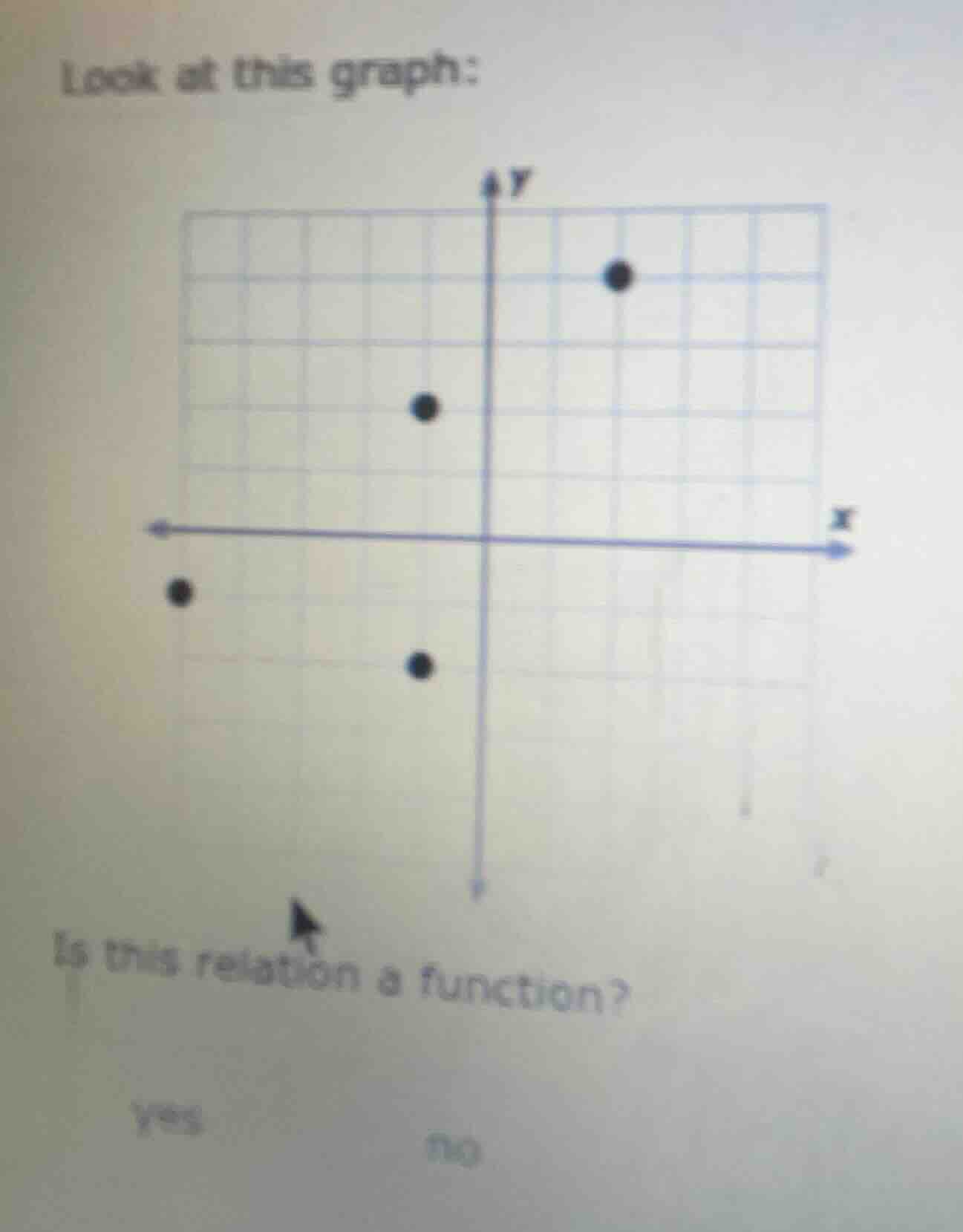
look at this graph: is this relation a function? yes no
Step1: Recall the definition of a function
A relation is a function if every input (x - value) has exactly one output (y - value). In other words, no two points in the relation can have the same x - coordinate with different y - coordinates.
Step2: Analyze the x - coordinates of the points
Let's identify the x - coordinates of each plotted point.
- The left - most point: Let's assume the grid has integer coordinates. From the graph, we can see that the points have x - coordinates: let's say the left - most point has \(x=-4\), the two middle points (the ones near the y - axis) have \(x = - 1\) (wait, no, looking at the graph, the two points that are vertically aligned (same x - coordinate)? Wait, no, let's check again. Wait, in the graph, do any two points have the same x - value? Let's list the points:
- Let's assume the coordinates: The left point: \((-4,-1)\) (approx, but the key is x - values). The two points near the y - axis: let's see, one is above the x - axis and one is below? Wait, no, looking at the graph, there are two points with the same x - coordinate? Wait, no, the user's graph: let's see, the points: one at \(x=-4,y=-1\) (or some y), one at \(x = - 1,y = 2\) (above x - axis) and \(x=-1,y=-2\) (below x - axis)? Wait, no, the problem is to check if any x - value is repeated. Wait, in the graph, are there two points with the same x - coordinate? Let's see: the two points that are horizontally aligned? No, vertically. Wait, the definition of a function is the vertical line test: if any vertical line intersects the graph at more than one point, it is not a function. So, if we draw a vertical line at \(x=-1\) (assuming the middle two points have \(x=-1\)), does it intersect two points? Yes! Because there are two points with the same x - coordinate (same x, different y). Wait, no, wait the graph: let's re - examine. Wait, the original graph: the user's image. Let's see: the points: one at the left (\(x=-4\), say), one above the x - axis at \(x=-1\), one below the x - axis at \(x=-1\), and one at \(x = 2,y = 3\) (or whatever). Wait, so the x - coordinate \(x=-1\) is shared by two points (one above x - axis, one below). So, for the input \(x=-1\), there are two outputs (two different y - values). Therefore, by the definition of a function (each input has exactly one output), this relation is not a function. Wait, but wait, maybe I misread the graph. Wait, no, the key is: in a function, each x must map to only one y. So if two points have the same x, different y, it's not a function. So let's check the x - coordinates of all points. Let's list the points:
- Point 1: Let's say \(x=-4\), \(y=-1\) (unique x)
- Point 2: \(x=-1\), \(y = 2\) (some positive y)
- Point 3: \(x=-1\), \(y=-2\) (some negative y)
- Point 4: \(x = 2\), \(y = 3\) (unique x)
So, the x - value \(x=-1\) is associated with two different y - values (\(y = 2\) and \(y=-2\)). Therefore, this relation does not satisfy the definition of a function (since an input \(x=-1\) has more than one output). So the answer is no.

Snap & solve any problem in the app
Get step-by-step solutions on Sovi AI
Photo-based solutions with guided steps
Explore more problems and detailed explanations
No (because there exists an x - value (e.g., \(x=-1\)) that is associated with more than one y - value, violating the definition of a function)