QUESTION IMAGE
Question
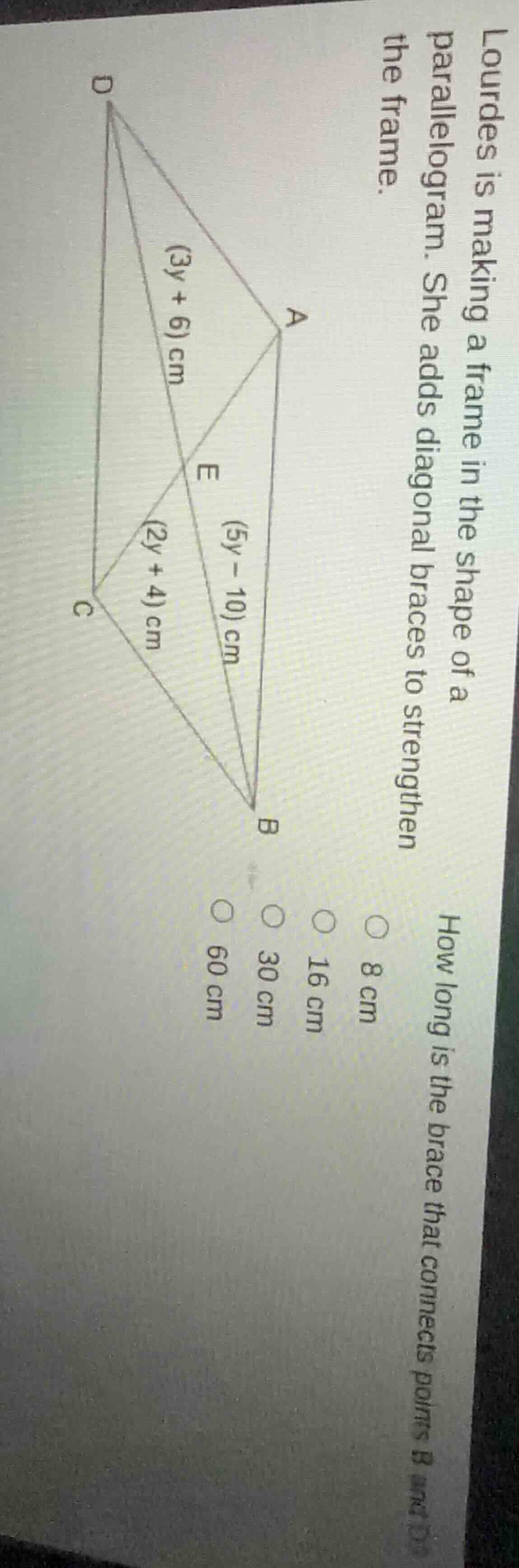
lourdes is making a frame in the shape of a parallelogram. she adds diagonal braces to strengthen the frame. how long is the brace that connects points b and d? 8 cm 16 cm 30 cm 60 cm
Step1: Recall parallelogram diagonal property
In a parallelogram, the diagonals bisect each other. So, \( AE = EC \) and \( DE = EB \). Wait, looking at the segments, maybe \( AD = BC \)? Wait, no, the segments given: \( AD = 3y + 6 \), \( BC = 2y + 4 \)? Wait, no, maybe the triangles? Wait, actually, in parallelogram \( ABCD \), \( AB \parallel CD \) and \( AD \parallel BC \), and diagonals bisect each other. Wait, the segments \( AE = 5y - 10 \) and \( EC = 2y + 4 \)? Wait, no, maybe the key is that in a parallelogram, opposite sides are equal? Wait, no, the problem is about the diagonal \( BD \)? Wait, no, the question is about the brace connecting \( B \) and \( D \)? Wait, no, let's re-examine. Wait, the segments: \( AD = 3y + 6 \), \( BC = 2y + 4 \), and \( AB = 5y - 10 \)? Wait, no, in a parallelogram, \( AD = BC \) and \( AB = CD \). Wait, maybe \( AD = BC \), so \( 3y + 6 = 2y + 4 \)? Wait, solving that: \( 3y - 2y = 4 - 6 \), \( y = -2 \), which doesn't make sense. Wait, maybe \( AE = EC \), so \( 5y - 10 = 2y + 4 \). Let's try that.
Step2: Solve for y using \( AE = EC \)
Set \( 5y - 10 = 2y + 4 \)
Subtract \( 2y \) from both sides: \( 3y - 10 = 4 \)
Add 10 to both sides: \( 3y = 14 \)? No, that's not right. Wait, maybe \( AD = AB \)? No, parallelogram sides aren't necessarily equal. Wait, maybe the diagonal \( BD \) is composed of \( DE \) and \( EB \), where \( DE = 3y + 6 \) and \( EB = 5y - 10 \), and in a parallelogram, diagonals bisect each other, so \( DE = EB \). Ah! That makes sense. So \( 3y + 6 = 5y - 10 \)
Step3: Solve \( 3y + 6 = 5y - 10 \)
Subtract \( 3y \) from both sides: \( 6 = 2y - 10 \)
Add 10 to both sides: \( 16 = 2y \)
Divide by 2: \( y = 8 \)
Step4: Find length of \( BD \)
Now, \( BD = DE + EB = (3y + 6) + (5y - 10) \). Since \( DE = EB \) (diagonals bisect each other), so \( BD = 2 \times (3y + 6) \) (or \( 2 \times (5y - 10) \))
Substitute \( y = 8 \) into \( 3y + 6 \): \( 3(8) + 6 = 24 + 6 = 30 \)
Then \( BD = 30 + 30 = 60 \)? Wait, no, wait: if \( DE = 3y + 6 = 30 \), and \( EB = 5y - 10 = 5(8) - 10 = 40 - 10 = 30 \), so \( BD = 30 + 30 = 60 \)? But the options are 8, 16, 30, 60. Wait, maybe the question is about the length of \( BE \) or \( DE \)? Wait, no, the question is "How long is the brace that connects points B and D?" So \( BD = 60 \)? But let's check again.
Wait, when \( y = 8 \), \( DE = 3(8) + 6 = 30 \), \( EB = 5(8) - 10 = 30 \), so \( BD = DE + EB = 30 + 30 = 60 \) cm. But let's check the options: 60 cm is an option. Wait, but maybe I made a mistake. Wait, maybe the brace is \( BE \) or \( DE \)? No, the brace connects \( B \) and \( D \), so it's \( BD \).
Wait, but let's re-express:
If diagonals bisect each other, then \( DE = EB \), so \( 3y + 6 = 5y - 10 \)
\( 3y + 6 = 5y - 10 \)
\( 6 + 10 = 5y - 3y \)
\( 16 = 2y \)
\( y = 8 \)
Then \( DE = 3(8) + 6 = 30 \), \( EB = 5(8) - 10 = 30 \), so \( BD = 30 + 30 = 60 \) cm.

Snap & solve any problem in the app
Get step-by-step solutions on Sovi AI
Photo-based solutions with guided steps
Explore more problems and detailed explanations
60 cm